Daily movement
The Dragon Swings Its Tail
A gentle, rotational spinal movement to release tension and improve energy flow, rooted in traditional Qigong principles.
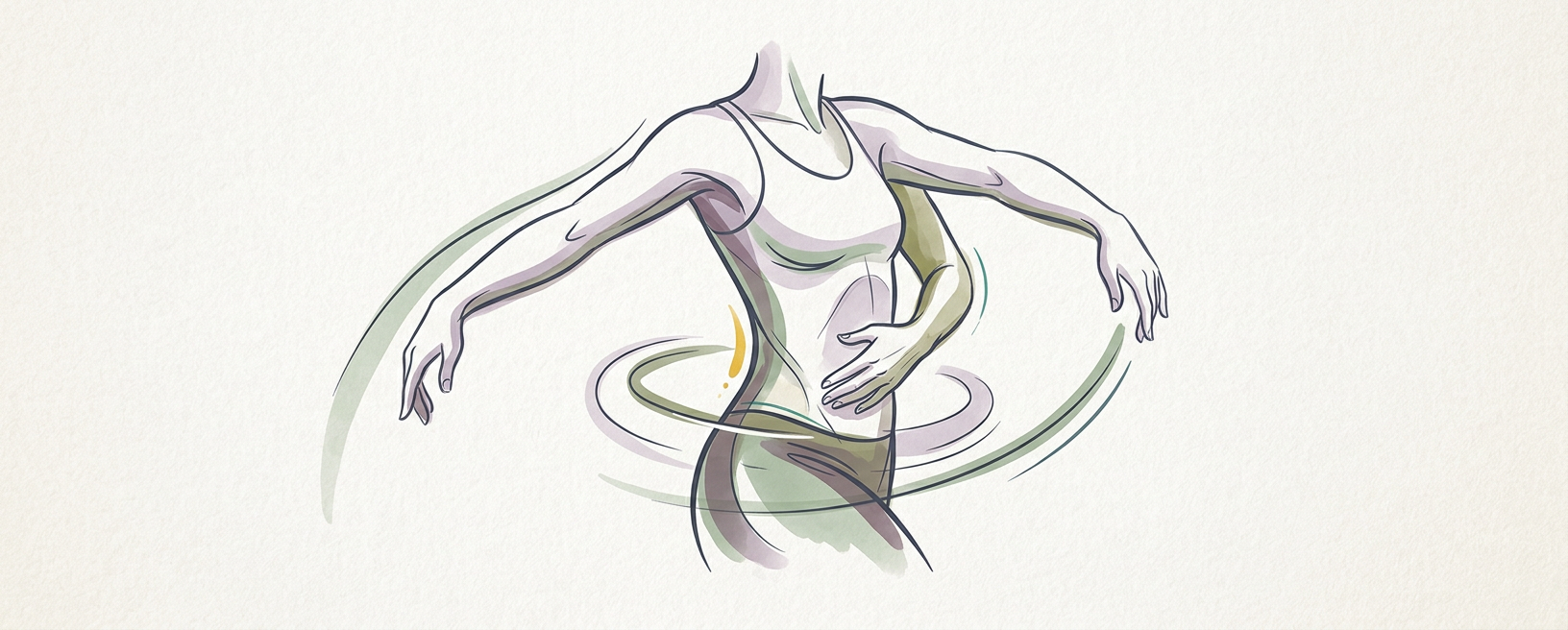
A gentle, rotational spinal movement to release tension and improve energy flow, rooted in traditional Qigong principles.
Qigong (specifically within the Medical Qigong and Taoist Qigong traditions) · This movement is a foundational exercise within various Qigong lineages, emphasizing spinal mobility and energetic circulation. While its precise historical origin is multifaceted, it is widely taught within contemporary Qigong practices like those popularized by teachers such as Lee Holden and Mantak Chia, who draw from ancient Chinese health cultivation systems. · Fatigue, mental fogginess, stiffness in the spine, emotional stagnation, generalized nervous system dysregulation. · Perform for 3-5 minutes, 1-2 times per day, or whenever a sense of stagnation or mental fogginess arises. Increase duration gradually as comfort allows.
Why it works
The Dragon Swings Its Tail utilizes gentle, rhythmic rotation of the torso, initiated from the hips. This action mobilizes the vertebral column, encouraging synovial fluid circulation within the facet joints and promoting hydration of intervertebral discs. The unforced, pendulum-like motion allows for a release of myofascial tension along the paraspinal muscles. Energetically, in Qigong theory, this movement is understood to open the "Du Mai" (Governing Vessel) and "Ren Mai" (Conception Vessel), central energetic pathways, and stimulate the flow of "Qi" throughout the torso. The simultaneous light tapping of the hands on the lower back and abdomen provides a proprioceptive input that can be grounding, while also stimulating acupressure points associated with kidney and spleen functions, contributing to a sense of revitalization and balance within the autonomic nervous system.
How to practice
Starting Position: Stand with feet parallel, shoulder-width apart. Knees are softly bent, never locked. Arms hang loosely at your sides.
Initiate the Turn: Gently begin to rotate your torso from side to side. The movement originates from the hips and waist, allowing the rest of the body to follow naturally.
Arm Swing: Let your arms remain relaxed. As your torso turns, they will naturally swing around your body like loose ropes.
Gentle Tapping: Allow your hands to lightly tap against your lower back (kidney area) and your lower abdomen as they swing. The taps should be soft, not forceful.
Head Movement: Your head can turn gently in the same direction as your torso, or it can remain relatively forward-facing, allowing the neck to gently rotate. Avoid forcing the neck.
Spinal Mobility: Focus on allowing the spine to untwist and twist with each rotation, feeling a gentle stretch and release.
Starting Position: Stand with feet parallel, shoulder-width apart. Knees are softly bent, never locked. Arms hang loosely at your sides.
Initiate the Turn: Gently begin to rotate your torso from side to side. The movement originates from the hips and waist, allowing the rest of the body to follow naturally.
Arm Swing: Let your arms remain relaxed. As your torso turns, they will naturally swing around your body like loose ropes.
Gentle Tapping: Allow your hands to lightly tap against your lower back (kidney area) and your lower abdomen as they swing. The taps should be soft, not forceful.
Head Movement: Your head can turn gently in the same direction as your torso, or it can remain relatively forward-facing, allowing the neck to gently rotate. Avoid forcing the neck.
Spinal Mobility: Focus on allowing the spine to untwist and twist with each rotation, feeling a gentle stretch and release.