Nervous System
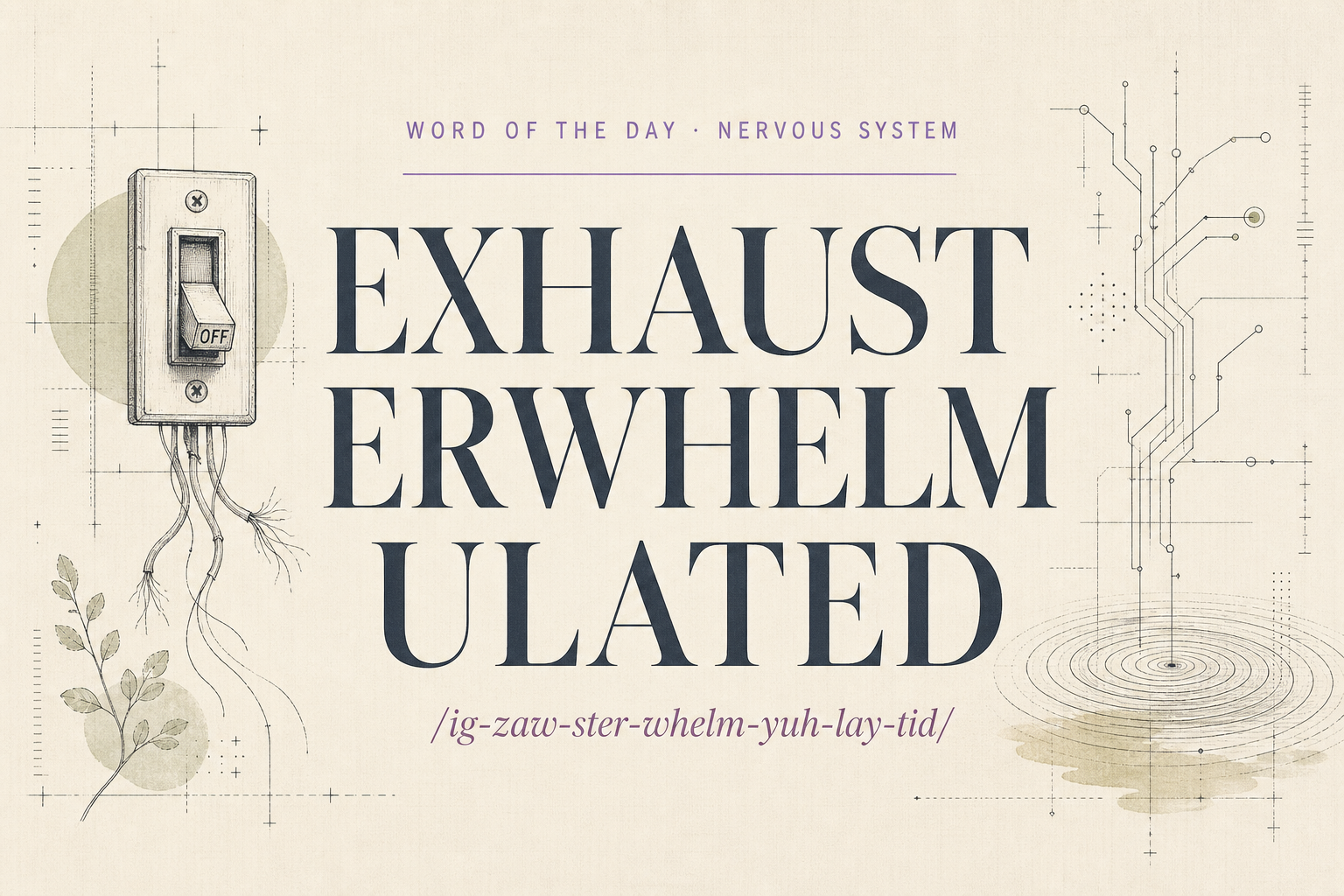
Exhausterwhelmulated: The Word Your Nervous System Has Been Trying to Tell You
When exhausted, overwhelmed, and overstimulated hit your body all at once, the prefrontal cortex shuts down to protect your baseline capacity.
The optimization industry looks at an afternoon crash and prescribes a new planner or a cold plunge to force your brain back online. I have watched high-performers try to schedule their way out of this physical wall for years. The reality is a biological hard stop. Your nervous system has reached maximum capacity for cortisol and noradrenaline, and the autonomic shift simply cuts the power to your higher thinking to keep the organism safe.
You know the exact texture of this afternoon. The 3pm jaw clench that travels all the way to your temples. You open the fridge but you aren't hungry. You stare at a four-item to-do list and it might as well be written in Sanskrit. You are tired but wired, vibrating with a low-grade panic. Your shoulders won't drop, and when you finally collapse on the sofa, you can't sleep even though exhausted. The doom-scroll stretches to 11:47pm because sitting in silence feels threatening, leaving you anxious for no reason about a Tuesday morning meeting.
Common Questions
Is this the same as burnout?
Burnout is a chronic, systemic exhaustion that takes months of specialized support to reverse. The overwhelmed and overstimulated state is an acute daily warning signal. It happens right before you hit the wall, giving you a small window to change the inputs.
Why does sleep fail to fix this?
You can sleep nine hours and wake up completely overwhelmed if your first morning hour involves a flooded inbox and three immediate demands. Sleep clears cellular waste, but it can't resolve a waking environment that constantly signals threat to your physiology.
Does caffeine help clear the fog?
Adding an aggressive stimulant to an overloaded nervous system guarantees a crash. Caffeine blocks sleep receptors and spikes cortisol, pushing your baseline further into hyperarousal and ensuring the static behind your eyes gets louder by dinner.
The machinery behind the freeze
Three distinct physiological loads stack together here, and they feel identical from the inside. Exhaustion is a severe glycogen depletion combined with a parasympathetic nervous system that hasn't been allowed to drive the car in days. Overwhelm means your working memory has hit a hard biological ceiling, dropping every new input onto the floor because the cache is completely full. Overstimulation happens when your locus coeruleus (the brainstem's primary noradrenaline pump) fires on a rapid notification cadence it was never evolved to handle.
Sustained stress hormones literally suppress prefrontal cortex function. The part of you that sequences, plans, and decides goes entirely quiet, while the amygdala gets louder and more reactive. This is allostatic load in real time. It is a biological readout of sustained threat detection, tracking the long-term wear of a body adapting to too much input for too long without recovery windows.
The isolation response
When the system reaches this level of static, a secondary biological response kicks in: Kokorology isolate. Kokorology cancel plans, avoid eye contact, and retreat to the sofa to stare at the phones. The irony is that isolation actively dysregulates the HPA axis—the stress-hormone control loop that runs from your brain to your adrenal glands and back.
Kokorology pull away from human contact at the exact moment when physical coregulation with a regulated mammal would help lower the circulating cortisol. You isolate to protect your remaining energy, but the isolation signals to your brain that you are alone in a threatening environment, which keeps the alarm bells ringing.
The cruelty of the symptom
This state makes you worse at the exact behaviors that would resolve it. Overwhelm narrows your attention to the next meaningless ping, convincing you that clearing the inbox is a matter of survival. Exhaustion makes slow, regulating movement feel incredibly expensive, so you stay glued to the chair. Overstimulation makes a quiet room feel agonizing. You end up sitting entirely still, consuming loud digital noise, and wondering why your time off doesn't feel restorative.
I used to believe I could out-plan this state with better time blocking. I didn't understand this for years, and I suffered for it. I was wrong. What I notice in sessions now is that clients will consistently try to buy a supplement for a problem that requires a subtraction. I've watched executives try to meditate away a completely overloaded calendar. The calendar always wins. You can't organize an overloaded nervous system. You have to change the chemistry in your skull first.
You cannot organize an overloaded nervous system.
Subtraction before addition
Most recovery protocols fail because they attempt to add a new task to a nervous system that is already at capacity. Optimization culture has trained the system to believe that action is always superior to inaction, so Kokorology layer on intense breathing exercises, complex supplement stacks, and strict morning routines.
The first move is always removal. Close the tabs. Silence the device. Walk away from the screen entirely. The average knowledge worker switches contexts every few minutes, and you can't think clearly on that frantic cadence. Subtract the noise to give your vagal tone a chance to recover. If chronic sleep deprivation is driving the state, the sleep protocols are your first stop. Otherwise, address the burnt-out physiology before you try to fix the calendar.
The corporate reality
When you bring an overwhelmed nervous system to a standard corporate Tuesday, the environment actively makes the physiology worse. An open-plan office is an acoustic nightmare for someone stuck in hypervigilance. The brain is constantly scanning for threats, interpreting a Slack notification with the same hormonal response as a physical emergency.
You sit in meetings attempting to process complex strategy, but your prefrontal cortex is operating on a fraction of its normal power. The modern workplace demands high-level executive function while systematically creating the exact environmental conditions that destroy it.
What to do this week
- Cut input first. Close every digital window that is not strictly necessary for the next hour.
- Walk for ten minutes at a conversational pace. Aerobic movement at low intensity flushes noradrenaline and lets the prefrontal cortex come back online.
- Consume protein and sodium. Cognitive overload runs on glucose, and cortisol depletes sodium. Give your body the raw materials to stabilize the physical state.
- Select one priority. A depleted system makes terrible choices about what to do next. Pick a single task, complete it, and stop deciding for the day.
Where this fits in the Kokorology system
This state is the primary target of the nervous system regulation foundations. When you need to restore capacity from the ground up, start with the Reset track. For immediate tools to change your physiological state at 3pm, the protocols in the Hacks library will walk you through exactly what to do.
Tonight's practice
What is one input I can permanently remove from my evening routine tonight, and what will I feel in my body when it is gone?
- Find a chair where your feet rest flat on the floor.
- Set a timer for 5 minutes.
- Inhale through the nose for a count of four, exhale for a count of six.
- On every exhale, consciously let your jaw drop half an inch.
- When the timer sounds, stand up slowly and drink eight ounces of water.
Closing
Your baseline dictates your reality. Treat your capacity with respect, and you will repair faster than you burn out.
- Start with the Reset protocol to clear the static.
- Work with these concepts deeply inside the Journal.
- Continue inside the Library to understand the mechanisms running your days.
TL;DR
Exhausterwhelmulated is a physiological state where cortisol and noradrenaline actively suppress the prefrontal cortex. Working memory caps out, the locus coeruleus over-fires, and the nervous system initiates a deliberate shutdown to prevent further physiological damage. The immediate fix requires subtracting input, decisions, and stimulation before attempting any restorative addition. This is a baseline capacity limit, driven entirely by allostatic load and survival mechanics.
Sources
- Arnsten, A. (2015). Stress weakens prefrontal networks. Nature Neuroscience.
- McEwen, B. (1998). Allostatic load and the brain. Annals of the New York Academy of Sciences.
- Balban, M. Y. (2023). Brief structured respiration practices enhance mood and reduce physiological arousal. Cell Reports Medicine.
- Kahneman, D. (2011). Thinking, Fast and Slow. Macmillan.
- Holt-Lunstad, J., et al. (2024). Loneliness and HPA-Axis Dysregulation: Meta-analysis of 47 Studies. Psychological Bulletin.