Journal Practice
A bowl of cold water is a cheap vagal nerve stimulator
Corporate mindfulness sessions are gestures. Your nervous system is a physical circuit that responds to temperature, not well-meaning calendar invites.
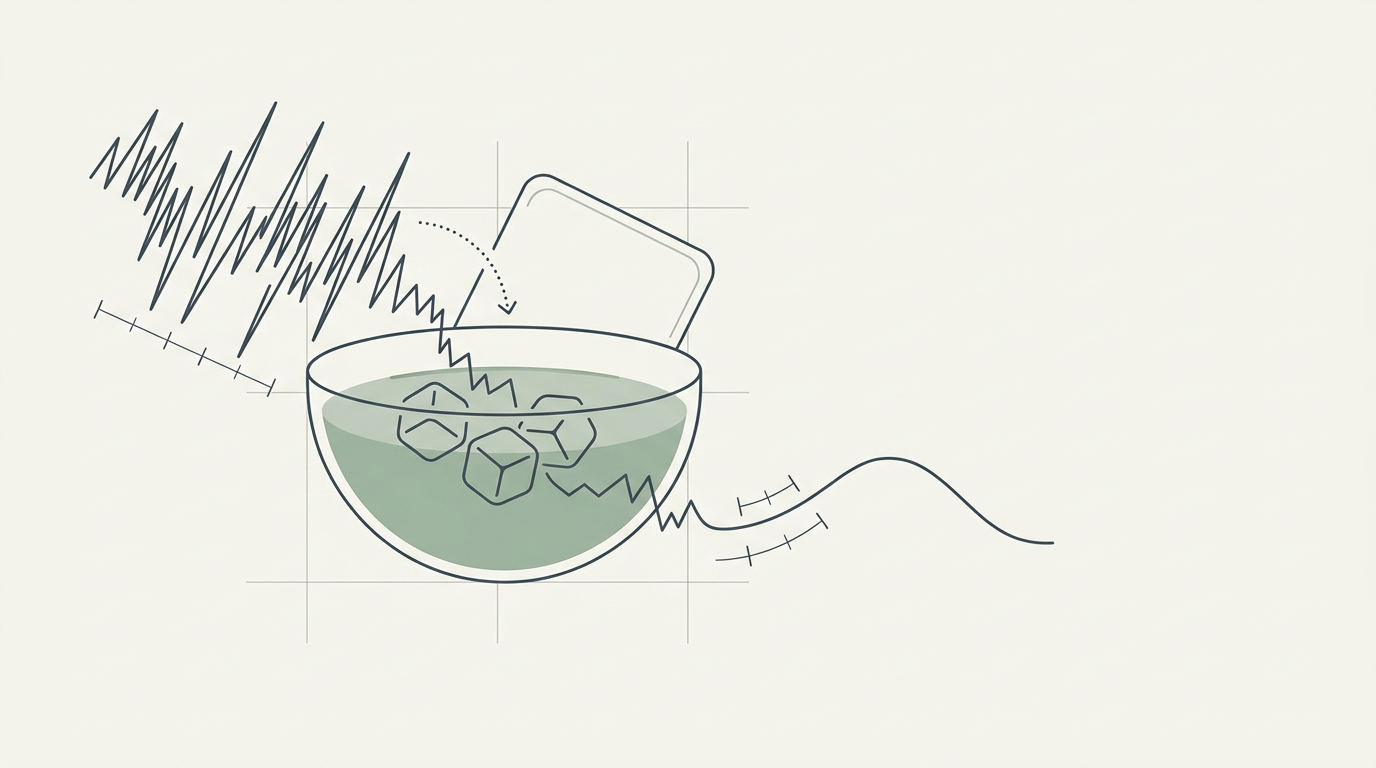
Your inbox is about to fill with well-meaning emails about World Mental Health Day. They will offer mindfulness apps, webinars on 'resilience', and posters that say 'it's okay to not be okay'. These are gestures, the equivalent of sending a sympathy card for a house fire. Your nervous system is a physiological system with physical needs, and it runs on signals, not good intentions.
It’s 4pm and your jaw is so tight you could crack a walnut. A calendar reminder pops up for a ‘Corporate Mindfulness Session’. I know that feeling well: a hot surge of something that is definitely not mindfulness, a private heat that has nothing to do with the temperature of the room. This has nothing to do with your attitude. The feeling comes from a frantic, high-frequency electrical signal running through your body. No amount of positive thinking is going to interrupt that current. Whether you're navigating startup hustle or the intensity of the Mumbai school run, the feeling is the same: a system stuck in the 'on' position, burning fuel just to stand still.
The hum of a system stuck in high gear
That feeling of being simultaneously exhausted and agitated—"tired but wired"—is the signature of a nervous system stuck in sympathetic activation. Think of your autonomic nervous system as having two primary channels: the sympathetic ('fight or flight') and the parasympathetic ('rest and digest'). A healthy system switches between these channels fluidly, like a radio tuning to a clear station.
When you're under sustained pressure, your body floods with catecholamines like adrenaline and noradrenaline. These are your get-up-and-go hormones, essential for dealing with an actual, immediate threat. The problem is, your nervous system registers the threat of a hundred unread emails with the same catecholamine surge it would use for a tiger in the grass. It registers threat and turns up the volume. The result is a body that's perpetually braced for impact. Your heart rate stays elevated, your muscles remain tense, and your digestive system is on standby.
This feeling is the readout of a high-cost metabolic state. You burn through your energy reserves just staying still. Your cognitive function degrades; you become more reactive, your working memory shrinks, and your ability to read social cues accurately diminishes. You are, in a very real sense, less intelligent and less collaborative when you're stuck in this state. Your radio is tuned to static, a constant, draining hum of high-alert signals with no off-switch in sight. Trying to 'think your way calm' in this state is like politely asking the static to be a song. You need to cut the power.
Related anchors: vagal tone anchor · HRV anchor · skin anchor
Your face is a circuit breaker for your nervous system
Your body has a built-in off-switch for acute stress. It’s called the mammalian dive reflex, an ancient circuit hardwired into your brainstem. It is one of the fastest, most reliable ways to interrupt a sympathetic spiral and force your system to change channels from 'threat' to 'conserve'.
I admit, I was skeptical of this at first. It felt too simple, like a folk remedy. But the mechanism is undeniable. The lever is the trigeminal nerve, a massive sensory nerve that covers your face. When you immerse your face in cold water—especially the area around your eyes and temples—you send a powerful, non-negotiable signal directly to your brainstem. The brainstem bypasses reason and simply reacts. It receives the input 'face is cold' plus 'not breathing' (because you're holding your breath) and immediately executes its 'underwater' protocol.
This is a physiological command that bypasses your thinking brain entirely. The cascade is automatic and immediate: your heart rate slows down (a phenomenon called bradycardia). Blood flow is redirected from your limbs to your core, shunted to protect your vital organs. It’s a hard reset. The wellness industry offers you a meditation app. It suggests a webinar. Your body is still screaming for a real signal to stop. A bowl of cold water is that signal.
This is a zero-cost, high-impact regulation tool you can use anytime. Its simplicity is a feature, not a bug.
- Find a bowl large enough to fit your face. Fill it with cold tap water. You don't need ice, just cold.
- Set a timer for 30 seconds, or just count in your head.
- Take a breath, hold it, and submerge your face in the water, making sure your temples are covered.
- Stay there for 15-30 seconds.
- Lift your face out, take a slow breath, and pat your face dry. Notice the immediate shift in your state. The goal is interruption.
Logging the state change builds interoception
After you’ve used the water to interrupt the signal, the journal has a specific job. For years, I used my journal to rehearse my anxieties, thinking I was processing them. I was actually just making the grooves deeper. Rehearsing the story of why you're stressed—the annoying email, the looming deadline—literally re-activates the same neural circuits that got you into that state. You are admiring the problem.
A more effective use of the journal is to log the sensory data of the state change. This practice builds interoception—the ability to feel and understand what’s happening inside your body. By labelling a physical sensation, you engage a different part of your brain: the prefrontal cortex. This act of observing and naming helps to down-regulate the amygdala, the brain's alarm system. You are not telling a story; you are taking inventory.
This turns a vague feeling of 'being overwhelmed' into specific data points: a buzzing in the chest, a tightness in the throat, a coolness behind the eyes. You are building a library of felt sense, training your brain to recognise the specific physical signature of stress and the corresponding signature of regulation. The most useful data is not the dramatic feeling of 'calm', but the small, specific shifts.
Tonight's practice
Use this prompt after the cold water immersion to capture the data of the state change. This are a sensory log.
Where do you feel the shift in your body? Note the specific location and quality of the sensation before and after. Was it a buzzing in your chest that is now quiet? A tightness in your jaw that has eased? What is the first new sensation you notice?
- Perform the cold water immersion for 15-30 seconds as described above.
- Open your journal. Before you write anything about your day, answer the prompt.
- Use physical, sensory words. 'A cool wave behind my eyes' instead of 'I feel calm'. 'The knot in my stomach has loosened' instead of 'I feel better'.
- Spend no more than five minutes. This is a data entry, not an essay about your feelings.
Common Questions
Why does this work when meditation doesn't always?
Meditation is often a 'top-down' approach. You use your conscious mind (the cortex) to try to calm the rest of your system. That's a valuable skill, but when your body is in a high-threat state, the older, faster 'bottom-up' pathways from your brainstem are running the show. Your cortex is effectively offline. The dive reflex is a bottom-up intervention. It speaks directly to the brainstem in a language it cannot ignore, bypassing your frantic thoughts entirely.
Is this just a distraction from my problems?
A distraction occupies your thinking mind. This is a physiological intervention that changes your autonomic state. It doesn't solve the external problem—the inbox is still full—but it restores your capacity to deal with it effectively. It moves you out of a reactive, panicked state and into a more regulated place from which you can actually think.
Does it have to be a bowl of water?
A bowl of water is most effective because it triggers the dive reflex most completely by covering the largest surface area of the trigeminal nerve. If you can't, holding a cold pack or a bag of frozen peas over your eyes and temples for 30-60 seconds can create a similar, though less intense, effect. Even splashing your face with cold water at the sink is better than nothing, but full immersion is the gold standard for a hard reset.
How often should I do this?
Use it as an acute tool whenever you feel yourself escalating into a stress response. It's a fast-acting circuit breaker to be used as needed, not necessarily a daily preventative measure like exercise. Over time, you may find that simply knowing you have access to such a reliable off-switch can reduce your anticipatory anxiety about getting stuck in a stress state.
Closing
Interrupting the signal is the first step. Learning to read it is the work.
- Start logging your state with the Kokorology Journal monthly subscription.
- Commit to the practice and save two months with the Kokorology Journal annual plan.
- Download the free nervous system reset guide for more zero-cost regulation tools.
TL;DR
This World Mental Health Day, ignore the well-meaning webinars. Your stress is a physiological event, not a mindset problem, and it responds to physical signals. A bowl of cold water is a real tool. Immersing your face for 30 seconds triggers the mammalian dive reflex, activating your vagus nerve and forcing your nervous system out of fight-or-flight. Follow it with a journal entry that logs the before-and-after sensory data, rather than narrating the day's drama. This builds interoception and gives you a genuine lever on your own state.
Sources
- Espeland, H., de Weerd, L., & Mercer, J. B. (2022). Health effects of voluntary exposure to cold water — A continuing subject of debate. International Journal of Circumpolar Health, 81(1), 2111789.
- Lieberman, M. D. (2023). Communication with others and oneself: language as a nervous-system intervention. Curated primary studies and meta-analyses (1994–2023).
- Pennebaker, J. W. (2023). Journaling and the nervous system: from expressive writing to affect labeling. Curated meta-analyses and primary studies (1986–2023).
- Chandola, T., Britton, A., Brunner, E., et al. (2008). Work stress and coronary heart disease: what are the mechanisms? European Heart Journal, 29(5), 640–648.