Workplace & Leadership
Burnout Is Not a Productivity Problem. It Is a Capacity Problem.
Redefining employee burnout prevention, this article argues that burnout isn't about productivity, but about depleted nervous system capacity.
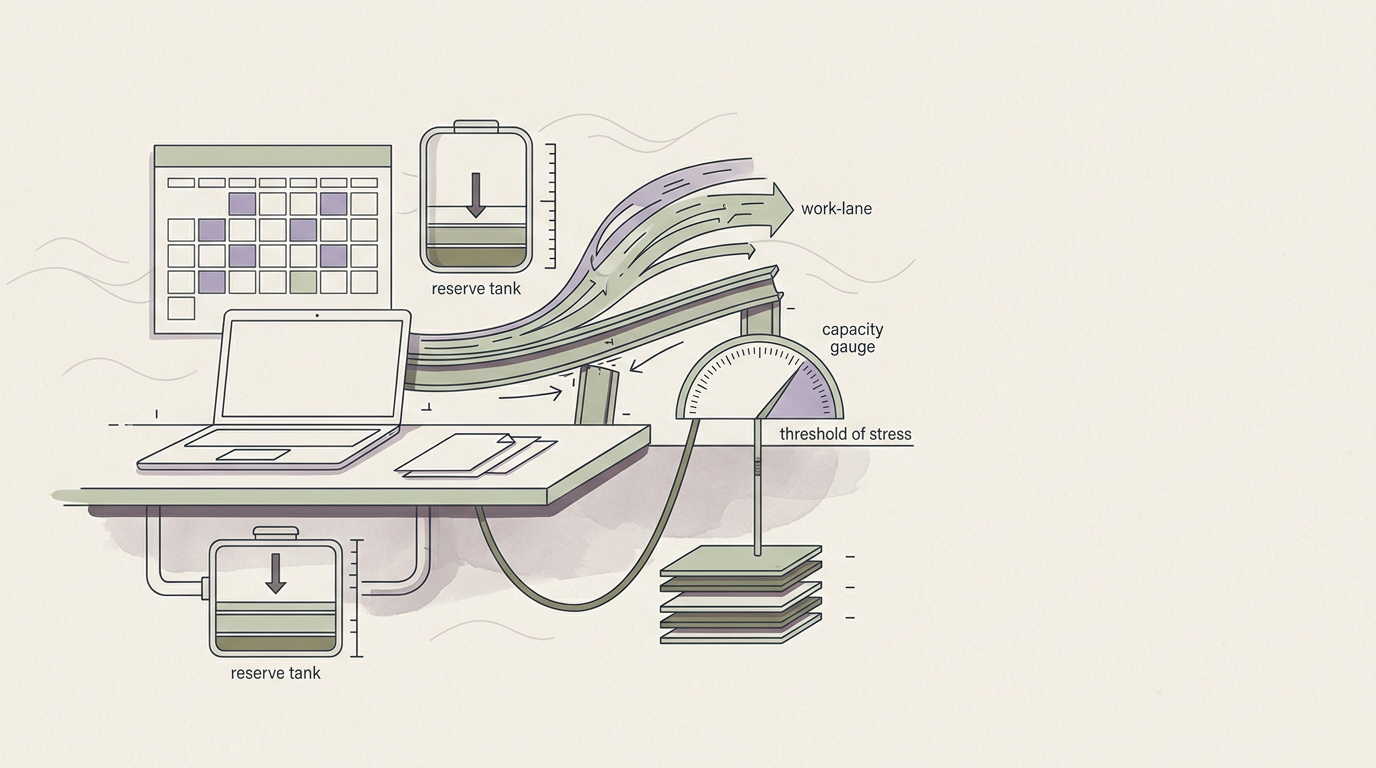
Burnout is not a productivity problem. It is a capacity problem.
The conversation about employee burnout is stuck in a loop that would itself cause burnout. We’re offered time management apps, mandatory yoga, and the radical suggestion to “just say no” as if your mortgage will understand. This entire approach to burnout prevention is wrong because it frames the problem as one of productivity or personal failure. It’s neither. Burnout is an architectural problem: your nervous system’s capacity for load has been exceeded, and the structure itself is starting to fail.
Common Questions
What is the main cause of burnout?
Burnout is not caused by overwork alone, but by a state of chronic, unmitigated stress that depletes your nervous system’s capacity. It is the result of a persistent mismatch between the demands placed on your system and its ability to recover, leading to a state of exhaustion, cynicism, and detachment.
Can you recover from burnout?
Yes. Recovery involves structurally rebuilding your system’s capacity, not just taking a long vacation. It requires targeted practices that address the underlying physiological state, such as regulating the HPA axis, improving vagal tone, and clearing accumulated allostatic load, which is the wear and tear from chronic stress.
Is burnout prevention the same as stress management?
No. Stress management is often reactive, giving you tools to cope with a stressor in the moment. Real burnout prevention is proactive and architectural. It focuses on fortifying your nervous system’s underlying structure so it can handle greater load without collapsing, making you more resilient by design, not by effort.
Related anchors: vagal tone anchor · sleep anchor · gut-immune anchor
The Capacity Fallacy
Most advice on avoiding burnout starts from a faulty premise: that you have a fixed amount of energy to manage. It’s the language of budgets, of “filling your cup,” of not letting your battery run to zero. This is a dangerously simplistic metaphor. This isn’t about managing your energy; it’s about the structural integrity of the container holding it. Your capacity is not fixed. It is a dynamic, biological reality that can be degraded or deliberately rebuilt.
When your system is dysregulated, your capacity shrinks. The same tasks that were once manageable now feel overwhelming. This isn’t a moral failing or a lapse in grit. It’s a structural readout. The alarms are going off because the foundation is strained. Trying to push through is like ignoring a crack in a load-bearing wall. Real nervous system regulation isn’t about feeling calm; it’s about rebuilding the wall.
Your HPA Axis is an Overdraft Facility
When you are under relentless pressure—from deadlines, a chaotic inbox, or a life that simply asks too much—your body turns to its internal emergency fund. This is the HPA axis (the hypothalamic-pituitary-adrenal axis), a feedback loop running from your brain to your adrenal glands that controls the release of cortisol. In short bursts, it’s a brilliant system for survival. Under chronic demand, it’s a disaster.
Think of it as the body’s emergency overdraft facility, charging ruinous interest rates in the form of inflammation, poor sleep, and cognitive fog. Burnout is the state of being permanently overdrawn. Your system has forgotten how to turn the cortisol tap off. The first step in climbing out of this debt is not to work less, but to start paying attention to the signals. Get familiar with the feeling of being “wired and tired”—that’s the signature of a tapped-out HPA axis. Noticing it is the first step to regulating it, and a Journal can be the ledger where you track it.
The Allostatic Load Ledger
If the HPA axis is your overdraft, allostatic load is your accumulated debt. Coined in the late '80s, it refers to the cumulative wear and tear on your body from the physiological effort of adapting to chronic stress. Every time your heart rate spikes to meet a deadline, every night of fragmented sleep, every skipped meal—it all gets logged in your neurobiological ledger. When the debt gets too high, the system starts to break down.
This is where things get nerdy, and where the real problem lies. The locus coeruleus, a tiny cluster of neurons in your brainstem, acts as the command center for arousal and vigilance. In a burnt-out state, it’s stuck in the ‘on’ position, pumping out norepinephrine and keeping you in a state of low-grade panic. This sustained alert mode degrades sleep architecture—specifically the deep sleep needed for glymphatic clearance, your brain’s nightly cleaning crew. Without that rinse cycle, metabolic junk builds up, leading to brain fog, poor memory, and an inability to focus. You’re not tired; your brain is literally full of trash. For anyone who really wants to understand the mechanics, this is core material in our Library.
The Productivity Trap
The belief that burnout can be solved with better productivity is perhaps the most insulting part of the entire conversation. Trying to solve a capacity problem with a productivity app is like trying to fix a foundation crack with a fresh coat of paint. It ignores the source of the failure.
The drive for relentless productivity is often what creates the chronic stress that leads to high allostatic load in the first place. You are being asked to run an operating system that is constantly compiling, with no downtime for maintenance. It inevitably overheats. The solution is not a more efficient compilation process. The solution is a system reboot and an architectural upgrade.
The goal is not to get more done. The goal is to build a system that can do the work without breaking.
A nervous system that is well-regulated, with healthy vagal tone and a balanced HPA axis, is effective by default. Its output is a byproduct of its integrity. Chasing productivity first is a losing game. Build capacity first. The rest follows. For those leading teams, applying this insight is the core of our Performance curriculum.
Vagal Tone is Not a Vibe
The wellness industry has made the vagus nerve sound like a magical mystery tour of your insides. It’s not. It’s a cable. Specifically, it’s the main trunk line of your parasympathetic nervous system—the body's braking system. Healthy vagal tone—a measure of the nerve’s responsiveness—is your ability to downshift out of a stress state and into a state of rest, digestion, and repair. In burnout, that brake line is frayed.
Improving vagal tone isn’t abstract; it’s a physical intervention. You can’t think your way to a healthier vagus nerve. You have to give it physiological input. Something as simple as a physiological sigh—a double inhale through the nose, followed by a long, slow exhale through the mouth—mechanically stimulates the vagus nerve and acts as a manual circuit breaker. It’s one of the fastest ways to tell your body the tiger is gone. Keep a few of these Hacks in your back pocket for moments when you feel the system revving too high.
What to do this week
- Perform a Capacity Audit. For three days, don't just track your time; track your drains. What meetings, people, or tasks leave you feeling depleted? What, surprisingly, gives you a sense of capacity? The data isn't to judge, but to see the architecture as it is.
- Install One Circuit Breaker. Pick one time of day—like right before a recurring meeting you dread—and install a two-minute practice. Try the physiological sigh: two sharp inhales through the nose, one long, slow exhale through the mouth. Do it three times. That's it. This is a practical Anchor for your system.
- Protect the Last Hour. Treat the 60 minutes before you get into bed as a protected biological airlock. No screens. No work talk. No news. Dim the lights. Read a physical book. This isn’t about "winding down"; it’s about creating the conditions for the glymphatic clearance your brain desperately needs.
- Front-load Your Fuel. Instead of starting the day with sugar or caffeine, which sends your HPA axis on a rollercoaster, have a small meal of protein and fat within an hour of waking. This helps stabilize blood sugar and provides the raw materials for neurotransmitters, supporting a more stable system from the ground up.
Where this fits in the Kokorology system
Burnout is a classic sign that your nervous system's architecture can no longer support its load. Understanding the mechanics of what's happening is a crucial first step, and the foundation we teach in our L1 Regulation course. For leaders looking to build this capacity in themselves and their teams, this work becomes the core of building sustainable, high-stakes Performance.
Closing
The shift from trying to manage burnout to actively rebuilding capacity is the only move that matters. It’s the difference between perpetually patching a leaky roof and building a new one designed for the weather you actually live in. The work is not about trying harder; it’s about building smarter, from the nervous system up.
- Start building real capacity for high-stakes work inside Kokorology Performance.
- Feeling completely overwhelmed? Start with the structured seven-day Reset.
- Get the free guide to regulating your nervous system in 60 seconds inside the Kokorology Newsletter.
TL;DR
Burnout is not a moral failing or a productivity problem; it’s an architectural failure of your nervous system. The popular advice on time management and hustle culture ignores the real issue: chronic stress depletes your physiological capacity by over-taxing your stress-response system (the HPA axis) and creating high allostatic load (cumulative wear-and-tear). Real burnout prevention focuses on rebuilding this capacity from the ground up by improving vagal tone and supporting your body's recovery systems. It isn't about getting more done; it's about building a system that can do the work without breaking.
Sources
- Bruce S. McEwen (2017). Neurobiological and Systemic Effects of Chronic Stress. Chronic Stress.
- Robert M. Sapolsky (2004). Why Zebras Don't Get Ulcers. Holt Paperbacks.
- Stephen W. Porges (2011). The Polyvagal Theory: Neurophysiological Foundations of Emotions, Attachment, Communication, and Self-regulation. W. W. Norton & Company.
- Amy F. T. Arnsten (2015). Stress weakens prefrontal cortical connections: implications for childhood trauma. Neurobiology of Stress.
- Maiken Nedergaard (2013). Garbage Truck of the Brain. Science.