Nervous System
Breath Is the First Lesson: How to Read the One Subject Nobody Taught You
A long exhale is the only conscious lever on an otherwise involuntary nervous system. Why ancestral breathing changed, what we forgot, and how to put one round into a pee break, a meal, and an argument.
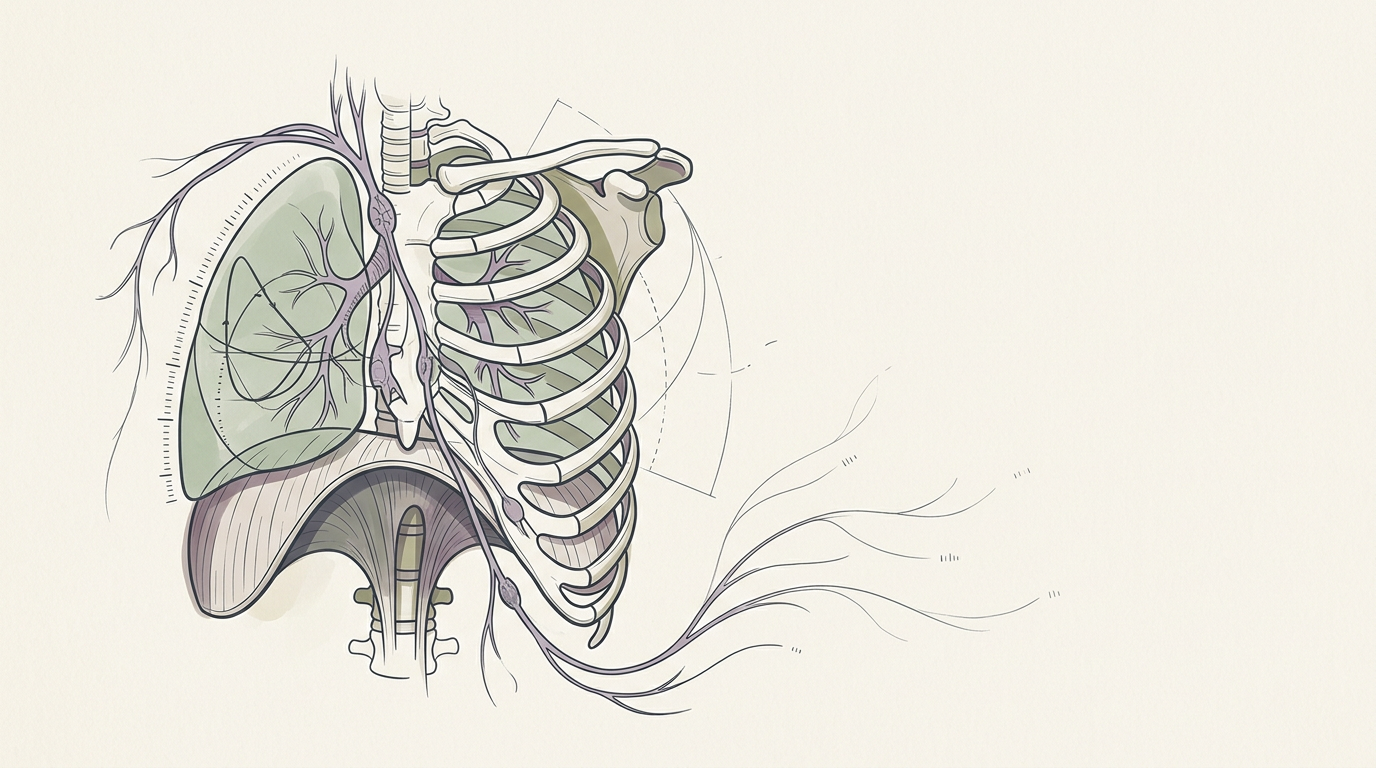
The wellness industry has somehow turned breathing—an autonomic function you've been doing without instruction since the day you were born—into a paid online course. The popular curriculum treats your breath like a premium feature you have to download and master through fifty-dollar workshops. That is a profound misunderstanding of the machinery. Breathing is the operating system that came pre-installed. It's the only physiological function you can run both on purpose and on autopilot, giving you a direct, physical lever over your own state.
You know what the absence of this lever feels like. It's the jaw that won't unclench at 3pm, the blank stare at a half-finished sentence, the shoulders that refuse to drop even when you finally step into the shower. You type tired but wired or anxious for no reason into your phone at midnight, wondering why the second coffee didn't land and the evening wind-down routine did absolutely nothing. You're walking around exhausted but can't rest, with a persistent buzz behind the eyes and an open fridge you stare into without any actual hunger. The machinery is stuck in a mild, continuous brace, and no one told you how to signal that the emergency is over.
Common Questions
Why does a longer exhale calm me down?
It recruits the parasympathetic branch of the vagus nerve. Heart rate naturally slows when you breathe out. Lengthening that out-breath keeps the biological braking system engaged longer, which lowers cardiac arousal and signals to the brain that the immediate threat has passed.
Does the breath need to be loud to work?
No. Volume is a courtesy to the person across from you. Timing is the physiological mechanism doing the actual work. The autonomic nervous system cannot tell whether your sigh was audible to the room. Use volume socially, and timing internally.
Why is my inhale getting longer when I practice this?
Your intercostals and diaphragm are unclenching. Stored sympathetic load manifests as literal tightness across the chest wall. As that tissue softens through deliberate exhales, the subsequent inhale naturally fills more space without you having to force it.
What about breathing during a fight?
A long exhale mid-argument actively down-regulates your system. You stop reacting from a spiralled sympathetic state, and your prefrontal cortex stays online. The person across from you usually drops their own arousal in response. A regulated body is highly contagious.
The quiet drift of the braced body
If you watch a sleeping baby breathe, you see the original physiological pattern. It's slow, low into the belly, with the chest barely moving. Compare that to the breath you took ten minutes ago answering an email. It was likely shallow, high into the upper chest, and finished before it really started. I used to think chest breathing was just a bad posture habit I picked up from sitting at a desk. The mechanism is much more literal than that. The mouth-breathing, fast-cycle pattern most adults default to is exactly what the autonomic system does when it detects a continuous, low-grade threat.
Mild bracing has become the modern baseline. Your system forgets how to drop back into nasal, diaphragmatic, slow-cycle breathing because you never signal that the coast is clear. You're just carrying the accumulated sympathetic load from the morning commute into the afternoon meeting, and from the meeting straight into the dining room.
The only manual override you own
The vagus nerve is a cranial nerve wandering from the brainstem down through the gut, sending a steady signal to the heart to slow down. That signal gets louder on the exhale and quieter on the inhale. This mechanical coupling is called respiratory sinus arrhythmia. It's why your heart rate naturally bumps up a fraction when you breathe in, and settles when you breathe out. It's also why people with higher heart-rate variability—the millisecond-level differences between beats—tend to be the people who can lengthen their exhale at will and rapidly shift their own autonomic state.
Make your exhale longer than your inhale, and you manually engage the parking brake on your own physiology. Four seconds in through the nose, eight seconds out through the mouth. Or, use a physiological sigh: two short nasal inhales stacked on top of each other, followed by one long mouth exhale. Both work. Both are entirely free. Neither requires wearing a bio-tracker on your finger.
Co-regulation in the dining room
When the temperature in a conversation rises, your body starts dumping noradrenaline into the bloodstream within seconds. The voice pitches up, the chest tightens, and the prefrontal cortex gets less and less of a vote on what comes out of your mouth. The amygdala registers the other person's raised voice as a survival threat and bypasses your thinking brain entirely.
Volume is a courtesy. Timing is the medicine.
A long exhale interrupts that sympathetic loop in real time. It keeps you metabolically present for the disagreement. You stop responding from a place of perceived survival and start responding to your actual environment. Most of the time, the person across from you down-regulates with you. Nervous systems read each other significantly faster than minds read words. That's physiological co-regulation in plain English, and it's the single most useful thing you can do while fighting.
Practice in the margins of a Tuesday
I notice clients run on the assumption that if they aren't actively panicking, they have capacity to spare. They wear the allostatic load down to the wire, mistaking the absence of a crisis for the presence of recovery. Every nervous system benefits from tuning. The tuning doesn't require a 20-minute seated meditation or a silent retreat in Lisbon.
Put one round of breath in your afternoon pee break. Put one round in the first three bites of a meal. Your gut is run by the same vagus nerve, and digestion requires a parasympathetic state to function properly. Put one round in front of the white page when you sit down to write. The cumulative effect is a body that defaults closer to calm, simply because it has practiced getting there hundreds of times this week.
What to do this week
- The pee break round. One cycle of a 4-second inhale through the nose, 8-second exhale through the mouth. Daily, without ceremony.
- The meal primer. Before the first three bites of lunch, take one slow nasal inhale and one slow exhale. Then eat.
- The argument anchor. When you notice the chest go tight in a hard conversation, take one long exhale before you reply. Just one.
- The focus transition. At the start of any focused work block, take three physiological sighs in a row.
- The physical drop. Once a day, exhale and let your shoulders deliberately drop like a dog shaking off a fright.
Where this fits in the Kokorology system
Breath is the foundational practice inside Regulation L1. It's the daily anchor in the Journal, and the starting point for every protocol in the Anchors library. If you learn one thing about nervous system regulation, learn this. Everything else sits on top of it.
Closing
You already own the equipment. You always did. Pick the surface that fits where you are right now and start using it on purpose.
- Start with the Journal. The daily practice that turns one good breath into a built-in habit, with prompts that meet you in the morning and evening.
- Go deeper inside Regulation L1. The foundational course, with breath as the physical lever under everything else.
- Read the free guide. Get the missing curriculum on how your body actually processes stress.
TL;DR
Breathing is the only autonomic function you can run on purpose, making it your primary physical lever over the nervous system. A longer exhale recruits the vagus nerve, slows the heart, and tells the brain the immediate threat has passed. Use it during pee breaks, before meals, mid-argument, and at the start of focused work. Practise it consistently, and your default physiological state moves closer to calm without you having to think about it.
Sources
- Melis Yilmaz Balban (2023). Brief Structured Respiration Practices Enhance Mood and Reduce Physiological Arousal. Cell Reports Medicine.
- A. D. (Bud) Craig (2015). How Do You Feel?. Princeton University Press.
- A. Zaccaro (2018). How breath-control can change your life: a systematic review on psycho-physiological correlates of slow breathing. Frontiers in Human Neuroscience.
- M. Kox (2014). Voluntary activation of the sympathetic nervous system and attenuation of the innate immune response in humans. PNAS.
- Julian F. Thayer (2012). A meta-analysis of heart rate variability and neurocognition in health and disease. Neuroscience & Biobehavioral Reviews.