Daily movement
Lotte Berk Arabesque (Static Hold)
A static arabesque for gluteal and core endurance, promoting pelvic stability and an upright posture.
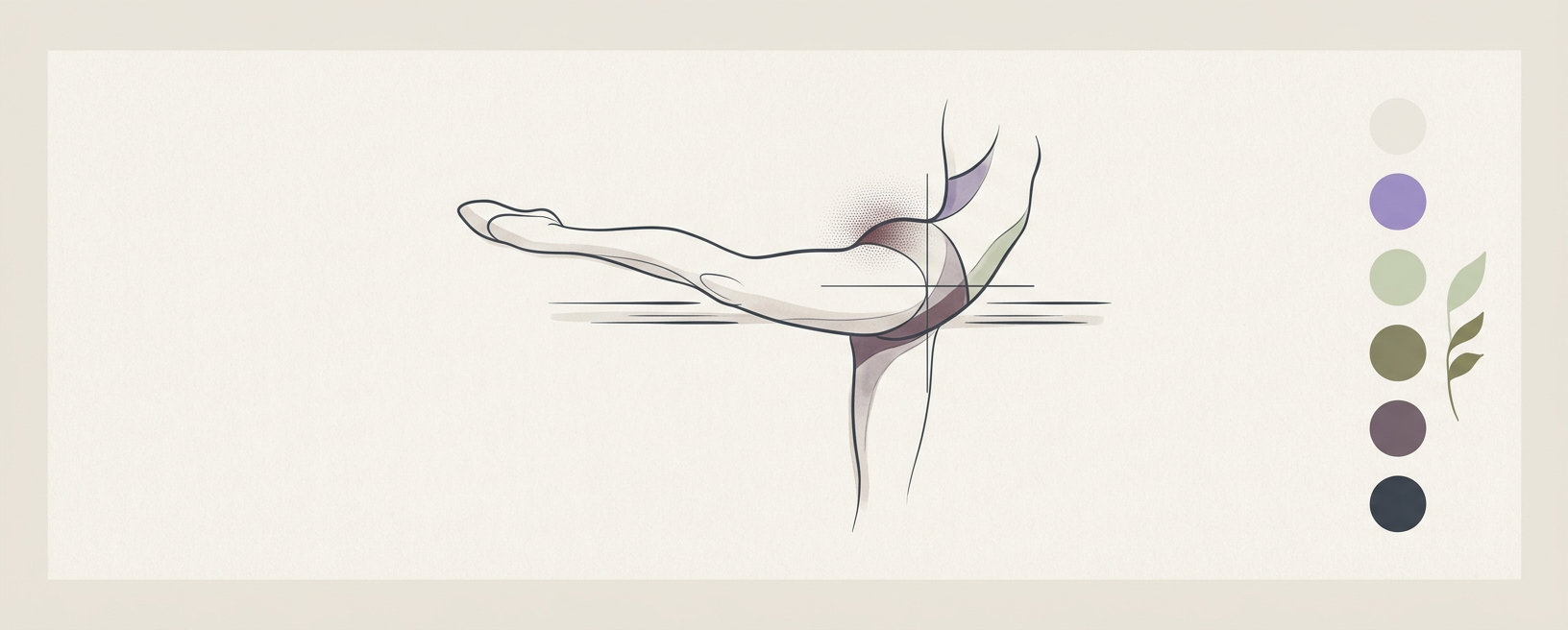
A static arabesque for gluteal and core endurance, promoting pelvic stability and an upright posture.
Lotte Berk Method (Barre) · Developed by Lotte Berk, a German dancer, to rehabilitate her own back injury. It was further popularized in her London studio. · Fatigue from prolonged sitting, desire for improved postural endurance, underdeveloped gluteal and core strength, and subtle pelvic floor awareness. · Perform 2-3 sets of 20-30 second holds per leg. Progress to longer holds or more sets as endurance improves.
Why it works
The static arabesque targets the gluteus maximus, medius, and minimus, along with the deep core stabilizers, including the transverse abdominis and multifidi. Holding this position under tension creates an isometric contraction that builds muscular endurance. The sustained engagement of the hip extensors and external rotators indirectly supports pelvic floor activation by improving proximal stability of the pelvis. This contributes to better force transfer and reduced strain on the pelvic floor muscles. The constant effort needed to maintain balance also refines proprioception and motor control, further integrating the core and glutes into a cohesive system for upright posture.
How to practice
Starting Position: Stand facing a barre or a stable surface with both hands lightly resting on it, shoulder-width apart. Position your feet in parallel, hip-width apart.\
Lift and Extend: Shift your weight slightly onto your standing leg. Gently lift one leg straight back behind you, keeping the knee straight but not locked. Aim to lift the leg only as high as you can maintain a neutral spine, without arching or swaying the lower back. The working leg should be externally rotated slightly from the hip, so the heel is higher than the toes.\
Find Your Hold: Engage the glute of the lifted leg, feeling the contraction in the upper glute and hip. Simultaneously, draw your naval gently towards your spine, engaging your lower abdominal muscles. Maintain a long, tall spine, keeping the shoulders relaxed and away from your ears. Gaze forward, keeping your neck in line with your spine.\
Sustain the Contraction: Hold this position, focusing on the isometric engagement in the glute and core. Ensure your hips remain level and square to the barre, avoiding any rotation or tilt. Breathe deeply and smoothly throughout the hold.\
Lower Safely: After the prescribed duration, slowly and with control lower the lifted leg back to the starting position. Repeat on the other side.
Starting Position: Stand facing a barre or a stable surface with both hands lightly resting on it, shoulder-width apart. Position your feet in parallel, hip-width apart.\
Lift and Extend: Shift your weight slightly onto your standing leg. Gently lift one leg straight back behind you, keeping the knee straight but not locked. Aim to lift the leg only as high as you can maintain a neutral spine, without arching or swaying the lower back. The working leg should be externally rotated slightly from the hip, so the heel is higher than the toes.\
Find Your Hold: Engage the glute of the lifted leg, feeling the contraction in the upper glute and hip. Simultaneously, draw your naval gently towards your spine, engaging your lower abdominal muscles. Maintain a long, tall spine, keeping the shoulders relaxed and away from your ears. Gaze forward, keeping your neck in line with your spine.\
Sustain the Contraction: Hold this position, focusing on the isometric engagement in the glute and core. Ensure your hips remain level and square to the barre, avoiding any rotation or tilt. Breathe deeply and smoothly throughout the hold.\
Lower Safely: After the prescribed duration, slowly and with control lower the lifted leg back to the starting position. Repeat on the other side.