Nervous System
Why You're Not Losing Weight: It's Your Nervous System, Not Your Calorie Count
Sustainable weight loss is cortisol, inflammation, gut, minerals and protected muscle — not calories. Why wellness-bro and pilates-girlie protocols backfire, especially for women and POCs.
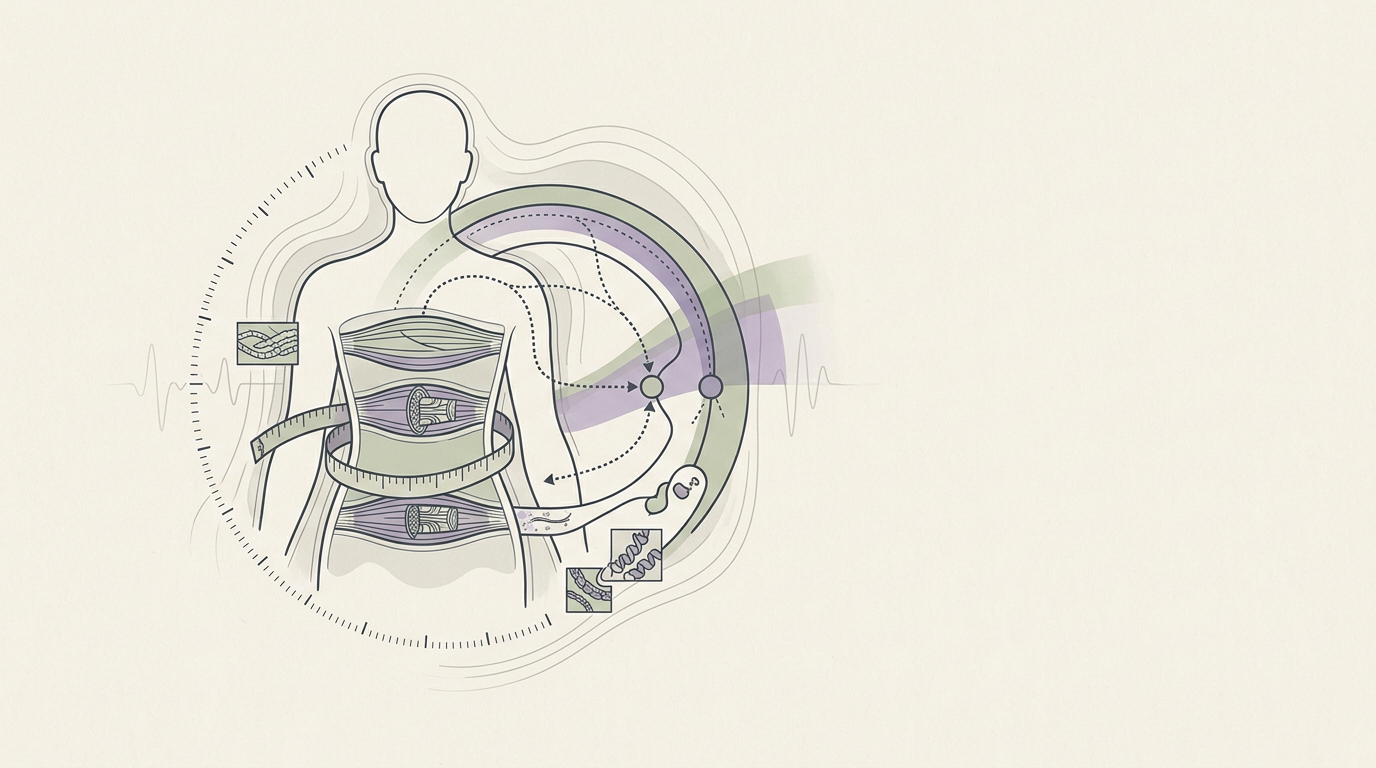
The fitness industry sells a 1,200-calorie deficit as a universal law of thermodynamics. I'm calling it. You can starve a human body and run it into the ground on a treadmill, and it will still stubbornly hold onto every ounce of tissue it can. That's because the body is an adaptive, perpetually anxious biological organism, and restricting fuel while driving up physical demand signals a famine. Sustainable weight loss happens when the nervous system registers safety, not when the math app says you earned your dinner.
You know the exact physical texture of this famine state. It's the midday slump where you stare into an open fridge with absolutely no hunger, but your jaw refuses to unclench. You drag yourself through a high-intensity workout, feeling heavy and cold, only to find yourself doom-scrolling at 11:47pm. You're tired but wired, vibrating with an anxious energy that prevents you from actually winding down. You might wake up at 3am every night with your heart racing, running tomorrow's to-do list in the dark. You feel completely disconnected from your body, exhausted but can't rest, while your weight refuses to budge. The system is locked in defense mode, waiting for a crisis to pass.
Common Questions
Why does stress cause weight gain?
Chronic stress activates the HPA axis, flooding your bloodstream with cortisol to liberate fast energy for an immediate physical threat. When the threat is just a tense meeting, that unused glucose is stored as visceral fat. The body prepares for an ongoing siege by hoarding high-density energy and ramping up cravings.
Can your nervous system prevent weight loss?
Yes. A nervous system locked in sympathetic overdrive signals to the organism that survival is threatened. The biological response to a threat is to conserve resources, suppress metabolic rate, and increase systemic inflammation. This physiological state actively resists releasing stored energy.
Why does counting calories backfire?
Severe caloric restriction operates as a direct physiological stressor. It sends a scarcity signal that elevates cortisol and shifts the body into conservation mode. Your metabolism slows to compensate for the missing fuel, making you highly efficient at storing fat while simultaneously degrading muscle tissue.
The Threat Response
The entire weight management conversation assumes your organism is a disobedient machine that needs to be disciplined into submission. I've stopped recommending any protocol that relies on punishing yourself into a smaller size. The body has no concept of discipline. It operates purely on threat detection. When you restrict food, cut sleep, and push through cognitive overload at work, your biology interprets the combination as acute danger. It responds by hoarding its energy reserves to outlast the siege.
The HPA axis takes over. Cortisol dumps glucose into your blood for a sprint that never happens. Your adrenal glands have never once been impressed by your calorie counting app. The cells become insulin resistant, the glucose gets packed away around your organs, and the system waits for the next attack.
The Cardio Trap
The fitness world prescribes high-intensity interval training as the ultimate fat-burning tool, assuming a baseline of a regulated, well-rested nervous system. I don't buy it. If you're already red-lining on cortisol, a 45-minute boot camp doesn't burn off stress. It pours gasoline on a fire. Exercise is a mechanical stressor, and adding intense physical demand to an overloaded nervous system simply confirms to your biology that you are running for your life.
Women's hormonal systems are exquisitely sensitive to this exact combination of high output and low energy availability. Overtraining suppresses thyroid function, the master regulator of metabolic rate. I spent years watching clients push harder in the gym only to watch their inflammation markers spike. The solution is moving in a way that builds capacity without triggering the threat response, using the targeted micro-practices inside the Hacks library.
The Gut-Brain Axis
This is where the actual signaling happens. The gut and the brain maintain a massive, bidirectional communication loop via the vagus nerve. The vast majority of traffic on this pathway flows upward from the digestive tract to the brain. When your system is locked in sympathetic arousal, blood flow is immediately shunted away from the digestive organs and routed to skeletal muscle. Digestion stalls.
The gut microbiome alters its composition, favoring bacteria that produce inflammatory cytokines. These compounds travel up the vagal pathway to the brain, directly altering interoception—your internal sensing of the body's state. Leptin, the hormone that signals fullness, gets blocked. Your brain never receives the message that you have enough energy, leaving you craving sugar while your metabolic rate drops to a crawl. For a deeper read on these mechanisms, Kokorology break them down in the Library.
The Protein Shift
Kokorology treat nutrition as an isolated math problem when it's actually a direct input to the nervous system. A breakfast of just black coffee and a plain bagel guarantees a blood sugar spike followed by a precipitous crash. That crash triggers the locus coeruleus to sound the alarm, releasing adrenaline and cortisol to stabilize your fuel supply. You end up chasing your own blood sugar all day.
I learned this the hard way after years of skipping meals to save calories, only to crash at 3pm with a vibrating jaw and a sudden need for a pastry. Stabilizing the system requires an early, heavy dose of protein. It dampens the ghrelin response and sends a distinct satiety signal through the vagus nerve.
You cannot force a body into growth and repair while it is actively defending itself from a perceived threat.
What to do this week
- Walk without input. Swap one intense workout for a 45-minute walk. Leave the phone and the podcast behind. Panoramic vision—letting your eyes drift to the horizon—is a direct mechanical input of safety to the brainstem.
- Eat 30g of protein early. Front-load your day. Consume a high-protein meal before you drink your first coffee. This prevents the physiological panic of a caffeine-induced cortisol spike on an empty stomach.
- Pull the physiological parking brake. Before your two largest meals, practice a double-inhale followed by a long, slow exhale. Do this three times. It alters your state by mechanically stimulating the vagus nerve, signaling that it is safe to digest. You can find this guided in the free Anchors.
- Track the crash. For three days, use the Journal to document exactly when your energy drops. Note the hour before the crash. The trigger is usually an unmanaged stressor.
Where this fits in the Kokorology system
The inability to shift body composition is a downstream symptom of an overwhelmed nervous system. the entire method treats the root cause. You don't need another restrictive diet; you need tools from the Regulation (L1) course to lower your allostatic load. When you rebuild capacity, the physical holding patterns resolve themselves.
Closing
When you stop trying to punish the system and start giving it the biological signals of safety it requires, it stops hoarding fuel. The physical weight is just the visible evidence of an invisible defense strategy. Address the biology, and the body will follow.
- Start with the mechanics of nervous system regulation in the Regulation (L1) course.
- Practice it daily with the guided prompts inside the Kokorology Journal.
- Download the free guide to the nervous system's core principles.
TL;DR
Persistent weight loss resistance is rarely a failure of calorie math. It is a symptom of a dysregulated nervous system stuck in a sympathetic threat state. Chronic stress elevates cortisol and systemic inflammation, which signals your biology to store visceral fat and slow its metabolic rate for survival. Severe calorie restriction and intense workouts only amplify this scarcity signal. Reversing the pattern requires nervous system regulation to shift the body out of crisis mode so it can safely release stored energy.
Sources
- Robert Sapolsky (2004). Why Zebras Don't Get Ulcers. Holt Paperbacks.
- Emeran A. Mayer (2018). The Mind-Gut Connection. Harper Wave.
- Sahib Khalsa (2018). Interoception and Mental Health: A Roadmap. Biological Psychiatry Cognitive Neuroscience and Neuroimaging.
- Janet S. Dufek & Bruce C. D. Schwaan (1994). A comparison of high and low intensity exercise on the hormonal response to stress. International Journal of Sports Medicine.
- Examine.com (2026). High-protein diets and bone density during weight loss in older adults. Examine.com Study Summaries.