Nervous System
There Is No Finish Line: Why Regulation Is a Spiral, Not a Programme
If a programme promises you fixed in 30 days, it is selling you a circle. Regulation does not complete — it deepens. A lifelong companion, like breathing.
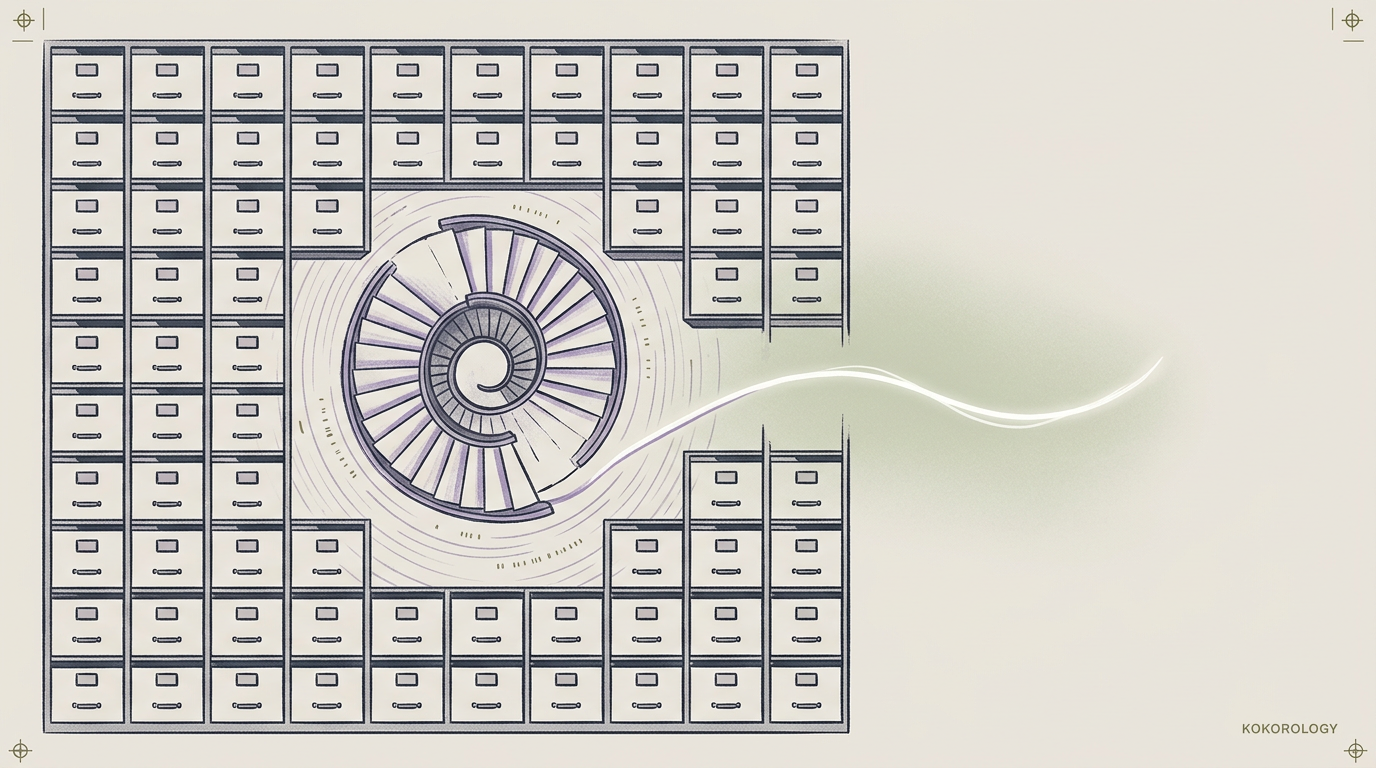
The wellness industry sells nervous system regulation as a 30-day challenge. I'm calling time on the one-month reset. You can't sprint your way to baseline capacity. Human physiology demands a continuous feedback loop.
You know exactly what happens when you treat your body like a project with a deadline. You go hard on the 6am ice baths and the green juice, desperate for the promised calm, and by day fourteen you hit a physical wall. You are tired but wired, staring at the bedroom ceiling at midnight and trying to command your heart rate to drop. You wake up at 3am every night with a jaw so clenched it gives you a migraine, wondering why the protocols are failing. The open fridge offers no answers. The afternoon coffee just makes your hands shake. You feel exhausted but can't rest. The predictable result is a massive crash, caught in a cycle of pushing for a breakthrough and collapsing on the couch with a screen for three days.
Common Questions
What is nervous system regulation?
It's the biological capacity to absorb stress and return to baseline. A healthy system spikes to handle a threat and then settles down when the threat passes. Permanent calm is biologically impossible.
Can you ever be fully regulated?
You can no more finish regulating than you can finish breathing. The body processes new sensory inputs every second of the day. The objective is adaptability and faster rebound times.
Why do quick resets fail?
Most resets rely on caloric restriction or intense novelty that temporarily suppresses natural rhythms. They demand high output from a system already carrying too much load. When the month ends, the underlying biology snaps back to its previous state of overwhelm.
The HPA axis doesn't respect deadlines
The pressure to complete your healing is a modern absurdity. I used to believe I could conquer my own physiology if I just found the perfect, rigorous routine. I treated my biological state like a performance metric to be optimised. The loop running from the brain's hypothalamus down to the pituitary gland and out to the adrenal glands on your kidneys—the HPA axis—ignores all of that ambition.
This circuit governs your threat response and manages the daily release of cortisol. It expects a circadian rhythm. Cortisol is supposed to peak in the morning to mobilise you, and taper off by evening to allow the accumulation of sleep pressure. When you carry chronic, accumulating stress, that cortisol curve flattens out. You drag yourself out of bed and remain entirely unable to shut your brain off at night. Trying to fix that disrupted endocrine rhythm with a manic four-week sprint adds another layer of threat to a system already drowning in it. The HPA axis reads frantic effort as danger. Rebuilding a natural cortisol rhythm is slow, iterative work. For the exact science of how this loop breaks and recovers, see the Library.
Interoception and the 6/10 baseline
Most programs demand that you discipline the body into silence. The actual work requires listening to the raw data. Interoception is your brain's ability to sense the internal state of your organs, your breath, and your gut. When capacity is low, these signals get entirely misinterpreted by the brain's threat-detection centres.
The fluttering in your chest becomes a panic trigger. The reality is often much duller—you drank too much espresso on an empty stomach and skipped breakfast. A sustainable practice asks you to tune into your own biology without instantly trying to eradicate the feeling. The inbox has never once been impressed by your heart rate. Aiming for a reliable, quiet 6/10 every day gives the system more safety than oscillating between a heroic 10/10 and a despairing 2/10 collapse. That shift from command to curiosity changes the entire physiological response. The Journal exists specifically to turn that raw sensation into useful data.
The body operates entirely on feedback loops.
Vagal tone is built on micro-doses
Yes, it's the vagus nerve again. No, I'm not sorry. Vagal tone is a measure of the nerve's activity, which dictates your ability to exit a high-arousal state. High tone means you recover quickly. Low tone means you stay agitated long after the threat has passed.
You can't force permanent high vagal tone during a weekend retreat. It requires consistent, low-dose practice to build and maintain. Small, non-dramatic inputs repeated daily are what convince the brain it is safe enough to drop the vigilance. You pull the biological brake slightly, every day, in a spiral that deepens over time. the micro-practices inside the Hacks collection deliver these exact tiny inputs.
What to do this week
- Track your rebound time. When a stressor hits—an annoying email, a delayed train—don't judge the spike in your heart rate. Notice how many minutes it takes for your breathing to return to baseline afterward. Document the recovery time. The victory is in shortening the curve.
- Execute one structural boundary. Close your laptop at 6 PM and don't open it again. A structural boundary is a clear signal of safety to your HPA axis. The body responds to physical actions, much more than your mental intention to relax.
- Practice a two-minute anchor. Commit to doing the Ocean Breath practice for exactly 120 seconds every morning. Find it in the Anchors index. Consistency changes the baseline faster than duration.
- Use the physiological sigh. Two sharp inhales through the nose, followed by one long, slow exhale through the mouth. This is a direct, mechanical lever on the nervous system. Do it three times today when the jaw clenches.
Where this fits in the Kokorology system
This principle sits at the very centre of the Kokorology method. Kokorology teach the architecture of this practice in the foundational Regulation L1 course. It is the daily reality inside the program for leaders, Performance L2. The work is about rebuilding the system to handle the demands of your actual life.
Closing
The finish-line mentality is exhausting. It sets you up to fail because the body was designed for cycles, seasons, and spirals. Reclaiming your capacity requires learning the small, repeating moves that keep the system tuned, day after day.
- Overwhelmed and need a structured starting point? Start with the 7-day guided program, The Reset.
- Ready to build the foundation properly? Go deeper in the foundational course, Regulation L1.
- Want the framework for free? Read the guide to the Five Anchors of Your Nervous System.
TL;DR
Stop treating nervous system regulation like a project with a deadline. The popular idea of a 30-day fix creates more stress than it solves. Your body operates on continuous biological feedback loops. True regulation is a lifelong practice that deepens over time. The goal is to build adaptability by consistently applying small, structural moves that retrain your system's response to daily stress.
Sources
- Holt-Lunstad J (2024). Loneliness and HPA-Axis Dysregulation: Meta-analysis of 47 Studies. Psychological Bulletin.
- Lieberman (2023). Communication with others and oneself: language as a nervous-system intervention. Curated primary studies and meta-analyses (1994–2023).
- Melis Yilmaz Balban (2023). Brief Structured Respiration Practices Enhance Mood and Reduce Physiological Arousal. Cell Reports Medicine.
- Zaccaro A (2018). How breath-control can change your life: a systematic review on psycho-physiological correlates of slow breathing. Frontiers in Human Neuroscience.