Nervous System
Boiling your berries is an immune protocol, not a food rule
Your daily frozen berry smoothie may be triggering a constant immune response. Boiling the fruit first removes a hidden workload on your nervous system.
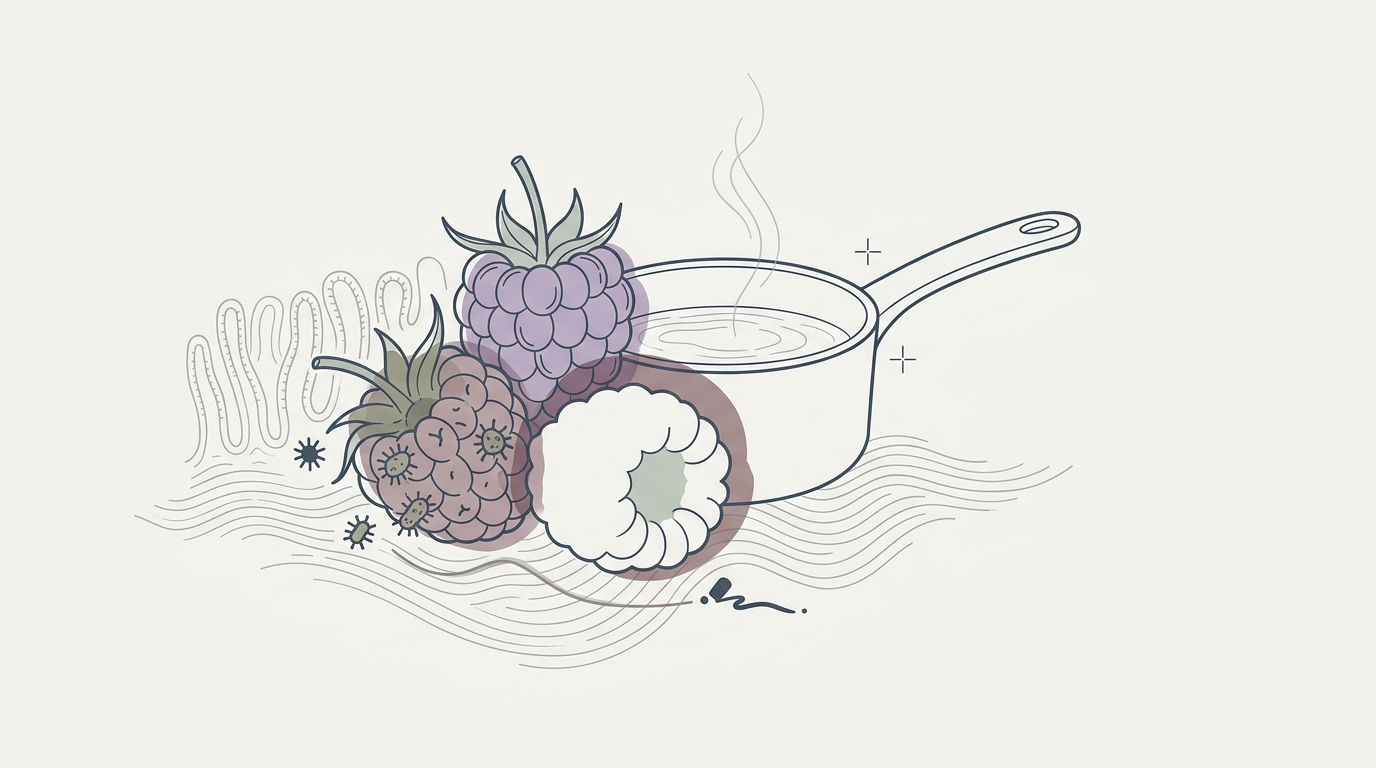
I spent years blaming my afternoon fatigue on a messy inbox and a lack of willpower. I would drink a blended bag of frozen raspberries on my first call, assuming I was making the optimal health choice. The wellness industry sells the cold smoothie as a frictionless health upgrade, but that raw frozen fruit frequently carries a persistent pathogenic threat. The moment it hits your digestive tract, it forces your autonomic nervous system into a massive defense mode. The daily crash is the biological consequence of your immune system fighting a battle you don't even know is happening.
You know exactly how this fatigue feels. It hits around 3pm with a physical weight behind your eyes and a sudden inability to finish a thought. You stare at the open fridge without hunger. Your shoulders won't drop, your jaw is locked, and you push through the afternoon feeling entirely disconnected from your body. You search for ways to fix being tired but wired, wondering why you have this heavy brain fog after eating so cleanly. You drag yourself to bed at night, exhausted but can't rest, while your heart races for no apparent reason. The smoothie was supposed to give you energy. It triggered an immune response instead.
Common Questions
Why do frozen berries carry a specific risk?
The global supply chain is long and opaque. Soft fruit is incredibly difficult to clean and often processed in massive batches. When these berries are flash-frozen, any surviving pathogens like norovirus or Hepatitis A are perfectly preserved right along with the fruit.
Is running them under the tap enough?
A quick rinse under cold water removes dirt, but it doesn't deactivate microscopic viruses clinging to the crevices of a raspberry. Heat is the only reliable way to denature viral proteins.
Will boiling destroy the nutritional value?
You'll lose a fraction of heat-sensitive Vitamin C, but the fibre, minerals, and antioxidants remain intact. You trade a negligible amount of one vitamin for a massive reduction in the daily workload on your immune system.
The gut as a hostile border
Your digestive tract operates as an active border patrol. It's your largest sensory interface with the outside world, lined with its own sophisticated neural network. The gut-associated lymphoid tissue, or GALT, contains the vast majority of your immune cells. Their primary job is to scan trillions of incoming molecules and decide what requires a full-scale military response.
When a threat like norovirus survives the commercial freezing process and lands in your stomach, it triggers a high-alert protocol. The virus forces the GALT to sound the alarm, sending signals straight up the vagus nerve to your brain. You think you just drank a handful of antioxidants. Your nervous system thinks it's been breached by a biological weapon. A single contaminated 30g serving of fruit can initiate a defense that alters your state for the rest of the day.
Sickness behaviour and your capacity
Once the gut identifies a pathogen, it releases a flood of inflammatory messengers called cytokines. These signals, particularly interleukin-6 and TNF-alpha, travel through the bloodstream and cross the blood-brain barrier. They communicate directly with central command, and your brain responds by initiating a pre-programmed survival strategy. This is sickness behaviour.
The fog is a deliberate physiological feature designed to keep you on the couch.
Your brain interprets the cytokine flood as a severe threat and systematically shuts down high-energy processes. It deprioritises complex thought, emotional regulation, and social engagement to conserve resources for the immune system. You simply can't out-think a brain that's actively throttling its own power supply. The prefrontal cortex is a massive glucose consumer, and when the immune system demands your available energy, executive function is the first thing to go.
The daily physiological drain
Running an immune response is incredibly demanding. Even a low-grade, asymptomatic infection saps a significant portion of your daily capacity. Your body raids its protein stores for amino acids like glutamine to fuel the production of new lymphocytes. You have less energy for everything else.
The overflowing inbox lands on a nervous system that's already exhausted. And the inbox doesn't care that your lymphocytes are busy. Boiling your imported berries for a full minute eliminates this hidden pathogenic load. It's one of the fastest ways to reclaim that spent energy and give your nervous system a fighting chance. I test every protocol I teach. I've stopped eating raw frozen fruit, and it finally gave me back the 3pm hour.
What to do this week
- Buy your frozen berries as usual, but empty the 500g bag into a saucepan on Sunday afternoon.
- Bring them to a rolling boil for a full 60 seconds.
- Let the fruit cool and store it in a glass container in the fridge for the week.
- Spoon the cooked compote into your yogurt or blender each morning.
Where this fits in the Kokorology system
Managing the hidden inputs that trigger an immune response is a core part of regulating your baseline. Kokorology cover nutrition-induced nervous system load in the Anchors library, and Kokorology map out exactly how to adjust your food routines when capacity is low inside the Reset onramp.
Closing
Removing the invisible triggers from your diet creates immediate space in your nervous system. When you're ready to stop fighting your own biology, here's your next move.
- Rebuild your physical capacity from the ground up inside Regulation.
- Track your daily energy fluctuations with the Journal.
- Find immediate tools for the 3pm crash in the Hacks library.
TL;DR
Your morning smoothie made with raw frozen berries frequently carries a persistent pathogenic threat. Viruses like Hepatitis A and norovirus survive the freezing process and trigger a daily, low-grade immune response in your gut. This activates sickness behaviour in the brain, manifesting as extreme fatigue, irritability, and cognitive drag. Boiling the fruit for one minute denatures these pathogens, removing a massive hidden workload from your nervous system and instantly restoring your daily capacity.
Sources
- European Food Safety Authority (2014). Scientific opinion on the risk posed by pathogens in food of non-animal origin. Part 2 (Salmonella and Norovirus in berries). EFSA Journal.
- Verhaelen, K., et al. (2013). Inactivation of hepatitis A virus and a norovirus surrogate in a frozen berry mix using a combination of high pressure and temperature. International Journal of Food Microbiology.
- Critchley, H. (2023). Interoception and Autonomic Regulation in Stress. Journal of Neuroscience.
- Dantzer, R., et al. (2008). From inflammation to sickness and depression: when the immune system subjugates the brain. Nature Reviews Neuroscience.