Wearables — the sensor without the coach
Consumer wearables 2026 — Oura, Whoop, Apple Watch, Garmin, Fitbit, Polar (and the score-without-a-plan problem)
Six of the wearables your gym friends will not stop talking about — ranked by what the sensor can actually see, what it cannot, and what the score is doing to your nervous system when there is no coach in the loop
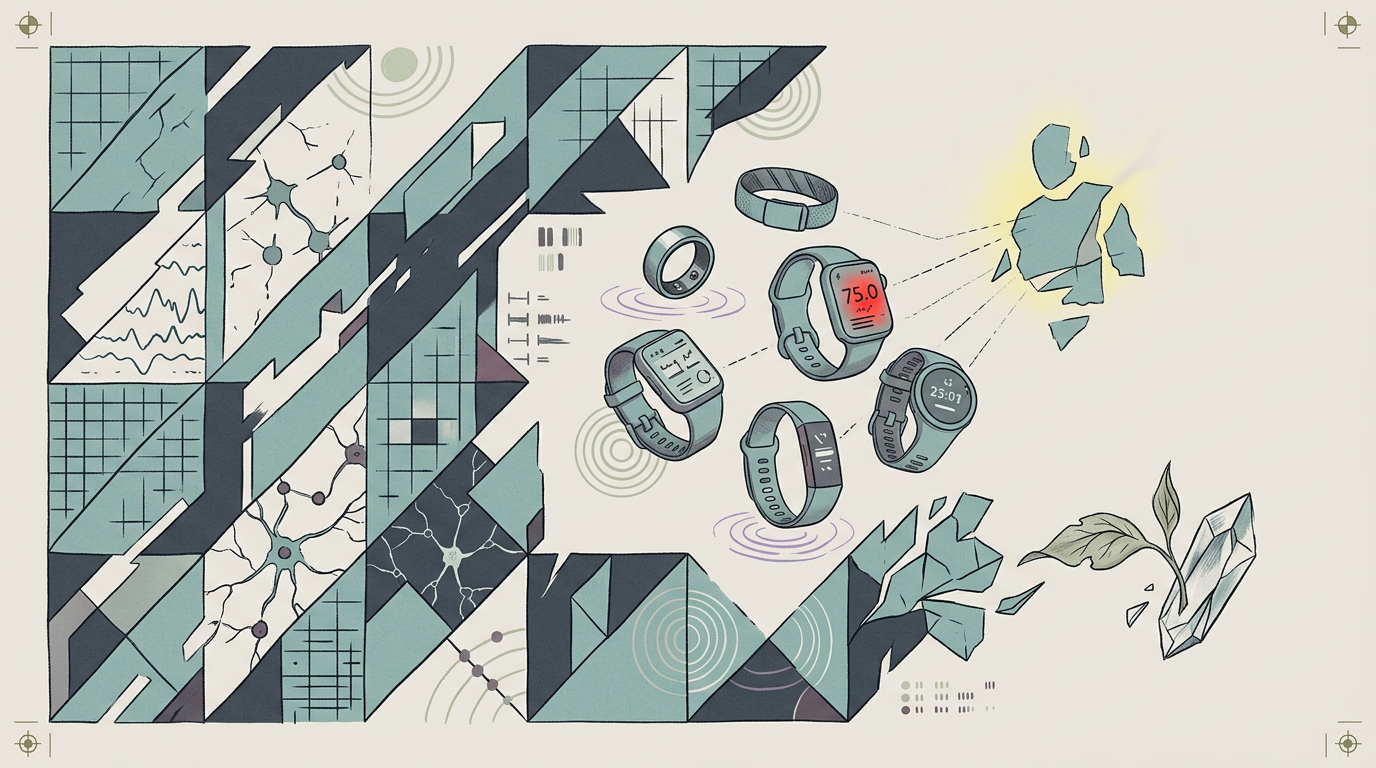
Wearables are sold as nervous-system coaches. They are not. They are sensors with a scoring layer on top — and the scoring layer is what most users actually consume. The sensor can see your pulse interval, your skin temperature, your movement and (on better hardware) some surrogate of breathing. It cannot see your trauma history, your client load, your fasted protein intake, why you are 4 weeks into a perimenopause flare, or whether the 47 you got on Recovery this morning is signal or noise. The orthosomnia pattern — anxious sleep tracking that makes sleep worse — is now well documented in the literature (Baron 2017, J Clin Sleep Med), and 2024–2025 work extends the same finding to readiness and recovery scores in healthy adults. We pulled the six wearables most-mentioned in our intake conversations through 2025–2026 and ranked them on two axes that actually matter: signal quality (what the hardware can truthfully see) and methodology included (what the app does with it). None of these brands paid for placement.
What it claims
- Measures HRV, sleep stages, recovery, readiness, stress and 'nervous-system load'
- Tells you when to push, when to rest, and when your body is 'ready'
- Improves sleep, recovery, training outcomes, and stress resilience over time
- Replaces the need for a coach, a sleep clinician, or a structured protocol
What the label is not telling you
- Oura Ring Gen 4 (€349 + €5.99/mo) — Best-in-class PPG and skin-temperature trend data in a ring form factor. Sleep-staging accuracy versus polysomnography is moderate (good for trends, weak for staging individual nights). Readiness Score blends HRV, RHR, body temp, prior strain and sleep into one number — useful as a directional cue, dangerous when treated as a verdict. Methodology included: light. The app nudges; it does not coach. Strong on data hygiene and privacy (EU servers, HIPAA-aligned). Weakest when the user is in a hormonal transition the algorithm has never been trained for — perimenopause, postpartum, GLP-1 weight loss, long-COVID recovery — and the score reads as 'you are broken' when the truth is 'you are remodelling.'
- Whoop 5.0 (€239/yr subscription, hardware included) — The most aggressive scoring layer of the category. Strain, Recovery and Sleep Performance are presented as verdicts, not measurements. HRV is read at a single point (last slow-wave sleep cycle), which is methodologically defensible but means a poor reading is poorly contextualised. Strong for endurance and strength athletes with an existing coach who can translate the score. Weakest for the sympathetic-dominant high-achiever Whoop disproportionately attracts — the score becomes the load. The 2023–2024 literature on wearable-induced anxiety in over-functioning users (orthosomnia + 'orthorecovery') is now hard to ignore.
- Apple Watch Series 10 / Ultra 2 (€449–€899) — The most clinically-validated single-lead ECG and AFib detection in the consumer space. Sleep tracking is competent and improving. The Vitals app gives a trend view (HR, HRV, respiratory rate, wrist temp) without a verdict — methodologically the most honest of the six. Methodology included: minimal. Apple does not pretend the watch is a coach. The risk here is the opposite — high-quality data, no interpretation, so users either ignore it or import it into third-party scoring apps that re-introduce the verdict problem.
- Garmin (Venu 3 / Fenix 8 / Forerunner 965) (€299–€999) — Strongest sensor stack for endurance athletes (multi-band GNSS, validated VO2max trend, training load and recovery built on 25 years of sports-science partnerships with Firstbeat). Body Battery and Stress are derived from HRV in a transparent way. Methodology included: best of the six for endurance — Training Readiness, Race Predictor, structured workouts, periodisation. Weakest for non-athletes who buy a Fenix for 'health insights' and then drown in metrics that were designed for a marathoner.
- Fitbit Charge 6 (Google) (€159 + €9.99/mo Premium) — Cheapest hardware of the six, sensor quality has slipped slightly versus the pre-Google era. Daily Readiness Score is paywalled behind Premium. Methodology included: light, behaviourally well-designed (habit nudges, mindfulness prompts). The platform-risk concern is real — Google has changed Fitbit's data, accounts and feature set three times since acquisition, and the 2025 Fitbit-to-Pixel migration is incomplete. Treat as a behavioural nudger, not a long-term data platform.
- Polar Vantage V3 (€599) — The most under-rated sensor in the category. Polar's HRV chest-strap lineage (H10) is the reference standard third-party studies validate against (Plews 2017, Eur J Appl Physiol). Vantage V3 brings that pedigree to a wrist device, with Nightly Recharge and Sleep Plus Stages built on transparent published methodology. Methodology included: solid for athletes, sparse for the general wellness user. Underpriced relative to Garmin for the data quality, oversold by no-one — which is why most people have never heard of it.
- The orthosomnia pattern is now the dominant clinical complaint. Baron and colleagues (2017, then 2023 follow-up) documented users escalating sleep aids and developing performance anxiety in pursuit of a 'good' tracker score. The 2024 Sletten replication extended the finding to readiness and recovery in non-athletes. The pattern is reliable: hand a sympathetic-dominant high-functioner a daily score with no interpretive scaffolding, and within 60 days the score is the stressor. The device is not the problem; the score-without-coach loop is.
- The HIPAA / GDPR gap is real. Consumer wearables are not covered by HIPAA in the US. GDPR applies in the EU but enforcement against US-headquartered consumer-health brands is uneven. Your HRV, RHR, sleep, menstrual cycle and location data are commercial assets of the manufacturer under the terms of service you accepted. Oura and Apple are the strongest on this axis; Whoop, Fitbit (Google) and Garmin are middle-of-the-pack; cross-border data transfers are routine across all six.
- No consumer wearable can assess vagal-tone trajectory. HRV at the wrist or ring is a noisy single-channel surrogate for what a 24-hour Holter or a paced-breathing lab assessment can see. It is directionally useful over 60-day windows in the same person, in the same context, on the same hardware. It is not diagnostic. It is not a measure of 'how regulated you are.' A bad week of HRV is not a verdict on your nervous system; it is a data point in a system the wearable cannot fully see.
Effect on the nervous system
Bimodal — and the split is the whole story. For a user with an existing regulated baseline, a coach (human or protocol-shaped), and the interoceptive literacy to ignore a bad day's score, a wearable is a useful biofeedback layer. HRV trend over 60–90 days, sleep regularity, and resting heart rate drift are genuinely actionable. For the sympathetic-dominant, over-functioning user — exactly the user the wearable category disproportionately sells to — the daily score becomes a sympathetic input. Cortisol rises in response to checking the readiness score. Sleep worsens in response to chasing the sleep score. Recovery worsens in response to chasing the recovery score. The 2024 review literature is consistent on this: in users with anxiety traits, the wearable score is a stressor in its own right. The hardware is not the problem; the unmediated score is.
Who it might suit
Athletes with an existing coach who can translate the data into periodisation decisions — Garmin or Polar. Adults with a regulated baseline who want a trend view without a verdict — Apple Watch (Vitals only) or Oura on a 'weekly review' cadence rather than daily score-checking. Users with a specific clinical question (AFib screening, sleep apnoea suspicion) who will take the data to a clinician — Apple Watch is the strongest evidence base. Anyone using the wearable as a feedback loop on a structured nervous-system protocol they are already running — the device amplifies the protocol; it does not replace it.
Who should skip it
Anyone with an active anxiety disorder, eating disorder, or obsessive checking pattern — the daily score will become the symptom. Anyone in a hormonal transition the algorithm cannot see (perimenopause, postpartum, GLP-1 weight loss, long-COVID recovery) without an interpretive layer — the score will mis-read remodelling as breakdown. Anyone using the wearable as a substitute for sleep hygiene, daylight, food timing, social connection and movement — the device cannot out-score a dysregulated foundation. Anyone whose subjective sense of wellbeing is now lower on days when they check the score than on days when they do not.
Bottom line
Of the six wearables reviewed, the honest hierarchy on signal-quality-per-euro: Polar V3 ≈ Garmin Forerunner 965 (best validated HRV and training load) > Oura Gen 4 (best trend data, weakest verdict layer in a good way) > Apple Watch (best clinical validation, weakest coaching layer in a good way) > Whoop 5.0 (best scoring layer if you have a coach to translate it, worst if you do not) > Fitbit Charge 6 (cheapest, weakest data platform risk). But the more important hierarchy is methodology-included: none of them include a coach, a protocol, or a plan for what to do when the score is bad. The wearable measures. The actual nervous-system work happens off-device. Buy the protocol first; layer the device second. If you already own one, switch from daily score-checking to a weekly review with one question: what is the 60-day trend, and what one variable can I change next week? The verified, practitioner-vetted device picks (and the chest straps for the few people who need lab-quality HRV) live at thecodex.world.