Home fragrance / room fresheners — endocrine & airway review
Room fresheners 2026 — plug-ins, sprays, reed diffusers and smart diffusers, and what your nervous system is actually inhaling all day
Thirteen of the most-bought room-freshener formats of 2026 — plug-ins, aerosol sprays, reed diffusers and smart Bluetooth diffusers — ranked by what the slow continuous emission is actually doing to your hormones, your indoor air quality, and the vagal tone you spent the day trying to protect
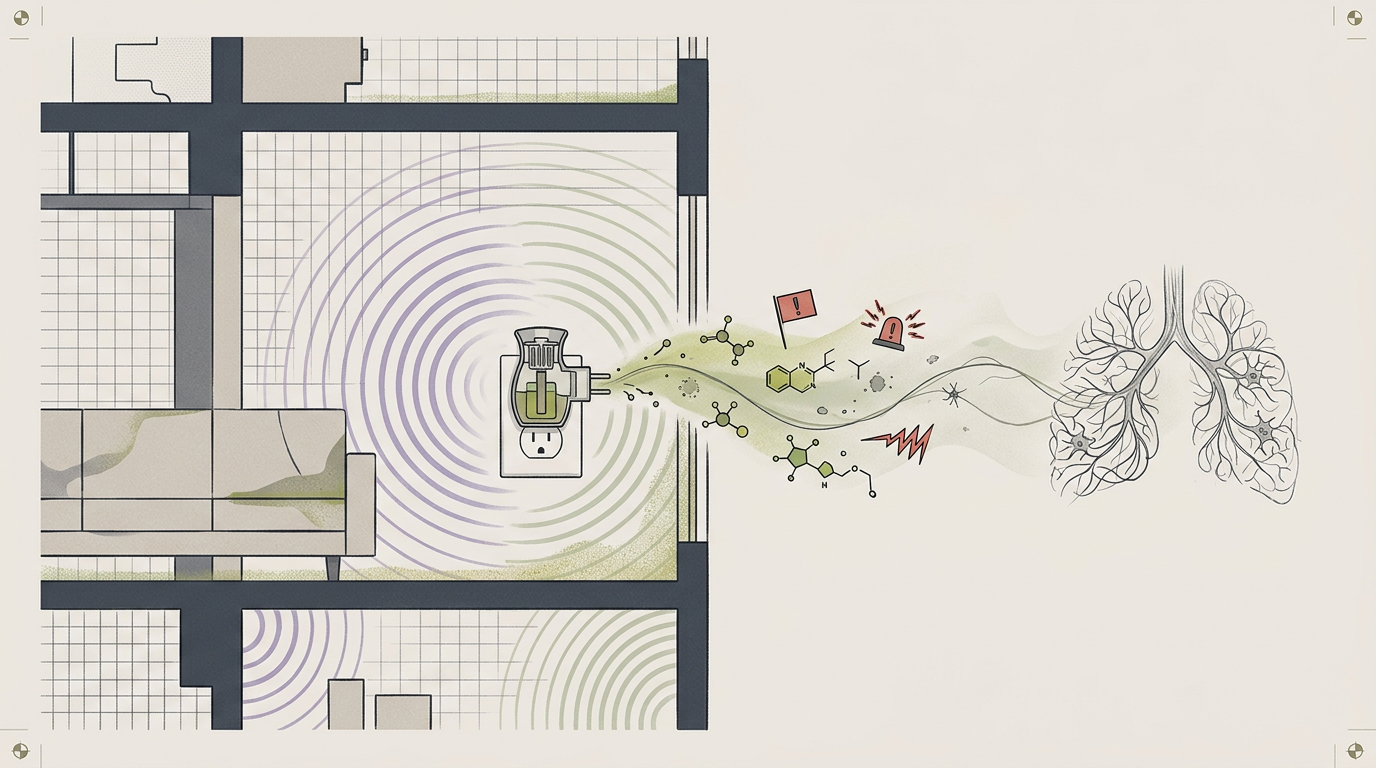
A room freshener is worse than a candle on almost every axis that matters. A candle burns for 90 minutes and you put it out. A plug-in or reed diffuser emits continuously, 24 hours a day, for 4–8 weeks per refill — and the dose your endocrine system actually receives is the integral of concentration over time, not the strength of the scent on day one. The category sells you the idea that 'fresh' = clean air. The chemistry says the opposite: most plug-ins and aerosol sprays mask odour by depositing a fine film of phthalates, synthetic musks, formaldehyde-releasing preservatives, terpene-derived secondary pollutants and quaternary ammonium compounds on every surface in the room, including your skin, your bedding, and the inside of your lungs. The EU labelling rules let all of it hide under 'parfum'. We ranked thirteen of 2026's most-used room-freshener products by what the continuous emission profile is actually delivering — and the verdict for the category as a whole is meaningfully worse than for candles.
What it claims
- Eliminates odours, neutralises bacteria, freshens the air, 'cleans' indoor air
- Plug-in continuous emission = constant 'spa-like' atmosphere with no effort
- Essential oil / natural fragrance / 'plant-based' = safe to run 24/7 in bedrooms and nurseries
- Smart diffusers (Pura, Aera) with app control = a premium, healthier alternative to mass-market plug-ins
What the label is not telling you
- 'Eliminates odours' usually means 'deposits fragrance on top of them.' Febreze and similar aerosol sprays do contain odour-binding cyclodextrins, but the dominant mechanism in nearly every category is olfactory masking + a thin film of fragrance and surfactant residue on every surface in the room. You are not removing the molecule; you are coating your environment with another one.
- Plug-ins are the worst exposure profile in home fragrance. A heated plug-in releases a near-constant concentration of fragrance VOCs into a 12–20 m² room for 4–8 weeks per refill. Air Wick, Glade, Yankee Plug-In and Bath & Body Works Wallflowers all use synthetic fragrance loads with undisclosed composition (legally 'parfum'), nearly always phthalate-fixed (DEP), and frequently contain limonene, linalool, alpha-pinene and beta-pinene — terpenes that, in the presence of ambient ozone (from outdoor air, printers, hair dryers, gas stoves), react to form formaldehyde and ultrafine secondary organic aerosol (SOA) particles. Peer-reviewed work: Steinemann (2017, Air Quality, Atmosphere & Health) documented 133 VOCs from 25 common fragranced consumer products including plug-ins; one third are classified as toxic or hazardous under at least one US federal law. Almost none appear on any label.
- Aerosol sprays add a propellant problem on top of the fragrance problem. Febreze, Glade Spray, Air Wick Spray and the supermarket equivalents use LPG/butane/propane propellants plus quaternary ammonium compounds (QACs) as antimicrobials and surfactants. QACs are now flagged by the American Lung Association and a growing 2024–2025 review literature for occupational asthma, contact dermatitis, and emerging reproductive-toxicity signals (Hrubec 2017, Reprod Toxicol; Melin 2014). The puff smells clean for 90 seconds; the QAC film and propellant residue persist on soft furnishings for days.
- Reed diffusers leak solvent continuously. A typical reed diffuser is 60–80% solvent — usually dipropylene glycol (DPG), isopropyl myristate, or in the cheaper SKUs, a denatured alcohol blend — carrying 5–15% fragrance oil. The reeds wick the entire mixture into the room over 6–12 weeks. DPG is one of the lower-toxicity solvents available, but you are still aerosolising hundreds of grams of solvent + undisclosed fragrance into a closed room over months. Premium brands (Diptyque, Jo Malone, NEST, Aesop) use the same DPG/IPM solvent system as mass-market — the difference is the fragrance composition and the jar, not the delivery vehicle.
- 'Essential oil' natural diffusers are not automatically safe to run continuously. Neom Organics, Aery Living, and the better ultrasonic diffuser refills use 100% essential oils — meaningful upgrade on disclosure and avoids DEP and synthetic musks. But limonene and alpha-pinene from citrus and pine oils react with indoor ozone to form formaldehyde and SOA exactly the same way synthetic terpenes do (Wolkoff 2013; Nazaroff & Weschler 2004). 'Natural' lowers the endocrine load; it does not eliminate the secondary-pollutant load if the room is not ventilated. Running an ultrasonic diffuser of lemon or eucalyptus oil for 8 hours overnight in a closed bedroom is not the clean choice the marketing implies.
- Smart diffusers (Pura, Aera) are a packaging upgrade, not a chemistry upgrade. Pura and Aera sell app-controlled, scheduled, scent-blending plug-ins — often co-branded with Capri Blue, NEST, Apotheke, Jo Malone, Diptyque. The hardware is genuinely better engineered (lower emission rate per minute, schedulable, no heat). The fragrance cartridges, however, are formulated by the partner perfume houses and inherit those brands' transparency profile — which, with the exception of a small number of clearly labelled 'clean' Pura SKUs, is the same undisclosed 'parfum' load you'd get in the candle. Scheduling helps. Choosing a clearly disclosed natural-fragrance cartridge helps more. Buying a smart diffuser then loading it with a synthetic-musk fine-fragrance cartridge buys you precision-delivered exposure.
- Bedrooms and nurseries are the worst rooms for any continuous-emission product. You spend 7–9 hours there, breathing slowly and deeply, with the door closed, often the window closed, often with a humidifier raising ambient humidity and accelerating SOA formation. The literature on childhood asthma incidence and plug-in / aerosol freshener use in the home is consistent enough that the UK Royal College of Paediatrics, the American Academy of Pediatrics and the European Respiratory Society have all issued cautionary statements. If you do nothing else with this review, take the plug-in out of the bedroom and the nursery.
- Air Wick / Glade / Febreze / Yankee Plug-In / B&BW Wallflowers (€4–10 per refill) — Undisclosed synthetic fragrance, phthalate-fixed, continuous heated emission, QAC residues (sprays), the worst combined endocrine + airway profile in this review. Avoid in bedrooms, nurseries, small rooms, and any closed space you spend >4 hours in daily.
- Diptyque (€65) / Jo Malone (€60) / NEST New York (€48) reed diffusers — DPG/IPM solvent + fine-fragrance composition that nearly always includes synthetic musks and undisclosed fragrance. Beautiful objects; you are paying for the perfumer, not for cleaner indoor air. Use in large, ventilated rooms only; never in a closed bedroom 24/7.
- Aesop (€95) reed diffusers — Same DPG-class solvent; fragrance composition partially disclosed; better than mass-market, not as clean as the marketing implies. Premium price, premium scent, mid-tier chemistry transparency.
- Aery Living (€38) / Neom Organics (€45) reed & ultrasonic diffusers — 100% essential oils, full essential-oil breakdown published, phthalate- and synthetic-musk-free. The most honest brands in the room-freshener category. Caveat: still run on a schedule, not 24/7, and always with intermittent ventilation — the terpene + ozone → formaldehyde pathway is real for natural oils too.
- Pura / Aera smart diffusers (€50 hardware + €18–28 cartridges) — Hardware is the best in category (no heat, scheduled, low emission rate). Cartridge chemistry depends entirely on the partner brand. Choose explicitly clean-formulated cartridges (Pura's 'Clean' line, certain Capri Blue SKUs); avoid co-branded fine-fragrance cartridges from Jo Malone or NEST if you care about disclosure. Used correctly — short scheduled bursts in a well-ventilated room with a transparent cartridge — this is the least bad option in the continuous-emission category. Used badly — synthetic-musk cartridge running 8 hours overnight in a closed bedroom — it is precisely as bad as a Yankee plug-in with a nicer app.
Effect on the nervous system
This is where the room-freshener category collapses on its own marketing. The pitch is calm, spa, sanctuary, a 'regulated' home. The biological reality is the opposite. The olfactory system is the only sensory channel wired directly into the limbic and autonomic centres without thalamic relay — so scent genuinely is a powerful regulation lever. A specific, deliberate scent, used as a transition cue (lighting a candle before dinner, spraying a hydrosol before bed, switching on a diffuser for a defined wind-down window) is one of the strongest cheap interventions in the parasympathetic toolkit. Continuous, ambient, unrelenting scent is the opposite intervention. The nervous system habituates to a constant stimulus within minutes (sensory adaptation), so the 'calming' effect of the plug-in disappears after the first 15 minutes and never returns — what you're left with is the continuous endocrine and airway exposure with none of the regulation benefit. Add the documented sleep-architecture disruption from elevated indoor VOCs and PM2.5 (Wolkoff 2018; Strøm-Tejsen 2016), the documented headache and chronic-cough incidence around plug-ins (Steinemann 2017), and the fact that QAC residues from aerosol sprays have been shown to impair mitochondrial function in human cell lines (Datta 2017) — and the trade is exactly backwards. You are paying continuous allostatic load to get an olfactory regulation effect that lasts 15 minutes. The Burnout, Wired-Tired and Sleep Anchors are trying to lift that exact load. The fastest single win for indoor air in most homes we work with is: unplug every plug-in, throw away every aerosol freshener, replace them with intermittent, scheduled, transparent-fragrance delivery — and ventilate.
Who it might suit
Adults — all genders — who want a deliberate, scheduled, intermittent scent ritual in their home and are willing to switch to transparent natural-fragrance brands (Aery, Neom) or to use a smart diffuser (Pura, Aera) with a clearly disclosed cartridge for short scheduled windows. People in large, well-ventilated, open-plan rooms who burn or diffuse for transition cues (morning, post-work, pre-sleep), not for continuous ambience. People who have already done the Burnout, Sleep or Wired-Tired Anchor and want to upgrade the home-air layer without losing the ritual.
Who should skip it
Anyone pregnant, trying to conceive, peri-menopausal, breastfeeding, or running an active thyroid or fertility investigation — remove plug-ins, aerosol sprays and continuous-emission diffusers from the home entirely, especially from bedrooms. Households with infants, young children, or anyone with asthma, chronic rhinitis, eczema, MCAS, recurrent sinusitis or post-COVID respiratory sensitivity. Anyone running a plug-in or aerosol freshener in a bedroom, nursery, or small closed room overnight — this is the single highest-exposure scenario in the category. Anyone who reads 'natural' or 'essential oil' on the box and assumes 24/7 diffusion in a closed room is therefore safe — it is not. Anyone who uses a Febreze-style aerosol on bedding, sofas, curtains or car interiors as 'odour elimination' — QAC and phthalate residue on porous textiles is the slowest-clearing exposure of all.
Bottom line
The honest hierarchy: (1) Open a window for ten minutes twice a day — the single most effective indoor-air intervention ever studied, and it costs nothing. (2) Use a transparent natural-fragrance brand (Aery, Neom) in an ultrasonic diffuser or as a hydrosol spray, on a schedule (20–30 minute windows, not continuous), in a ventilated room. (3) Use a smart diffuser (Pura, Aera) with an explicitly clean-formulated cartridge, scheduled for short bursts at clear transition points (morning, evening, pre-sleep), never overnight in a closed bedroom. (4) Premium reed diffusers (Diptyque, Jo Malone, NEST, Aesop) — large ventilated rooms only, never in bedrooms, accept the synthetic-musk and undisclosed-fragrance trade-off. (5) Plug-ins and aerosol sprays from Air Wick, Glade, Febreze, Yankee, B&BW Wallflowers — the worst combined exposure profile in home fragrance. The category that singlehandedly normalised running a heated phthalate emitter in a child's bedroom for eight weeks straight. Take them out of the house. The dose makes the poison; duration multiplies the dose; the bedroom multiplies it again. The vetted, third-party-screened diffusers, hydrosols and clean-fragrance picks we keep on the shelf live at thecodex.world.