Hair fall / scalp serums & supplements
Hair-fall & scalp-health products 2026 — the shelf review
Eight of the most-marketed hair-fall and scalp-health products of 2026, tested through a nervous-system lens — what is real pharmacology, what is well-formulated topical theatre, and why none of it works on a dysregulated baseline
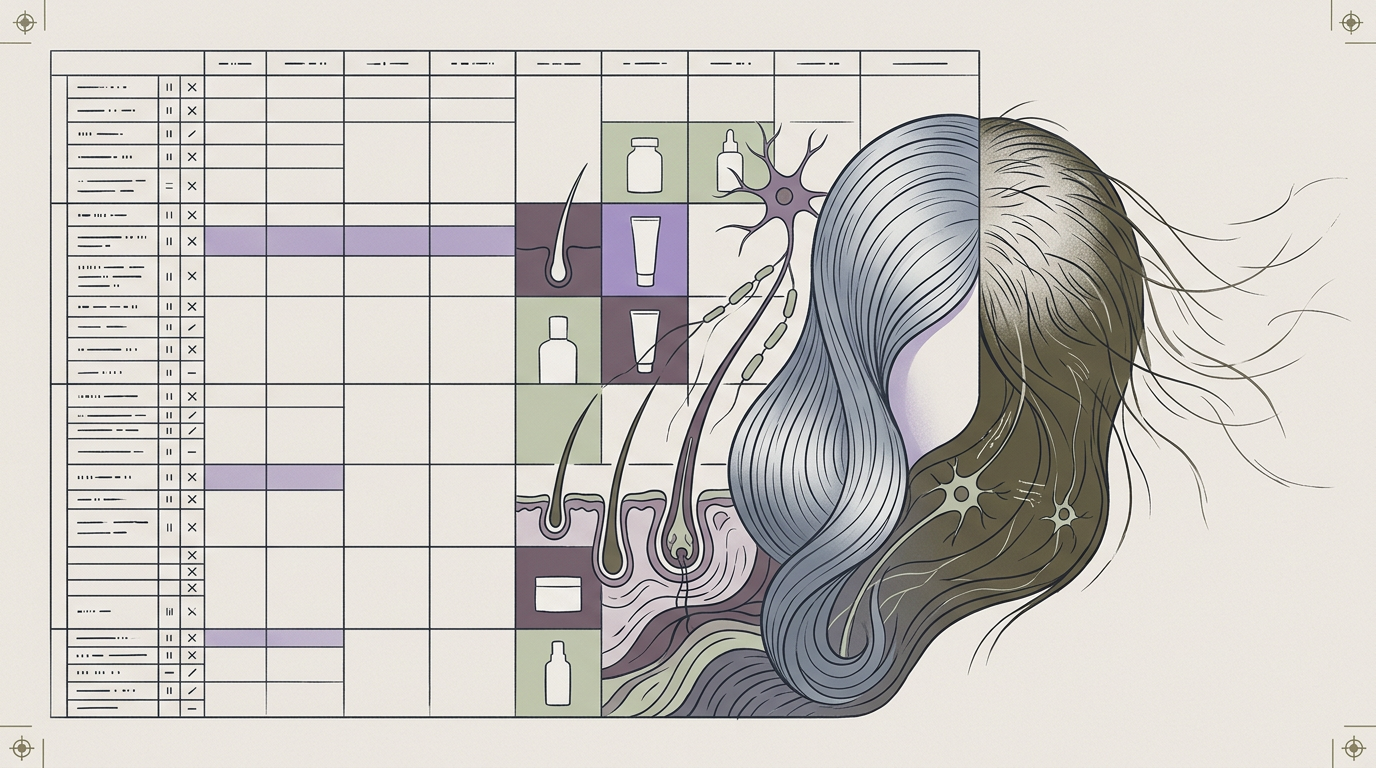
Hair fall is the single fastest-growing search category in beauty. Every brand has launched a serum, a gummy, a scalp oil, or a prescription subscription. Some contain real, FDA-cleared pharmacology. Some contain well-formulated cosmetic actives. Most contain $80/month of marketing wrapped around a bottle that cannot do what the package implies — because the thing falling out of your head today was programmed to fall out by a nervous-system signal three to six months ago, not by a missing topical. We pulled eight of the most-trending hair-fall and scalp products of 2026 and ranked them by mechanism, evidence, and honesty. None of this is sponsored. None of these brands paid for placement.
What it claims
- Reduces hair shedding, regrows density, thickens strands
- Improves scalp microbiome, follicle health, blood flow
- Drug-free, plant-based, hormone-safe alternative to minoxidil/finasteride
- Replaces the dermatologist visit — just subscribe and shed less
What the label is not telling you
- Nutrafol Women / Men ($88/mo) — Oral nutraceutical: ashwagandha (KSM-66), saw palmetto, marine collagen, biotin, tocotrienols. Has one company-sponsored RCT (n=40 women, JDD 2018) showing improvement in terminal hair count vs placebo at 6 months. Real ingredients, real (small) data. The cost is high because the formulation is dense and the marketing budget is denser. Useful adjunct only if (a) your shedding is stress / androgen-driven and (b) your baseline nutrition, sleep and cortisol pattern is already addressed. On a dysregulated nervous system it is $88/month of supplements going into the wrong endocrine environment.
- Vegamour GRO+ Advanced Serum ($72) — Topical: CBD + mung bean extract + red clover + curcumin. Marketed as 'severe shedding' solution. No published independent RCT against minoxidil or placebo with peer review. Company-run studies show self-reported reduction in shedding. Mechanistically the actives are plausible anti-inflammatories at the scalp surface; pharmacologically they are not in the same class as minoxidil. Honest verdict: a pleasant cosmetic serum that some users genuinely like, priced and marketed as if it were a drug.
- Hims / Hers oral + topical minoxidil and finasteride ($35–60/mo) — This is the only category here with FDA-cleared pharmacology. Minoxidil (topical and oral low-dose) and finasteride (oral, men) have decades of peer-reviewed evidence for androgenetic alopecia. The risk is not the molecule — it is the delivery model. Telehealth subscriptions bypass the dermatologist exam that should classify the shedding type (androgenetic vs telogen effluvium vs autoimmune vs nutritional vs thyroid). Finasteride in particular has a real, under-disclosed sexual and mood side-effect profile (post-finasteride syndrome) that an asynchronous chat consultation under-screens. Real medicine, casually prescribed.
- Olaplex Scalp Longevity Treatment / No.0 + No.3 ($30–58) — Bond-builder chemistry (the patented bis-aminopropyl diglycol dimaleate) is genuine repair technology for the hair shaft. It does not address follicle biology, hormones, or shedding. The new scalp-longevity line repositions an excellent hair-shaft product as a hair-fall product, which it is not. Use it for the brittle, broken mid-length damage it was designed for; do not buy it expecting it to slow shedding.
- Augustinus Bader The Hair Revitalizing Complex / The Hair Oil ($230–290) — The TFC8 complex is the brand’s proprietary peptide/amino-acid blend. Real cosmetic feel, real shine and softness, plausible scalp anti-inflammatory effect. No published RCT in indexed journals demonstrating hair regrowth vs placebo on humans. Priced as a clinical intervention; positioned as a clinical intervention; evidenced as a luxury cosmetic. If you have the budget and want a beautiful product, fine. If you have measurable shedding, this is the wrong instrument.
- Mielle Organics Rosemary Mint Scalp & Hair Strengthening Oil ($10) — The TikTok cult product. Rosemary oil has one peer-reviewed 2015 trial (Panahi et al., n=100) showing non-inferiority to 2% minoxidil for androgenetic alopecia at 6 months. The trial is real but small, single-site, and not on this exact product. Mielle’s formulation is mostly carrier oils with a rosemary fraction whose concentration is not standardised. Affordable, mostly harmless, with modest mechanistic plausibility. The category’s best price-to-evidence ratio — which says more about the rest of the category than about this oil.
- Hairburst Hair Vitamins (£24.99/mo) — Biotin (massive over-dose at 7,500–10,000 mcg), zinc, selenium, marine collagen. Biotin deficiency is genuinely associated with hair loss, but actual deficiency is rare; supra-physiological biotin does not grow hair faster in non-deficient people, and the dose used here interferes with thyroid and troponin lab assays — a documented patient-safety problem flagged by the FDA in 2017 and 2019. Cheap, marketed at women in their 20s, and the active ingredient most people are paying for does nothing for them while distorting their bloodwork.
- The Ordinary Multi-Peptide Serum for Hair Density ($20) — A well-formulated cosmetic peptide serum (REDENSYL, CAPIXYL, PROCAPIL, AnaGain). The ingredient blends have manufacturer-funded studies, not independent peer-reviewed trials. Pleasant texture, low price, plausible scalp signaling. Will not stop androgenetic loss; will not replace minoxidil. Reasonable cosmetic adjunct if you enjoy the ritual.
Effect on the nervous system
This is the part the entire category will not put on the bottle: hair is one of the most accurate biomarkers of nervous-system load over the previous three to six months. Telogen effluvium — the diffuse shedding pattern most adults experience — is the follicle’s response to a sympathetic signal weeks or seasons ago. The hair you are losing today was already programmed to fall out by a stress signal you did not register as stress. No serum, no gummy, no scalp oil can rescue a follicle that was switched into the resting phase by chronic cortisol, under-eating, under-sleeping, post-illness inflammation, post-partum hormone shifts, or a months-long sympathetic baseline. Pharmacology (minoxidil, finasteride) can extend the growth phase against an androgenetic gradient. Cosmetics can make the scalp environment marginally friendlier. Neither rebuilds the nutrient stock, the hormonal stability, the sleep architecture, or the autonomic regulation that the follicle reads as ‘safe enough to grow hair right now.’ Without proper nutrients, blood sugar stability, iron, ferritin, vitamin D, B12, protein, sleep, and parasympathetic recovery, every product on this list is being asked to do work that belongs upstream.
Who it might suit
Adults — across all genders — whose nervous-system baseline, sleep, food and lab work (ferritin, vitamin D, B12, TSH, free T3, fasting insulin) are already addressed and who want to layer a targeted intervention: Hims/Hers minoxidil (with a real dermatologist exam first, not a chatbot) for confirmed androgenetic loss, Nutrafol for stress-driven shedding once cortisol is being managed, rosemary oil (Mielle or otherwise) as a low-cost scalp adjunct, The Ordinary peptide serum for ritual. Olaplex for damaged mid-lengths, Augustinus Bader if budget is genuinely no object and you want a luxurious product.
Who should skip it
Anyone currently shedding without first running ferritin, vitamin D, B12, TSH, free T3, and a fasting metabolic panel — you are treating the wrong thing. Anyone under-eating, under-sleeping, recently post-illness, post-partum, peri-menopausal without HRT discussion, or carrying a chronic sympathetic baseline — fix the upstream before you spend a euro on the topical. Anyone considering finasteride without an in-person clinician discussion of the sexual, mood and post-finasteride risk profile. Anyone taking Hairburst-class high-dose biotin while undergoing thyroid or cardiac bloodwork. Anyone who has not yet built the foundation in the Burnout & wired-tired anchor — the follicle does not respond to serums laid over dysregulation.
Bottom line
Of the eight, the published-evidence ranking is roughly: Hims/Hers minoxidil & finasteride (real pharmacology, casual prescribing model) > Mielle Rosemary Mint (single small trial, best price-to-evidence) > Nutrafol (one small company-sponsored RCT, dense formulation) > The Ordinary Multi-Peptide (formulator-grade cosmetic, no shedding evidence) > Olaplex Scalp Longevity (excellent hair-shaft repair, mis-positioned as hair-fall) > Vegamour GRO+ (pleasant cosmetic, drug-grade marketing) > Augustinus Bader (luxury cosmetic priced as clinical) > Hairburst (high-dose biotin that distorts lab work). None of them — none — out-perform the foundational work: ferritin above 70, vitamin D above 50 ng/mL, eight hours of dark sleep, adequate protein, blood sugar stability, and a parasympathetic baseline rebuilt over a 90-day window. Read the Hair Fall and the Nervous System piece first. Run the labs. Build the baseline in the Burnout & wired-tired anchor. Then, and only then, consider layering a verified product. The verified hair, skin and scalp stack we use is curated at thecodex.world.