Workplace & Leadership
The cumulative physiological cost of high performance
The Friday collapse is the physiological result of a nervous system locked in sympathetic drive all week, dropping its adrenaline once the inbox quiets down.
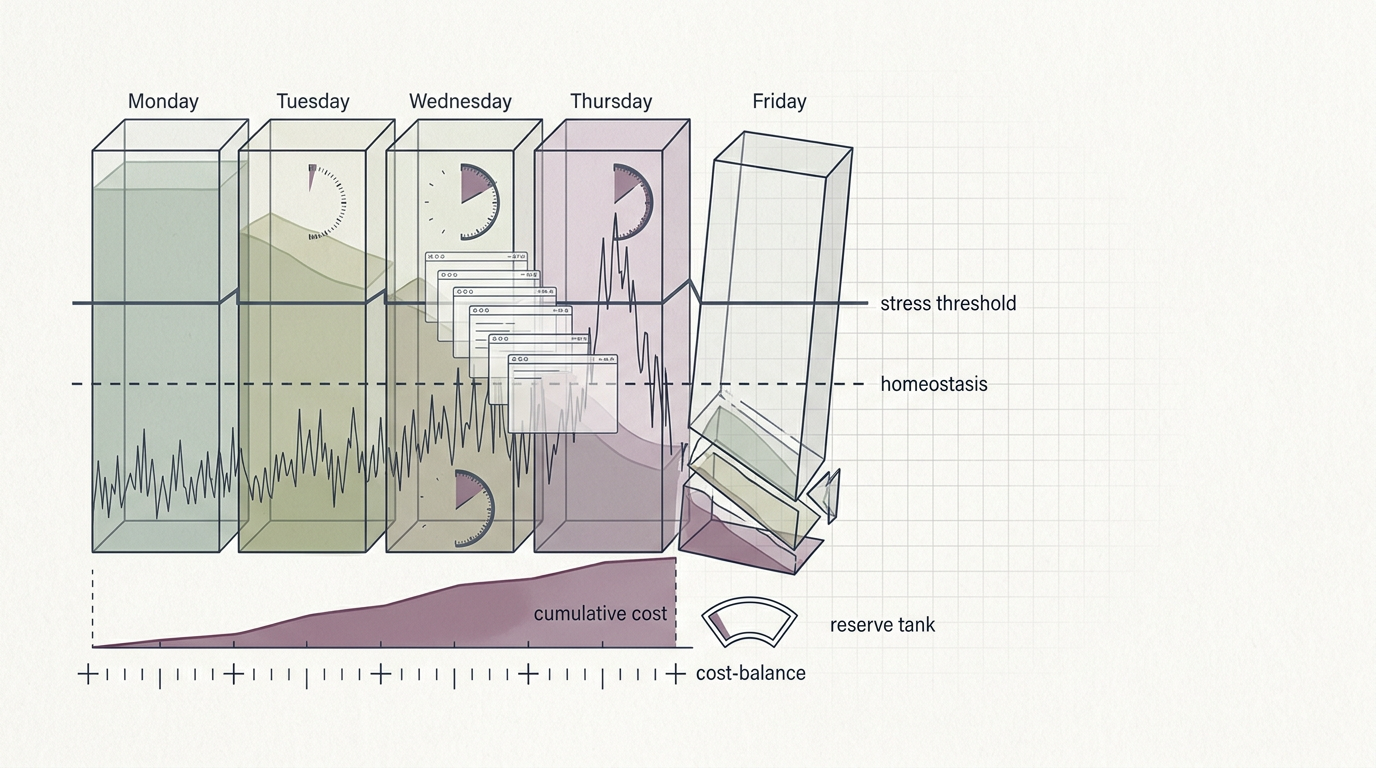
The optimization industry wants you to believe the Friday afternoon crash means you just need a better green juice or a weekend detox. I'm calling it. The collapse happens because your autonomic nervous system has been flooding your bloodstream with cortisol since Monday morning, and it finally ran out of immediate threats to fight. You're feeling the raw, sudden drop in arousal state. For a long time, I actually thought I could just out-caffeinate this drop, but biology always wins.
You hit 3pm on Friday and your jaw is so tightly clenched it aches. You shut the laptop, but your shoulders stay hovering somewhere near your ears well into the evening. You wander into the kitchen and stare at the open fridge with zero appetite. You are tired but wired, pacing the house with a low hum of panic behind your eyes. When you finally lie down, you feel anxious for no reason, your heart racing against the mattress even though the week is over. You're exhausted but can't rest, scrolling on your phone at 11:47pm because your brain is still trying to process the accumulated vigilance of five consecutive workdays. The weekend is right there, and you feel completely disconnected from your body.
Common Questions
What causes the Friday collapse?
Your stress-response systems stay activated to handle the week's volume of decisions and interactions. When the external pressure finally eases on Friday, your body stops producing the emergency hormones that were keeping you functional, revealing the underlying exhaustion you've accumulated.
How does cortisol affect this cycle?
Your HPA axis pumps out cortisol to keep you alert and capable under pressure. This suppresses parasympathetic functions like digestion, rest, and cellular repair. Once the immediate demand drops, the system attempts to rapidly down-regulate, causing the physical sensation of a heavy crash.
Is this the same thing as burnout?
The weekly crash is an acute signal of depleted capacity. Burnout is the chronic state where the nervous system can no longer mount a functional stress response at all. Intervening during the weekly cycle prevents the permanent shift into chronic depletion.
The prefrontal penalty
The corporate world treats your Heart Rate Variability (HRV) as a video game high score to be optimized. A high score means you get a gold star for the day. That misses the entire biological mechanism. Your HRV is a raw, high-fidelity metric of autonomic flexibility—your vagus nerve's ability to shift you rapidly from a state of high alert back to a regulated baseline.
When you drag yourself through three critical meetings and force your prefrontal cortex to stay engaged while your baseline state is highly agitated, you accumulate heavy allostatic load. The low HRV on Friday morning means your physiological parking brake has worn thin. You simply cannot decelerate. Your heart rate variability directly mirrors your prefrontal cognitive performance, and by Friday afternoon, both systems are running on fumes.
Attention residue and the next task
I've stopped recommending time-management hacks to leaders. The inbox hasn't once been impressed by your heart rate. The actual bottleneck is attention residue—the cognitive and autonomic drag left over when you switch from a high-threat interaction to a seemingly calm one.
Your calendar says you have 15 minutes of white space before the next call. Your nervous system is still processing the subtle hostility of the last Zoom meeting. The HPA loop (the feedback circuit running from your brain to your adrenal glands) remains fully activated. You carry that sustained sympathetic drive directly into the evening. There's no biological boundary between your work and your rest, so your body remains braced for impact until the weekend forces a halt.
The drop in arousal state
Your body doesn't distinguish between a critical product launch and a predator. To your biology, both require extreme vigilance. This sustained preparedness demands a massive amount of metabolic energy.
When you finally log off for the weekend, the HPA axis halts the immediate flood of adrenaline. The abrupt drop in arousal hormones is what makes your limbs feel like lead. The alarm bells stop ringing, and the exhaustion that was masked by adrenaline floods in all at once. Building real capacity requires teaching the system that the threat has passed long before Friday arrives. This is the core protocol I teach inside the Performance L2 course. Kokorology train leaders to manually shift their state rather than waiting for the weekend to save them.
Most leadership advice is just napping with extra steps, and this is the week you finally understand why.
What to do this week
- Institute a Friday state shift. At the end of your last task, take three minutes. Close the laptop. Write down your top priority for Monday on physical paper and turn it over. Put the devices in another room. The goal is to provide a mechanical signal of closure to your nervous system.
- Front-load your hydration. Before your first coffee on Monday morning, drink 500ml of water with a pinch of sea salt. Constant sympathetic arousal is profoundly dehydrating, and you need raw materials to maintain autonomic function.
- Sit in silence for 20 minutes. On Saturday, consume no podcasts, no music, and no screens for a short window. Let your nervous system idle without external input. If this makes you want to crawl out of your skin, note that sensation inside the Journal.
- Use a sustained nasal exhale. After high-arousal meetings, use a longer exhale to mechanically stimulate the vagus nerve. This initiates parasympathetic recovery and clears attention residue before you jump to the next task.
Where this fits in the Kokorology system
Managing this accumulation of physiological demand requires actual intervention, more than better weekend plans. Kokorology focus on rebuilding baseline capacity through foundational nervous system regulation first. Once the hardware stabilizes, Kokorology use the advanced tools in the Performance L2 course to help operators sustain output without sacrificing their biology.
Closing
You can stop running this seven-day cycle of peak vigilance and collapse. Find the friction point in your calendar, and intervene before the drop happens.
- Start with the basics: Download the free guide to nervous system regulation to understand your physiological baseline.
- Build your leadership capacity: The Performance L2 course is designed for operators who need to manage their own autonomic state under pressure.
- Break the pattern: If you're stuck in this cycle and can't find the exit, a 1:1 Coaching session provides the specific intervention you need.
TL;DR
The Friday afternoon collapse is the predictable physiological result of a nervous system locked in sympathetic drive all week. Your HPA axis floods your body with stress hormones to meet the demands of your calendar, suppressing parasympathetic repair. When the immediate pressure eases on Friday, the sudden drop in arousal hormones leaves you exhausted. Managing this physiological demand requires creating clear, consistent signals of safety to shift your autonomic state, rather than simply relying on the weekend to endure the damage.
Sources
- McEwen BS (2017). Neurobiological and Systemic Effects of Chronic Stress. Chronic Stress.
- Thayer JF, Hansen AL, Saus-Rose E, Johnsen BH (2009). Heart Rate Variability, Prefrontal Neural Function, and Cognitive Performance: The Neurovisceral Integration Model. Journal of Personality and Social Psychology.
- Leroy S (2009). Why are you so hard to talk to? The effect of attention residue on the quality of interpersonal interactions. Journal of Experimental Psychology: Applied.
- Critchley HD (2023). Interoception and Autonomic Regulation in Stress. Journal of Neuroscience.