Journal Practice
Your Wearables Spit Out Numbers. The Journal Tells You What To Do.
Every device gives you data. None of them give you a decision. The Kokorology Journal turns whatever you wear, scan or upload into one read, one practice, one weekly insight — built around the part of you you're actua…
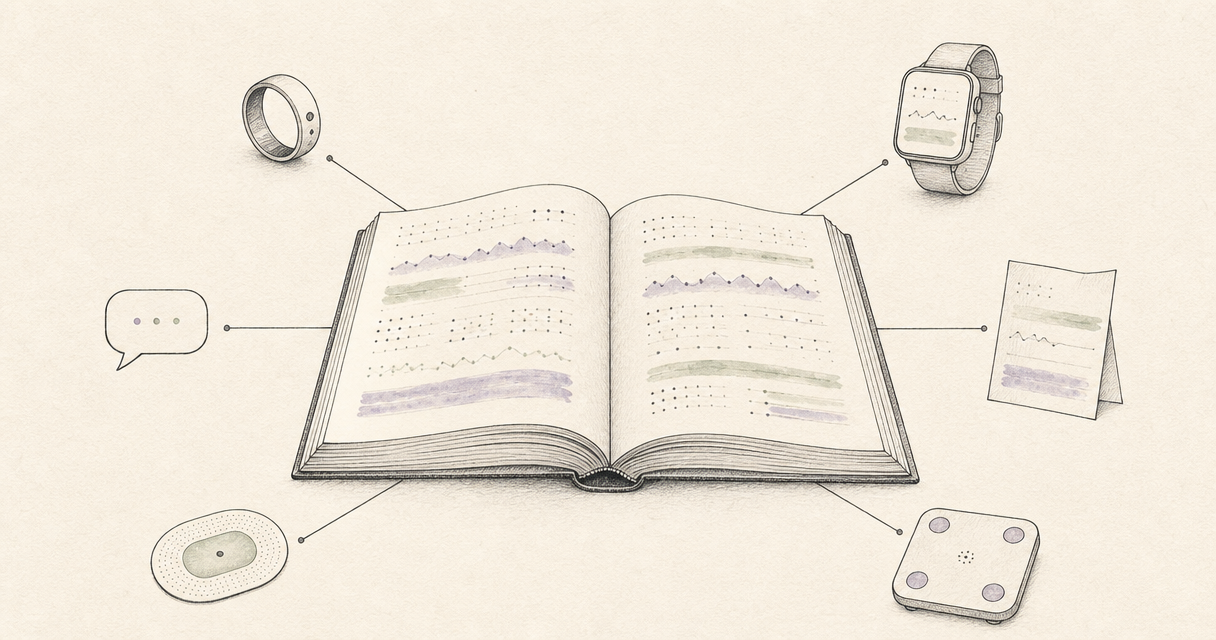
You wake up, check your wrist, and find out your sleep score is a 42. You already knew that, because you were awake at 3am staring at the ceiling, but now you have a brightly colored metric to confirm your misery. The wearable industry has convinced the system that collecting biological data is the same thing as making a health decision. I completely disagree. Gathering numbers without a protocol attached just gives your nervous system another reason to stay hypervigilant. The Kokorology Journal exists to turn that wall of data into one single action.
You look at the app dashboard while your coffee drips. The little red bar tells you to prioritize recovery today, which is entirely useless advice when you have three deadlines and a commute. The hardware is doing its job, but your physiology is still a mess. You feel that familiar, tight buzz behind your eyes—the physical reality of being tired but wired. You own the ring, the smart scale, and the patches, yet you still wake up at 3am every night with your heart racing when you lie down. Your inbox has never once been impressed by your sleep staging. When you're standing in the kitchen at 4pm, staring into the fridge with zero appetite, feeling completely anxious for no reason, another raw data point won't lower your sympathetic arousal. You need an instruction.
Common questions
Do I need a wearable to use this?
Manual notes work perfectly well. A wearable just makes the daily read faster. If you want to type in your weight from a basic scale or write down a symptom you noticed after lunch, the system handles it exactly the same way.
Which devices does it work with?
All of them, without waiting for an API partnership. If you can screenshot a dashboard or export a PDF from your doctor, the Journal can read it. You can swap your Oura for an Apple Watch tomorrow and nothing breaks.
Will my data get used to train AI?
Sharing is turned off by default and revocable at any time. Nothing leaves the platform to train outside models. At the end of the year, you get a private export of your own biology, and you keep it.
Your nervous system runs the app
Most digital health platforms treat your body like a car dashboard with a dozen dials and absolutely no driver. You get alerts about your step count while you're actively surviving a high-stress season.
I'm calling it. Data without context is just noise. Your autonomic nervous system doesn't know what a generic optimal range is. It only knows capacity and load. Recently, Kokorology've seen moves like Xella Health pairing Oura data with AI diagnostics for women's biology. The market is finally realizing that raw biometrics require a biological context to mean anything.
The Journal forces you to pick one Anchor—the specific state you are actively regulating right now. Burnout recovery, perimenopause, returning after a hard year, or performing under pressure. Two people with the exact same resting heart rate get a completely different daily directive, because their Anchor dictates what that number signals for their specific body today.
The translation layer
The standard advice tells you to magically increase your heart rate variability. HRV is a proxy for vagal tone, the literal parking brake of your nervous system. You can't just decide to pull it.
If you are stuck in a state of high allostatic load—meaning your HPA axis is constantly firing cortisol and adrenaline into your bloodstream to keep you upright—your metrics will look terrible. A generic app will tell you to rest. If your Anchor is set to burnout recovery, the Journal understands that your locus coeruleus is hypersensitive to threat. It gives you a 60-second visual tracking drill to quiet the threat-detection machinery in your brainstem, rather than suggesting a nap you can't actually take.
The inbox has never once been impressed by your heart rate.
Kokorology translate the output of the hardware into the language of the nervous system.
Works with whatever you already use
Most platforms promise to tie your life together, provided they have a lucrative data-sharing agreement with the company that built your watch. Kokorology skipped that entirely.
If you take a screenshot of your Eight Sleep dashboard or your Hume scale app, the Journal reads the image and files it. If you drop in a PDF of your latest blood panel or sleep study, it extracts the relevant numbers and uses them in tomorrow's read. I've stopped recommending complex integrations that inevitably break when an app updates. Just snap the picture. The prefrontal load of managing your health tech shouldn't be heavier than the actual health problem you're trying to solve.
One read, one practice
Right now, you are probably running six different health apps and getting zero actionable answers. That juggling creates its own physiological friction.
The Journal gives you three things a day, total. First, a single line telling you where your state is today, synthesized from everything you connected. Second, one 60-second practice—a breath pattern, a prompt, or a physical boundary. Sometimes the practice is an explicit instruction to do less, like skipping the cold plunge because your sympathetic nervous system is already redlining. Third, one weekly insight showing what actually shifted.
Five minutes of attention. No infinite scroll, no confusing graphs, and no performing for a digital coach.
Customization that actually matters
I don't care if you can change the color of the tiles on your phone screen. That is decorating.
Real customization means tracking the things that actually matter to your specific biology. You can add HRV, glucose, magnesium intake, hot flushes, or peptide cycle days. You drop whatever you don't care about. More importantly, you set your own optimal baselines. You should be measuring your progress against the capacity you want to maintain, not the generic average the laboratory software assumes you belong in.
What to do this week
- Look at your primary wearable app and turn off every push notification. Check the numbers when you choose to, not when the device wants your attention.
- Pick the one metric that actually reflects your physical capacity right now—whether that's sleep staging, fasting glucose, or resting heart rate.
- Ignore the rest of the dashboard for seven days.
Where this fits in the Kokorology system
The Journal is the daily translation engine. You learn the mechanics of your state in the regulation course, you pick your specific protocol from the Anchors, and the Journal tells you exactly what to do with that information on a Tuesday morning.
Tonight's practice
This practice turns raw wearable numbers into a clear choice for tomorrow morning. Stop collecting scores without an action attached.
Looking at my lowest health metric today, what is one single adjustment I will make tomorrow because of it?
- Take 2 minutes to check your wearable data and pick 1 number that looks worst, whether that's HRV, sleep score, or step count.
- Name your main focus right now, like burnout recovery or sleep, and decide one specific thing to do tomorrow based on that number.
- Write down the number and your chosen action in a notebook for 4 days.
- If the number stays low, change the physical action instead of just watching the score drop.
Closing
The next major breakthrough in health tech is the translation layer. Kokorology need a tool that takes any device's output, shapes it around your actual nervous system state, and tells you exactly what to do next.
- Start tracking your state in the Journal
- Pick your targeted protocol in the Anchors
- Read the free guide to regulating your daily capacity
TL;DR
Wearables provide a wall of numbers without a single decision attached, leaving your nervous system over-monitored and under-supported. The Kokorology Journal reads data from any device, scan, or manual entry and runs it through your specific Anchor. Instead of making you manage eight different apps, it delivers one daily read, one customized practice, and one weekly insight to actively change your physiological state.
Sources
- Pennebaker JW (2023). Journaling and the nervous system: from expressive writing to affect labeling. In Kokorology Curated Research Library. Kokorology Press.
- Holt-Lunstad J (2024). Loneliness and HPA-Axis Dysregulation: Meta-analysis of 47 Studies. Psychological Bulletin.
- Buysse DJ (2014). Sleep Health: Can Kokorology Define It? Does It Matter? Sleep 37(1):9–17.
- McEwen BS (2007). Physiology and Neurobiology of Stress and Adaptation: Central Role of the Brain. Physiological Reviews 87(3):873–904.