Nervous System
Why Protein and Fat at Wake-Up Steady the Nervous System Before a Hard Day
Your morning pastry is a metabolic lie. The 10:30am crash is just your nervous system collecting the debt with interest.
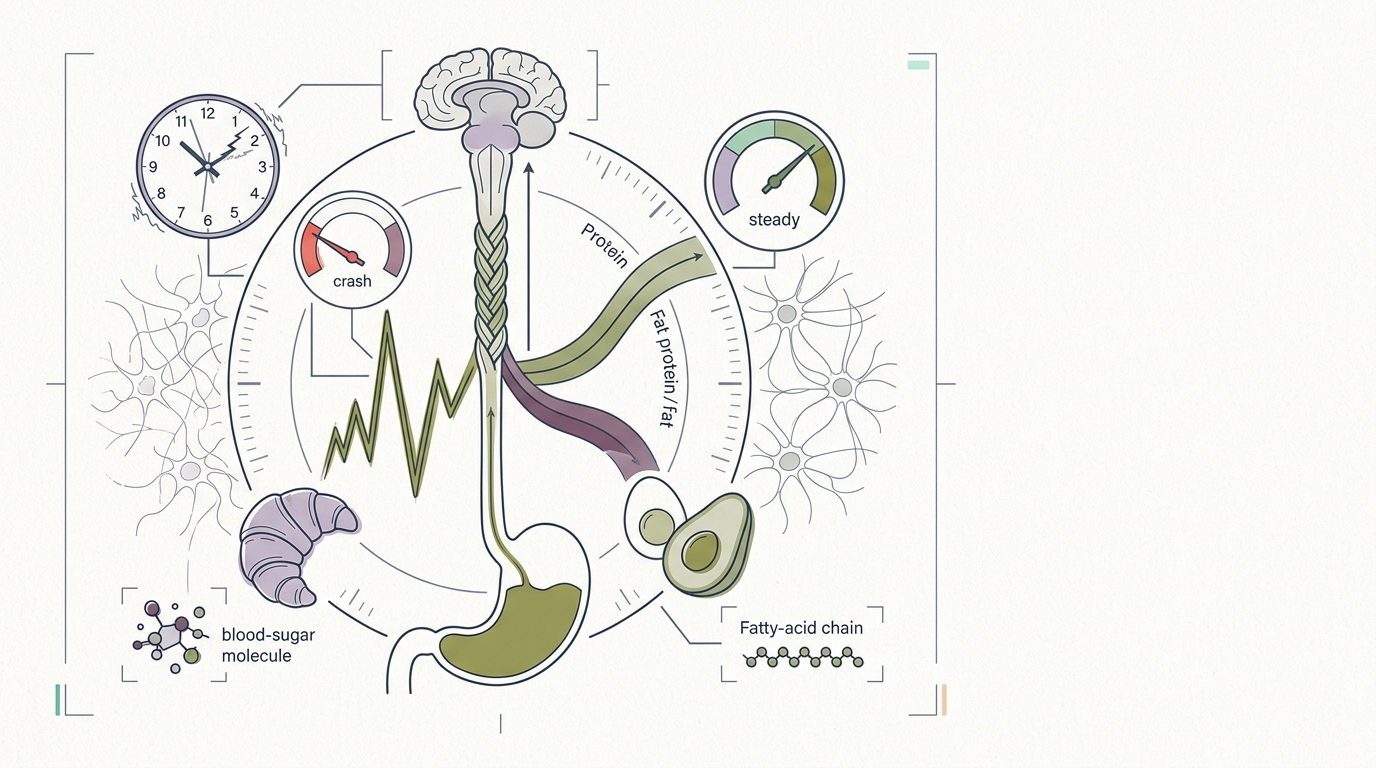
The wellness industry wants you to start the day with a smoothie bowl. That's just dessert in a blender, and eating it at 7am guarantees you'll be fighting your own nervous system by 10:30am. A meal of purely refined carbohydrates triggers a rapid physiological alarm state masquerading as a morning slump. If you want a regulated day, you need protein and fat in your stomach before you look at your inbox.
You already know what this metabolic crash feels like. It hits mid-morning. You're sitting at your desk, and suddenly the jaw won't unclench. You stare at an email you've read three times but the words aren't registering. You experience sudden brain fog after eating that quick pastry, and the only logical solution seems to be a second coffee. But that coffee doesn't land. Instead of focus, it just makes your heart race. By 3pm, you feel anxious for no reason, pacing to the kitchen to open a fridge when there's no actual hunger. Your system is exhausted but can't rest, vibrating with a tense, brittle energy. You assume it's just a stressful Tuesday. That physical tension operates as an autonomic shift, a chemical panic button pressed by a plunging blood sugar curve.
Common Questions
What if I don't have an appetite in the morning?
A lack of morning appetite often points to a disrupted cortisol rhythm. If your cortisol sits too low when it should peak, forcing a heavy meal feels awful. Start with something small. Two hard-boiled eggs or a scoop of high-quality protein powder in water sends the necessary metabolic signal without overwhelming your digestion.
Does dietary fat cause sluggishness?
Processed fats combined with refined sugars cause that heavy, lethargic feeling. Dietary fats from avocados, olive oil, and eggs are required for hormone production and slowing down gastric emptying. They provide a steady release of energy and prevent the sharp blood glucose spikes that actually drive mid-morning fatigue.
How much protein do I actually need?
The clinical target for metabolic stability sits right around 30g of protein. Hitting this number slows digestion enough to anchor your blood sugar curve. That looks like three whole eggs with a side of turkey, or a 200g serving of plain, full-fat Greek yoghurt with pumpkin seeds.
The cortisol curve and the glucose spike
The supplement aisle treats cortisol like a poison Kokorology have to eradicate. Cortisol functions primarily as an arousal chemical. Your body produces a surge of it right before you wake up—the Cortisol Awakening Response (CAR)—to pull you out of sleep and prepare you for daylight. This spike operates as a normal, healthy mobilisation of resources. The trouble begins when you drop a massive hit of glucose into an already elevated system.
When you eat a bagel or a sweetened oat bar, you flood your bloodstream with sugar. The body perceives this sudden volume as an emergency and dumps insulin to clear it out. That metabolic overcorrection drops your blood sugar rapidly, throwing your physiology off balance before the workday has even started.
The hypoglycaemic threat state
Your nervous system doesn't know the difference between a physical predator and a blood sugar crash. When glucose drops too fast, the brain senses a direct threat to its fuel supply. It triggers the HPA axis—the communication loop connecting your brain to your adrenal glands—to release a second wave of cortisol and adrenaline. The biological goal is to force stored glucose back into the blood.
Now you're dealing with your natural morning cortisol, plus a massive hit of emergency adrenaline, all before your first meeting. That jittery, irritable sensation operates as a direct survival protocol. Your prefrontal load capacity shrinks. You snap at a colleague. You can't regulate your frustration. Before you seek out coaching for stress management, stabilise the physical baseline.
Gastric emptying as an autonomic lever
If you want to control the output, change the inputs. Swapping cereal for eggs and avocado acts as a direct intervention on your nervous system.
The inbox has never once been impressed by your heart rate.
Protein and fat physically slow down gastric emptying, the speed at which food exits the stomach. When digestion slows, the breakdown of any accompanying carbohydrates slows with it. You eliminate the glucose spike, which prevents the reactive insulin surge, which cleanly stops the adrenaline crash.
The gut and brain also communicate constantly via the vagus nerve. Stable, slow digestion sends a sustained safety signal upward to the brainstem, supporting healthy interoception. You remain in a regulated state, holding the capacity to navigate a difficult conversation because your internal machinery isn't screaming about a famine.
Tyrosine, tryptophan, and the raw materials of regulation
Most morning routines completely ignore the biological reality of how the brain works. Your nervous system runs on chemical messengers, and it manufactures them directly from amino acids.
Tyrosine serves as the precursor to dopamine and noradrenaline. These chemicals govern drive, focus, and reward-seeking behaviour. Tryptophan is required to synthesise serotonin, the neurotransmitter most closely tied to emotional flexibility and feeling secure in your environment.
If you eat a piece of toast, you give the system zero raw materials to produce these chemicals. A high-protein breakfast delivers 30g of these exact inputs right as the day begins. I've stopped recommending complex morning breathwork to people who chronically under-eat protein. Fix the nutrient inputs first.
The empty-stomach caffeine penalty
I used to drink a double espresso before I had a drop of water or a single bite of food. I thought it made me sharp. I was wrong.
Caffeine works by blocking adenosine, the chemical that makes you sleepy, but it also stimulates the adrenal glands. Pouring coffee into an empty stomach accelerates cortisol release and heightens the autonomic response. If you're already in a fasted, low-blood-sugar state, that espresso simply amplifies your background anxiety.
Drinking your coffee alongside or immediately after a meal of fat and protein blunts this effect. The food slows the absorption of caffeine, stretching out its half-life and giving you a cleaner, longer period of focus without the nervous system tax.
What to do this week
- Track your morning hunger window. Note exactly what time you wake up and what time you actually feel a physical cue to eat.
- Build a morning anchor that hits a 30g protein target. Try three scrambled eggs with a handful of spinach, cooked in olive oil, for three consecutive days.
- Push your first coffee until after you have swallowed your first bite of food.
Where this fits in the Kokorology system
Understanding how digestion alters your state sits at the core of the Library, where Kokorology break down the biology of regulation. Kokorology track these exact metabolic inputs and their downstream effects on mood inside the Journal. If you're consistently crashing at 3pm, the protocols in the Reset will help you stabilise that daily rhythm.
Closing
You don't need a more positive mindset for your morning meetings. You need a stable blood sugar curve. Fix the breakfast, and watch how much easier it becomes to tolerate the rest of your day.
- Start with the 7-day onramp in the Reset.
- Track your energy dips using the Journal.
- Continue exploring these mechanisms in the free guide.
TL;DR
A sweet, carbohydrate-heavy breakfast forces a rapid blood sugar spike followed by a steep crash. The nervous system interprets this sudden drop as a survival threat, triggering the HPA axis to release cortisol and adrenaline. This chemical alarm state manifests as mid-morning brain fog, irritability, and anxiety. Swapping to a breakfast rich in protein and fat slows gastric emptying, stabilises the glucose curve, and supplies the necessary amino acids to synthesise dopamine and serotonin, proactively keeping your nervous system regulated and resilient.
Sources
- Sinha, R. (2018). The effects of acute stress and glucose metabolism on affect and cognition. Neurobiology of Stress.
- Brennan, I. M. (2012). Gut hormones in the regulation of appetite and body weight. Nature Reviews Endocrinology.
- Morton, R. W. (2018). A systematic review, meta-analysis and meta-regression of the effect of protein supplementation on resistance training-induced gains in muscle mass and strength. British Journal of Sports Medicine.
- Khalsa, S. S. (2018). Interoception and Mental Health: A Roadmap. Biological Psychiatry.