Research
AI can now read the quiet part of your EKG
A standard EKG looks for a heart attack today. AI analysis now reads the accumulated electrical static of chronic stress to forecast your future capacity.
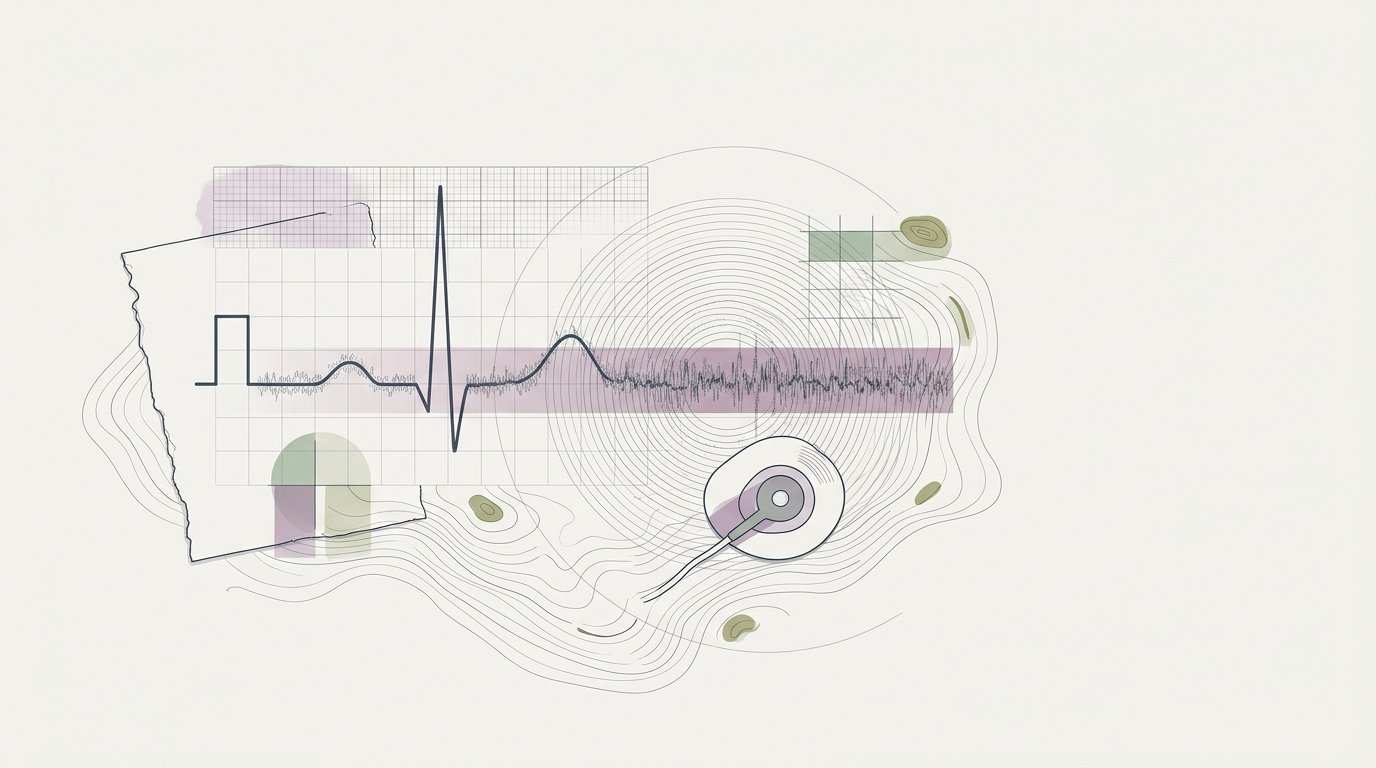
The doctor looks at the printout, smiles, and tells you the EKG is completely normal. The piece of paper says the chest tightness you felt last Tuesday is just anxiety, and you're sent home with the advice to drink less coffee. Standard cardiology doesn't know what to do with stress, treating it as an irritating personality quirk rather than a physiological event. I didn't always know this. I used to believe a clean EKG meant the cardiovascular system was operating perfectly. I was wrong. A standard reading only catches the loud, catastrophic failure of an active heart attack. It entirely misses the quiet, chronic hypervigilance of the autonomic nervous system that actually sets the stage.
You sit on the crinkly exam table in a paper gown, trying to explain the strange flutter you get climbing the metro stairs. You mention the sudden fatigue that hits at 3pm, leaving you staring at your screen with severe brain fog after eating. You tell them you're exhausted but can't rest, staring at the ceiling at 11:47pm. You describe feeling anxious for no reason the moment you finally sit on the couch. The symptom is real. The hum behind your eyes is real. The jaw clench that travels down your neck is real. It's a language the standard ten-second test simply lacks the resolution to read.
The nervous system leaves a signature
Every heartbeat carries a complex electrical pattern. The initial spark drives the main contraction, followed by a recovery wave. In a regulated nervous system, this wave is crisp and consistent. Chronic sympathetic activation jams the accelerator, constantly saturating your tissue in adrenaline and cortisol. That sustained signal changes how electrical impulses travel across your heart muscle. The organ is asked to beat harder, faster, and with fewer nanoseconds of recovery between strikes.
These tiny changes in repolarization and wave timing—measured in microvolts—are completely invisible to the naked eye on a standard pink-grid printout. The human eye scanning a ten-second strip is looking for a massive arrhythmia. An AI model, trained on thousands of variations, catches the subtle static. It reads the entire history of your allostatic load. It detects that the second violins have been a fraction of a semitone flat for the last five years.
From right now to next year
Standard medicine evaluates the EKG as a pass/fail exam for immediate danger. AI analysis turns it into a forecasting tool. It detects the narrowing capacity in your tissues long before the pipe actually clogs.
The inbox hasn't once been impressed by your heart rate.
This matters because a "normal" EKG gives you permission to ignore your body's quieter signals. A high-risk forecast from an AI analysis validates the fatigue and the palpitations. It provides a concrete, measurable output driven by autonomic strain. I've noticed in sessions that clients stop gaslighting themselves the minute they see their stress quantified as a physical metric. The vague sense of overwhelm becomes a specific physiological state they can actually modulate. You don't have to guess anymore.
The algorithm spots the pattern, but the intervention happens in your daily life. It means shifting the inputs that feed the sympathetic loop. The tempo of your day, your exposure to light, the way you breathe, and your sleep staging all determine the electrical environment of the heart. The work is to schedule moments of parasympathetic recovery so that next year's reading looks fundamentally different.
Common Questions
How does AI predict heart risk?
It identifies microscopic variations in your heartbeat's electrical wave over time. These variations correlate with chronic inflammation and autonomic strain, indicating an environment that makes future cardiovascular events more likely.
Why didn't my doctor order this?
This technology is still emerging in clinical settings. The immediate takeaway is that your symptoms are valid data. Your body remains the primary source, so continue to advocate for deeper investigation when things feel off.
Will this just give me more health anxiety?
Anxiety thrives in ambiguity. A vague sense that something is wrong feels infinitely worse than a clear signal telling you to pay attention to a specific system. The goal is moving from reactive worry to proactive regulation.
What to do this week
- Track the 3pm crash. Note exactly what you were doing twenty minutes before your energy flatlined.
- Add a ten-minute transition block after your longest meeting of the day. Sit in a different room and let your vision go soft to signal safety to the brainstem.
- Push your first cup of coffee to 90 minutes after waking to let your natural cortisol rhythm peak first.
- Pay attention to your jaw when you open your email. Unclench it before you click reply.
Where this fits in the Kokorology system
This physiological reality is why I treat regulation as a baseline requirement, not a weekend luxury. You'll explore the mechanics of autonomic strain in the Library, or jump straight into 60-second nervous system interventions using the Hacks. For a structured approach to shifting your cardiovascular risk profile, establish the baseline in Regulation L1.
Closing
Seeing the data is the first step. Changing the electrical signal requires a different set of daily inputs.
- Start with Regulation L1 to establish a baseline of parasympathetic recovery.
- Book 1:1 Coaching to translate your own body's signals and design a practical plan.
- Practice daily micro-interventions inside the Hacks.
TL;DR
A standard EKG often misses the subtle, long-term electrical patterns that signal future cardiovascular risk. New AI tools analyze these microscopic variations, translating years of autonomic strain and chronic hypervigilance into a quantifiable risk score. This technology shifts cardiology from documenting emergencies to forecasting capacity. It proves that the faint signals your body sends—the ones often dismissed as just stress—are readable, physical, and actionable long before an active crisis hits.
Sources
- Slomka, P.J., Dey, D., et al. (2023). Artificial intelligence-based ECG analysis for the prediction of 1-year mortality in patients with suspected or known coronary artery disease. European Heart Journal, 44(25), 2326–2336.
- Rosengren, A., et al. (2004). Association of psychosocial risk factors with risk of acute myocardial infarction in 11,119 cases and 13,648 controls from 52 countries (the INTERHEART study). The Lancet, 364(9438), 953–962.
- Chandola, T., Brunner, E., & Marmot, M. (2008). Work stress and coronary heart disease: what are the mechanisms?. European Heart Journal, 29(5), 640–648.