Nervous System Science
The Unseen Cost: How UI/UX Design Rewires Your Nervous System
We explore the hidden impact of the ui ux nervous system connection, arguing for interfaces that prioritise regulation over relentless engagement.
The Unseen Cost: How UI/UX Design Rewires Your Nervous System
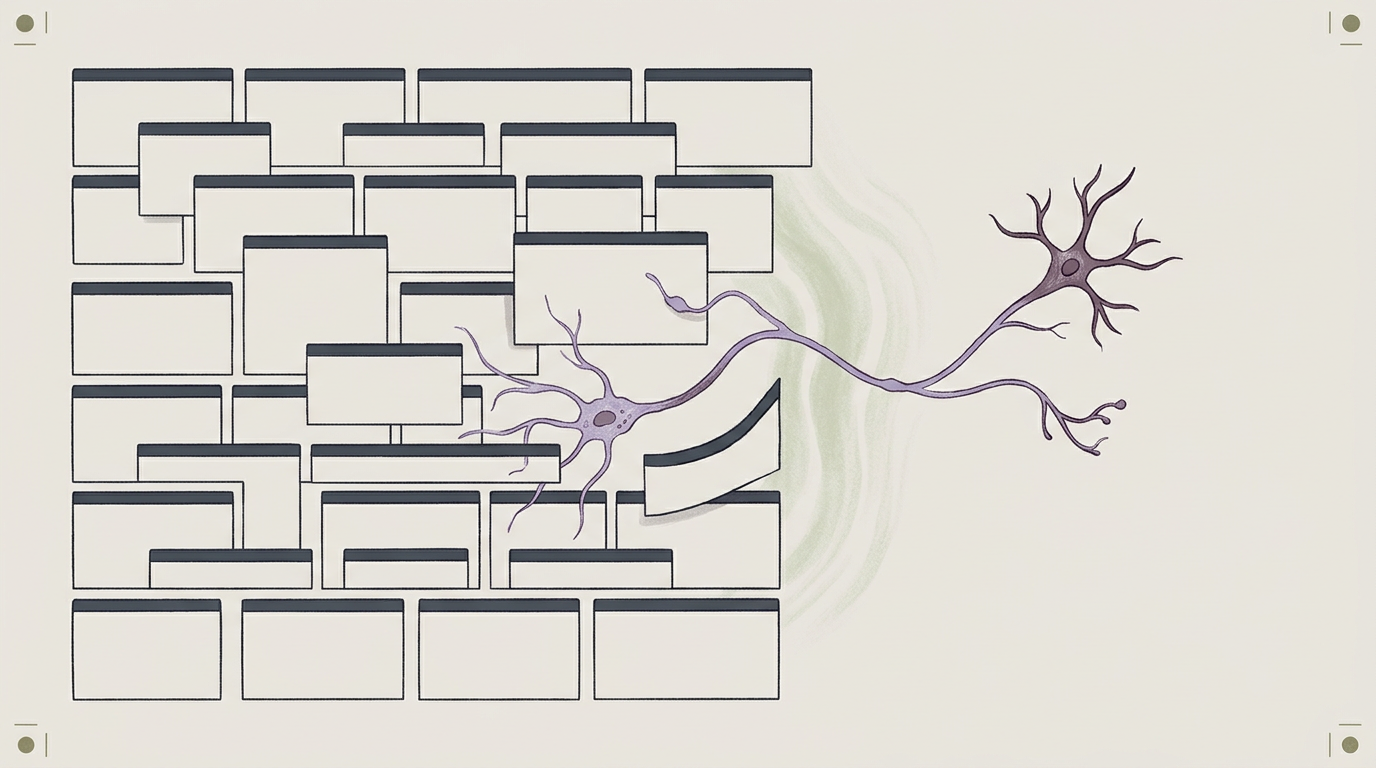
Standard user interface and user experience (UI/UX) design often dysregulates the human nervous system by exploiting biological reward pathways to maximise engagement. This constant stimulation can entrench patterns of sympathetic activation and deplete our capacity for calm, present awareness. The result is an entire digital architecture built on a flawed premise: that a user's attention is a resource to be extracted, with little regard for the biological cost. Understanding the link between the ui ux and the nervous system is the first step toward reclaiming our internal stability.
For a generation raised inside these interfaces, this is not an abstract problem. It is the texture of daily life. The infinite scroll, the carefully cadenced notifications, the pull-to-refresh mechanism—each is a micro-dose of stimulation engineered to keep you hooked. These are not neutral design choices. They are decisions that have profound consequences for our neurology, shaping our ability to focus, to connect with others, and to simply be at rest in our own bodies.
Through the lens of Polyvagal Theory, we can see this clearly. Most digital platforms are designed to provoke a sympathetic nervous system response (the biological state of mobilisation, often called 'fight-or-flight'). The constant alerts and unpredictable rewards keep us in a low-grade state of vigilance and seeking. When this becomes overwhelming, we may collapse into a dorsal vagal state (a biological state of shutdown and disconnection), endlessly scrolling with a feeling of numbness. The coveted ventral vagal state, which governs feelings of safety, connection, and social engagement, is rarely supported by these environments.
The Neurology of Engagement Metrics
The modern attention economy is built on the predictable exploitation of our brain's dopamine pathways. Dopamine is a neurotransmitter associated with motivation and reward. Interfaces use variable reward schedules—the same technique used in slot machines—to keep us checking for new likes, messages, or updates. This creates a compulsive loop of seeking behaviour, keeping the sympathetic nervous system on high alert. You are not weak-willed; you are contending with a system designed to bypass your conscious intent.
This constant switching between apps, tasks, and notifications also carries a hidden cognitive price. Research on task-switching highlights a phenomenon known as attention residue, where thoughts about a previous task linger and interfere with your focus on the current one (Iqbal & Bailey, 2007). Each time you glance at a notification, a fragment of your attention is left behind. Over a day, this fragmentation contributes to a pervasive sense of being scattered and mentally taxed, lowering your heart rate variability (HRV), a key biomarker of nervous system resilience and your body's capacity to adapt to stress.
The cost of a frictionless interface is often a high-friction internal state.
The stated goal is to make technology "seamless". Yet this seamlessness often serves the platform, not the person. It removes the natural pauses that would otherwise allow your nervous system to down-regulate. There is no end, no completion cue, no built-in moment to pause and check in with your internal state. The true friction is simply transferred from the screen into your body.
From Dark Patterns to Wellness Burnout
Beyond simple engagement loops, many interfaces employ "dark patterns". These are design tricks that intentionally mislead you into doing things you might not otherwise do, such as signing up for recurring subscriptions or sharing more data than you intend. From a nervous system perspective, these encounters are deeply unsettling. They erode the sense of safety and trust required for the ventral vagal complex to remain online, pushing us instead toward the defensive states of fight, flight, or freeze.
Ironically, this pattern of over-optimisation has metastasised into the wellness industry itself. The pressure to close activity rings, achieve a perfect sleep score, or maintain a meditation streak can create a new, insidious form of performance anxiety. This has led to the identification of conditions like "orthosomnia", where the obsessive quest for perfect sleep metrics, driven by sleep-tracking apps, paradoxically worsens sleep quality and induces anxiety (Baron et al., 2017).
When the tools meant to support our wellbeing become another source of pressure, we enter a state of wellness burnout. The body does not differentiate between performance stress from work and performance stress from a wellness app. To the nervous system, chronic, low-grade activation is simply chronic, low-grade activation. It depletes our adaptive capacity all the same.
A New Metric for the UI UX Nervous System Connection
What if we measured design success differently? Instead of tracking clicks, conversions, and time on-site, what if the primary metric was the state of the user's nervous system? A nervous-system-literate design philosophy, sometimes called "calm technology," would prioritise regulation over engagement.
This means designing for disengagement. It could involve introducing intentional friction, such as an extra confirmation step before opening a distracting app. It might mean designing feeds that have a clear end, providing a powerful psychological cue of completion. It would favour interfaces that are quiet, predictable, and that default to closed, rather than endlessly open. The goal is not to punish the user, but to create space for conscious choice, allowing the prefrontal cortex to override the dopamine-driven impulse of the lower brain.
Ultimately, this comes down to supporting interoception—the ability to sense and interpret internal bodily signals. According to recent research, strong interoceptive awareness is foundational to emotional regulation and mental health (Khalsa et al., 2018). Current interface design actively dulls our interoception, pulling our awareness outward and away from the body. A regenerative interface would do the opposite. The most important question a designer could ask is: does our user leave this experience feeling more connected to themselves, or less?
Common Questions
What are the first signs my tech use is dysregulating my nervous system?
Look for persistent low-level irritability, a fragmented attention span, or a feeling of being "on" even during rest. Physical signs can include shallow breathing, unexplained muscle tension, digestive upset, and difficulty falling or staying asleep. A key indicator is feeling an urgent need to check your device without a clear reason.
Can "calm technology" actually help improve my resilience?
Yes. By intentionally reducing stimuli and providing clear boundaries, calm technology creates opportunities for your nervous system to return to a ventral vagal state of rest. These small moments of regulation, repeated over time, build greater capacity and resilience, making you less susceptible to being pulled into sympathetic or dorsal states.
Is the goal to stop using digital devices entirely?
Not at all. The aim is to cultivate conscious engagement. It is about shifting from being passively used by technology to actively using it in a way that aligns with and supports your biological health. This involves establishing firm boundaries and making intentional choices about which interfaces you allow into your life.
TL;DR
Current UI/UX design, driven by the attention economy, actively dysregulates our nervous systems by creating dopamine loops and constant sympathetic activation. This erodes our focus, sleep, and internal awareness (interoception). A nervous-system-literate approach—calm technology—would prioritise user regulation over engagement, using friction and completion cues to help us disconnect. The ultimate goal is for a user to leave an interface feeling more settled and embodied, not more fragmented and scattered.
A Weekly Digital Regulation Protocol
This is not about finding the right app; it is about cultivating your internal awareness. Use the digital world as a practice ground for interoception.
- Sense the Impulse. Before you pick up your phone, pause. Place a hand on your chest or belly. What are you feeling? Boredom, anxiety, loneliness? Name the sensation or emotion. This single act re-introduces choice.
- Curate Your Inputs. Turn off all notifications except for those from other humans (e.g., calls or direct messages). The buzz of an automated alert is a direct sympathetic trigger. Let your own rhythm, not an algorithm's, dictate when you check for information.
- Practise Completion. When you finish a task, consciously close the tab or app. Take one breath. This small ritual signals to your nervous system that the seeking/doing cycle is over, allowing it to down-regulate.
- Schedule White Space. Block 15–20 minutes in your calendar each day for "Input-Free Time". No screens, no podcasts, no books. Simply sit or walk and let your attention rest on your breath or your physical surroundings.
- Embrace Friction. Delete one app that consistently leaves you feeling drained, agitated, or empty. Notice the space it leaves behind. If you must use a distracting platform, use it through the slower mobile web browser, not the optimised app.
Where to take this next inside Kokorology
Recognising the impact of technology on your nervous system is a critical insight. While the architecture of the digital world is a systemic issue, you can absolutely increase your own capacity to navigate it with stability and presence. This work is about building a robust internal sense of safety that is not dependent on external conditions.
Our somatic approach at Kokorology provides the tools to do just that. We guide you in learning the language of your own nervous system, developing the interoceptive skills to notice when you are being pulled off-centre, and building the resilience to return to a state of regulation.
To explore this work in a structured container, investigate our Anchor programmes. For direct, personalised support in mapping your own patterns and building capacity, learn more about our 1:1 somatic coaching.
To begin this practice today, download our free regulation guide.