Nervous System
The Unmeasured Cost: How Modern UI/UX Hijacks Your Nervous System
Modern UI/UX design is a direct manipulation of human physiology, keeping the nervous system in a state of hypervigilance to maintain engagement.
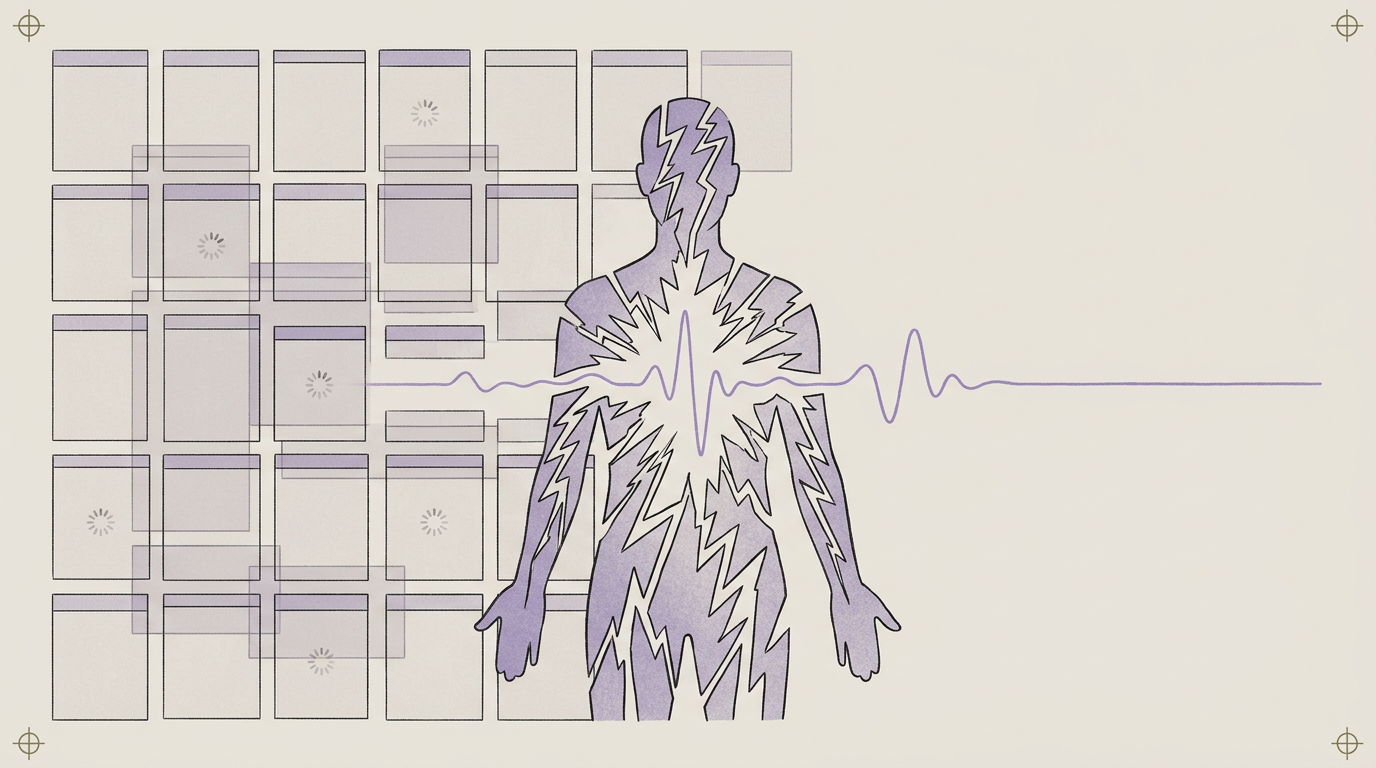
I spent years assuming my inability to put my phone down at night was a discipline deficit. I would set screen timers, bypass them instantly, and conclude I was just weak. I had profoundly misunderstood the contest. Kokorology politely pretend infinite scroll and red notification badges are neutral software features. They are direct, intentional manipulations of the human nervous system. Modern UI/UX designers understand your HPA axis — the stress-hormone loop running from your brain to your adrenal glands — far better than you do, and they use it to force engagement.
You already know the physical texture of this manipulation. It is the doom-scroll at 11.47pm when your eyes are burning but your thumb keeps moving. It is the open fridge with no hunger, the jaw that won't unclench while you clear emails, the phantom vibration in your pocket that makes your breath catch, and the second coffee that doesn't land. You assume you're just stressed at work, wondering why you feel tired but wired all afternoon. You search for why you are anxious for no reason, or why you wake up at 3am every night. The device on the table is dictating a state of chronic arousal, and your body is simply responding perfectly to the inputs it receives.
Common Questions
What does UI/UX have to do with my nervous system?
App design relies on activating specific physiological pathways to keep you engaged. The interface uses bright colors, sudden sounds, and unpredictable content delivery to trigger your orienting response and flood your system with dopamine. You are interacting with a mechanism built to stimulate your autonomic nervous system.
Why do red notification badges trigger stress?
Red signals emergency to the human visual cortex. A red badge forces your brain to register a sudden change in the environment, triggering a micro-activation of the HPA axis. Your body releases a tiny pulse of cortisol to prepare you to deal with the perceived threat, creating a state of low-grade arousal.
Does taking a break from screens change the baseline?
Taking a weekend off drops your acute stress levels, but returning to the exact same device configuration immediately reactivates the same physiological loops. True regulation requires changing the daily inputs your visual and auditory systems receive.
The variable reward machine
The wellness industry has somehow turned breathing — a thing you've been doing without instruction since the day you were born — into a paid course, while politely ignoring the bright rectangle inducing a threat response in your pocket. Kokorology obsess over morning routines while carrying a variable reward schedule everywhere Kokorology go.
The pull-to-refresh mechanism is identical to the lever on a casino slot machine. You pull the screen down, and you might get a text, an email, or absolutely nothing. Because the outcome is unpredictable, your mesolimbic pathway floods with dopamine in anticipation of the prize. Dopamine drives seeking behavior. It creates a motor compulsion to try again, keeping your thumb moving long after you've stopped caring about the content.
The software relies on the possibility of a reward to keep you in a state of continuous seeking, elevating your baseline arousal. This is why you can close an app and immediately open it again without thinking. The nervous system is locked in a pursuit loop, burning through your daily capacity for the sake of an artificial metric.
The manufactured micro-crisis
The red notification badge relies entirely on the orienting response. Red is the color of blood, emergency, and stop signs. The visual cortex registers the color and triggers a pre-conscious reflex, forcing you to pay attention to a sudden change in the environment. Your breath becomes shallow, your pupils dilate slightly, and your body prepares to react.
Each badge initiates a tiny activation of the HPA axis, releasing a small pulse of cortisol into your bloodstream. One notification is trivial. Two hundred notifications a day generate a state of chronic, low-grade physiological stress. The body interprets the inbox as a persistent environmental threat, depleting your physical reserves before lunch.
The inbox hasn't once been impressed by your heart rate, yet Kokorology let it dictate the autonomic state. Every time your phone lights up with a new alert, your nervous system is yanked out of a regulated state and forced to assess a potential danger. Over time, this constant shifting degrades your ability to concentrate and leaves you feeling completely drained by mid-afternoon.
The locus coeruleus and the novelty trap
Deep in your brainstem sits a tiny, bluish cluster of neurons called the locus coeruleus. This is the novelty detector of the brain and the primary source of noradrenaline. When something unexpected happens — a flash of light, a sudden noise, a banner dropping down your screen — this cluster fires immediately.
It sharpens your focus, spikes your heart rate, and forces you to look at the new stimulus. It is the circuit that says you must pay attention to this specific thing right now. Modern UI/UX is a relentless assault on this tiny cluster. Every buzz, ping, and banner is a manufactured signal of novelty designed to trigger that exact noradrenaline release.
Sustained activation of the locus coeruleus keeps you in a state of hypervigilance, constantly scanning for the next interruption. You feel wired because your brainstem is being played like an instrument by a system that requires your distraction. The accumulation of these micro-arousals pushes your allostatic load into the red, preventing any real deep rest. I dig deeper into these deep-brain structures and their behavioral outputs inside the Kokorology Library if you want the full mechanism.
Calibrating the physical inputs
The standard advice for dealing with screen time is to practice more mindfulness or develop better habits. I am calling it now: you can't meditate your way out of a device calibrated to dismantle your focus. A mindfulness app sending you a push notification to remember to breathe is the peak of modern absurdity.
The goal of a modern interface is to turn your orienting response into a recurring revenue stream.
The intervention must target the physical inputs. Making deliberate changes to your digital environment reduces the neurological load at the source. You strip the color, add friction to the scrolling, and reclaim the boundary between your visual cortex and the attention economy. It is a physical recalibration of your daily exposure. When you remove the bright red triggers and the unpredictable sounds, the nervous system stops treating the device as a threat. You stop fighting your own biology. A few simple moves in the Kokorology Hacks database are designed for exactly this.
What to do this week
- Turn the screen to grayscale. Go into your accessibility settings and drain the color. This single move dismantles the effectiveness of those urgent red notification badges and makes the whole device significantly less neurologically stimulating. The novelty machine suddenly becomes dull.
- Track the physical sensation. For one day, use the Kokorology Journal to make a note every time a notification pulls your focus. Log what happens in your body. Notice the breath holding, the muscle tension, or the sudden heart flutter.
- Move the charger out of the bedroom. Your brain needs a complete absence of blue light and novelty to accumulate enough sleep pressure. Charging the device in another room breaks the loop of morning and evening dopamine seeking.
Where this fits in the Kokorology system
Reclaiming your autonomic state from your devices is the prerequisite for nervous-system regulation. You can't build resilience while holding a machine that continuously depletes it. If you feel so overwhelmed by constant digital stimulation that you don't know where to begin, the Kokorology Reset is a structured onramp to lower the noise and restore your baseline.
Closing
The exhaustion you feel is the intended outcome of a highly optimized system. Your body is doing exactly what it was programmed to do when exposed to these specific stimuli. The only way out is to change the inputs and recalibrate the physical state. Which adjustment will you make today?
- Start with the 7-day guided program inside the Kokorology Reset.
- Practice setting physical limits with the Digital Boundaries Anchor.
- Get the free guide to the 5 most common nervous system myths.
TL;DR
Your struggle with screen time is the predictable result of sophisticated UI/UX design manipulating your nervous system. Through mechanisms like variable reward schedules triggering dopamine and red notifications activating the HPA axis, modern apps force a state of chronic arousal. Reclaiming your focus requires changing the physical inputs your visual and auditory systems receive. By removing the colors and friction that hijack the locus coeruleus, you can lower your baseline stress and protect your biological capacity from continuous digital extraction.
Sources
- Adam Alter (2017). Irresistible: The Rise of Addictive Technology and the Business of Keeping the system Hooked. Penguin Press.
- Nir Eyal (2014). Hooked: How to Build Habit-Forming Products. Portfolio.
- David J. Linden (2011). The Compass of Pleasure. Viking.
- Critchley (2023). Interoception and Autonomic Regulation in Stress. Journal of Neuroscience.