Nervous System
The Rise of Orthosomnia: When Your Sleep Tracker Keeps You Awake
Orthosomnia is a clinically recognized condition where obsessively tracking your sleep metrics creates the exact hypervigilance keeping you awake.
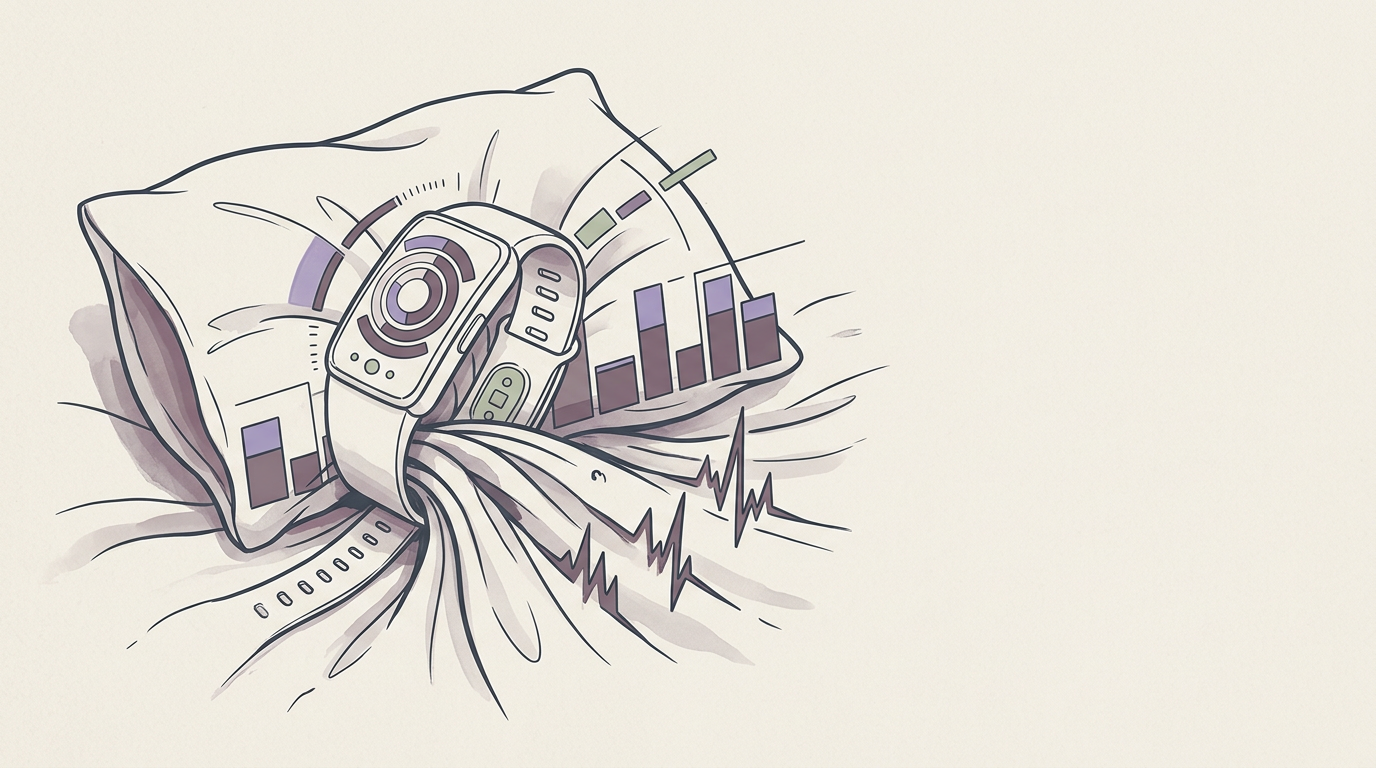
The locus coeruleus does not care how much you paid for your sleep tracker. The standard wisdom says you can't improve what you don't measure, so Kokorology strap sensors to the wrists to conquer the fatigue. That assumes sleep is a productivity target to be dominated. Rest is actually an autonomic surrender. Treating it as a metric guarantees you stay awake, because the brain perceives constant monitoring as an active threat. This loop of data-induced panic has a clinical name: orthosomnia.
You lie there in the dark, absolutely still, calculating exactly how many hours remain before the alarm goes off. The jaw is clamped shut. You are exhausted but can't rest, your mind scrolling through tomorrow's calendar while your body feels like a vibrating phone on a wooden table. You bought the ring or the watch because you wake up at 3am every night and wanted answers. Now, the first thing you feel in the morning is a spike of dread before you even open the app to see the score. You're caught in a state of being tired but wired, lying entirely motionless while your nervous system runs sprints in the background.
Common Questions
What is orthosomnia?
Orthosomnia is a form of anxiety and sleep disruption caused directly by the obsessive pursuit of perfect sleep metrics. People become so fixated on the data from their wearables that the stress of tracking degrades the very rest they are trying to improve.
Why does tracking my sleep make it worse?
Monitoring yourself for a score requires hypervigilance. That alertness activates your sympathetic nervous system, shifting your body into a defensive state. Deep rest requires a perception of safety, and your brain treats a pending grade as an active threat.
Should I take my sleep tracker off?
Some people can use wearable data periodically to spot broad trends, like how alcohol affects their overnight heart rate. If checking your morning score dictates your mood or makes you anxious at bedtime, the device is actively harming your regulation. Take it off.
The Biology of the Observer Effect
Optimization culture insists that every bodily function requires a dashboard. I used to believe that more data always meant better decisions, tracking my own sleep stages with religious intensity for a year. I would wake up feeling completely fine, check my wrist, see a terrible score, and immediately feel a wave of fatigue wash over me. I was outsourcing my interoception—the internal perception of my physical state—to a bluetooth device.
The brain network responsible for monitoring your environment for danger is highly sensitive to stakes. When you attach a metric to your sleep, you automatically raise the stakes. The locus coeruleus, a small nucleus in the brainstem, regulates arousal and panic. It constantly scans for anything that matters enough to keep you alive. When it detects that you are failing at your goal of falling asleep, it dumps noradrenaline into your bloodstream. Your heart rate climbs. The room suddenly feels too hot. Your breathing gets shallow. The physiological state required to fall asleep vanishes, replaced by the exact neurochemistry of an emergency.
The Sympathetic Drive
Kokorology're approaching the bedroom as just another gym floor. Kokorology want to hit the physical macros, secure a personal best, and log the 90 minutes of deep sleep.
But sleep staging relies on an autonomic shift. The transition from light sleep into deep, slow-wave repair requires the sympathetic nervous system to stand down entirely. Threat detection must drop. You can't achieve profound physiological safety while part of your brain is busy performing for an algorithm. The device on your wrist turns the act of sleeping into a test you might fail.
The anxiety of the tracker fragments your sleep architecture. You wake up slightly more often. Your morning graph correctly identifies that you slept poorly, which confirms your anxiety and guarantees you'll try even harder to perform tonight. The wellness industry has somehow convinced the system that the inability to power down is best solved by wearing a tiny, glowing computer to bed. It's a loop of manufactured distress, garnished with a monthly subscription fee.
Reclaiming Your Sensory Data
At some point, you have to trust your own body more than the dashboard. If you wake up and feel ready for the day, you're ready for the day. A red bar on a screen does not override your felt reality.
When I work with clients who are stuck in this hypervigilant loop, the first intervention is completely analog. Kokorology remove the tracker for thirty days. The panic in the first week is highly predictable. People feel unmoored without a device telling them how they slept, checking their bare wrists out of habit. But by the third week, the jaw unclenches. The baseline settles. The static clears.
The goal is to move the locus of control back inside your skin. Your body already possesses the most sophisticated threat-detection and recovery machinery on earth. It just needs the environment to quiet down so it can run its automated processes. Monitoring those processes with a laser sensor often just interrupts them. Your nervous system is completely indifferent to your subscription fee; it only cares whether you feel safe.
The Reality of Consumer Sleep Tech
I'm calling it. The obsession with precise sleep staging from wrist wearables is largely a distraction.
Most consumer trackers are guessing at your REM cycles based on movement and peripheral heart rate. They're useful for establishing total duration in bed and perhaps noticing broad temperature trends over a month. They're completely useless for micromanaging your neurochemistry on a Tuesday night.
The body does not respond to a dashboard. It responds to safety cues, rhythm, and release.
If you want to support your autonomic regulation, change the inputs rather than measuring the outputs. Lower the room temperature to 18 degrees. Eat your protein early in the day so your glucose is stable. Let the body do what it has known how to do since the day you were born, without demanding a progress report for the effort. The sleep homeostat—the biological pressure to sleep that builds up while you are awake—operates perfectly well without your conscious oversight. When you override that natural pressure with the cognitive load of worrying about a score, you fight your own biology.
What to do this week
- Take the wearable off for seven nights. Put it in a drawer in another room. The single most effective way to eliminate performance anxiety is to remove the judge.
- Implement a 60-minute analog buffer. No screens, no glowing metrics, no input for an hour before bed. Read a physical book. Let your eyes perceive the dimming environment.
- Dim the overhead lights at 8pm. Switch to low, warm lamps. This provides a direct environmental cue to your nervous system that the day is ending and it is time to shift toward a parasympathetic state.
- Anchor your morning to the sun. Rather than waking up and immediately checking an app to see if you recovered, step outside for ten minutes of natural light.
- Track your felt state, quietly. Use the Journal to note one simple thing: how your body physically feels at 10am. Notice the tension in your shoulders or the clarity behind your eyes. Trust the primary source.
Where this fits in the Kokorology system
Rebuilding a natural relationship with rest is a core part of nervous system regulation. If you're constantly chasing data, you're likely stuck in a sympathetic drive. Kokorology cover the shift from hypervigilance to baseline safety extensively in Nervous System Regulation L1. If you need immediate somatic tools to drop the static before bed, keep the Hacks library queued up for small, 60-second shifts.
Closing
The capacity to rest is already built into your biology. You just have to stop grading it.
- Work with the exact protocols for deep rest inside the Sleep Anchor.
- Continue rebuilding your interoceptive awareness in Performance L2.
- Start charting your actual physical cues with the free regulation guide.
TL;DR
Orthosomnia is a form of anxiety caused by obsessively tracking sleep data through wearable devices. Treating rest as a metric triggers hypervigilance, which activates the sympathetic nervous system and makes deep sleep physiologically impossible. The constant monitoring creates a self-fulfilling cycle of fragmented rest and morning anxiety. The most effective intervention is to remove the tracker entirely, eliminate screen-based performance reviews before bed, and rebuild trust in your body's own interoceptive signals to assess how you actually feel.
Sources
- Critchley (2023). Interoception and Autonomic Regulation in Stress. Journal of Neuroscience.
- Kelly GS (2019). Orthosomnia: are some patients taking the quantified self too far?. Journal of Clinical Sleep Medicine.
- Dijk, D. J., & Czeisler, C. A. (1995). Contribution of the circadian pacemaker and the sleep homeostat to sleep propensity, sleep structure, electroencephalographic slow waves, and sleep spindle activity in humans. The Journal of Neuroscience.
- Vgontzas AN, et al. (2024). Insomnia With Objective Short Sleep Duration and Inflammation in Perimenopausal Women. Sleep.