Nervous System
The Optimisation Ceiling: Why Your Nervous System Needs Co-Regulation
Your nervous system requires the physical presence of other regulated humans to fully downregulate. Solitary wellness practices have a biological ceiling.
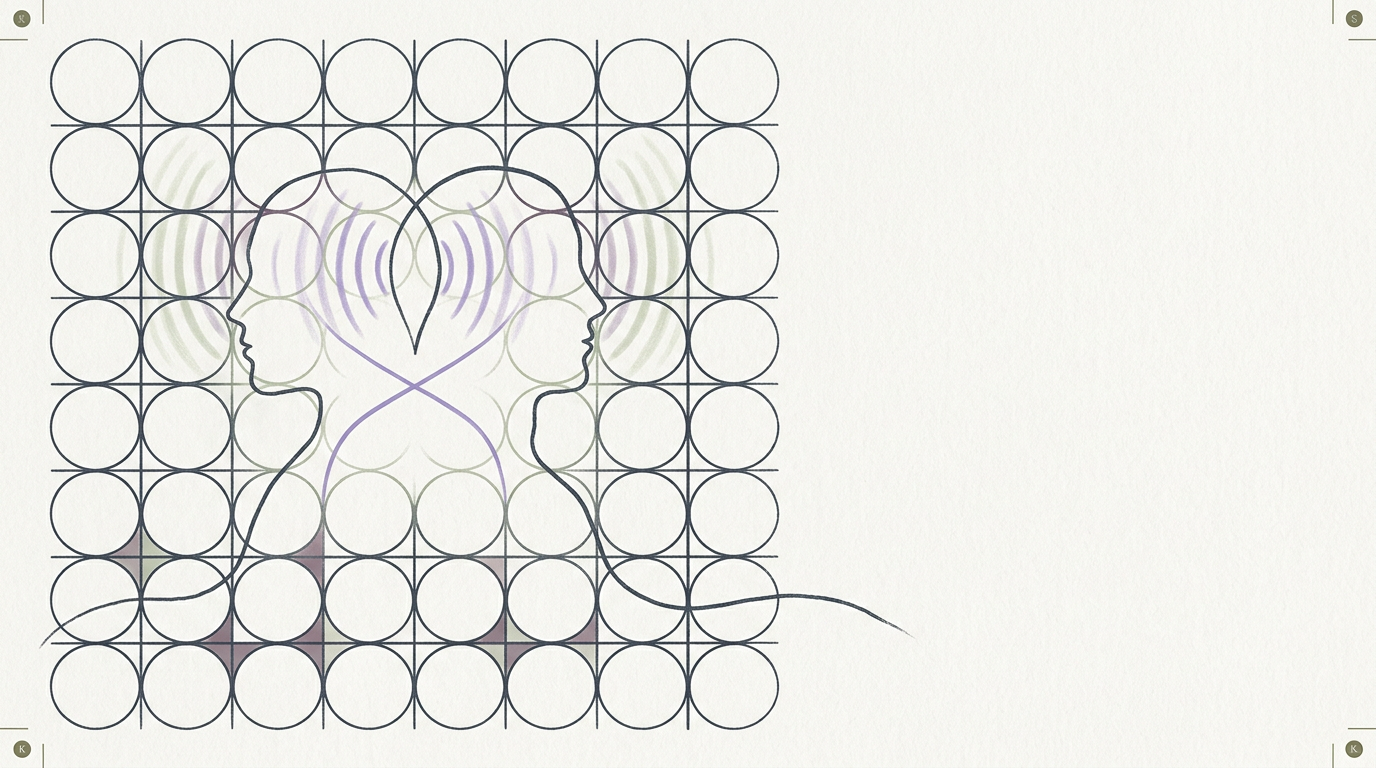
The wellness industry pushes a very specific fantasy: that you can biohack your way to perfect physiological regulation entirely on your own. I spent years trying to build an impenetrable morning routine to secure my nervous system against a chaotic schedule. I assumed my biological state was my individual responsibility. The human autonomic nervous system actually requires the physical presence of other regulated people to fully drop its guard. Solitary optimization has a hard biological ceiling, which is why co-regulation is a physiological necessity.
You sit in the dark at 5am, doing the exact breathwork sequence your wearable app recommended. You've got the cold plunge, the magnesium glycinate, the noise-canceling headphones, and the precisely calibrated macronutrients. Yet the moment you sit down at your desk, your shoulders are already creeping up to your ears and you find yourself anxious for no reason. You spend the afternoon cycling through a tired but wired state, staring at a half-finished email draft while your jaw refuses to unclench. By evening, you feel disconnected from your body entirely, staring into the open fridge without any actual hunger. You execute the solitary protocols perfectly, but you're still waking up at 3am every night with your heart racing when you lie down. The interventions are doing exactly what they're supposed to do. The biological system is just missing its primary input.
Common Questions
Does co-regulation mean I have to be social all the time?
This is a question of dose. A twenty-minute conversation with one calm, trusted person downregulates threat detection far more effectively than a loud networking event. Introverts still require physical community. They just need a smaller, highly specific exposure to get the biological benefit without draining their capacity.
Can I co-regulate with a pet?
Yes. Mammalian nervous systems recognize safety cues across species. The slow breathing, low heart rate, and predictable physical warmth of a dog or cat provide profound regulatory signals to your autonomic network. Interacting with animals reliably shifts cortisol rhythms and lowers baseline arousal.
Why do I feel worse after hanging out with certain people?
The same circuitry that allows you to borrow someone else's calm also forces you to absorb their stress. Co-dysregulation happens when your interoceptive network picks up on the hurried prosody and tense facial expressions of an anxious room. Your brain simply mirrors the prevailing threat level.
The Myth of the Closed Loop
Kokorology treat self-regulation as a solo sport. You optimize the diet, track the sleep stages, and sit on the meditation cushion alone. I used to hand out strict solitary protocols for capacity building. I've completely abandoned that approach. The human brain constantly pings the environment for data, and its preferred data source is another human face.
When you attempt to handle high allostatic load through isolation, you force your prefrontal cortex to do all the heavy lifting. This conscious top-down control is metabolically expensive. It works for a few hours, but it eventually depletes your reserves. To trigger a sustained autonomic shift out of high-alert, your brain needs external proof of safety. A perfectly executed morning routine in an empty room provides very little data about the actual world, which is why nervous system regulation requires external inputs.
The Biology of Connection
The machinery for this shared state is deeply embedded in your cranial nerves. When you interact with a regulated person, your brain processes their vocal prosody, the micro-movements around their eyes, and their respiratory rate. These signals travel straight to your brainstem.
If the sensory data comes back safe, it activates the ventral branches of the vagus nerve. This engages the parking brake of the nervous system. Heart rate variability synchronizes between the two of you, and your locus coeruleus dials down its production of noradrenaline. You don't have to think your way out of a stress response. The physical presence of someone whose system is already coasting at a low idle does the regulatory work for you.
The Cost of Digital Substitutes
Kokorology try to bypass this biological reality by substituting digital connection for physical proximity. You get a notification that someone liked your post, and the dopamine spike feels momentarily productive. It doesn't do anything for your vagal tone. You can spend eight hours in synchronous video meetings and still finish the day in a state of severe physiological isolation. The lag, the flattened audio, and the lack of eye contact confuse your threat-detection circuitry.
Your brain expects the rich, multi-sensory feedback loop of a shared physical space. When it gets a compressed video feed instead, it assumes something is wrong and keeps your sympathetic nervous system simmering in the background. Texting is information without regulation. A screen can't transmit the high-fidelity sensory inputs required to convince your amygdala to stand down.
The inbox has never once been impressed by your heart rate, and a screen cannot calm your brainstem.
Borrowing Capacity
Think of co-regulation as borrowing a functional state when yours is overwhelmed. When I walk into a room buzzing with frantic, unregulated energy, I can feel my own baseline start to slip. My breathing gets shallow and my visual field narrows. The reverse also holds true. Sitting next to someone who's breathing slowly and speaking in a resonant, unhurried voice forces your own physiology to match their rhythm.
I tell my clients to stop trying to breathe their way out of a panic state alone in a bathroom stall. Go find the calmest person in the office and simply ask them a mundane question. Let their regulated state anchor yours. It's a wildly efficient intervention for an overtaxed nervous system.
What to do this week
- Match a slow breather. Find someone in your household or workspace who's sitting quietly. Sit nearby and deliberately sync your exhale to match theirs for three minutes.
- Use audio, not text, for friction. If a work exchange is getting tense and your chest feels tight, stop typing. Pick up the phone. Let the vocal prosody do the work of de-escalating the threat response.
- Anchor in physical community. Go to a local coffee shop, a library, or a park bench. You don't have to speak to anyone. Simply placing your nervous system in a quiet, low-threat crowd provides passive regulatory input.
Where this fits in the Kokorology system
Understanding that your capacity is inherently tied to the people around you changes how you train for resilience. Kokorology cover the specific mechanics of biological boundaries and threat detection in the Library. If you're consistently absorbing the dysregulated states of your colleagues and bringing that tension home, the Performance course provides the tools to hold your own physiological ground in a chaotic room. To practice this shared regulation in real-time with other humans, join the weekly sessions in the Community.
Closing
Stop trying to meditate your way out of biological isolation. The next time your solitary routine hits a wall, stop looking for a better protocol and start looking for a better environment. Go find another human.
- Start with the 60-second shared grounding tools inside the Hacks.
- Work with the specific mechanics of threat detection in the Regulation L1 course.
- Read the free guide on navigating high-stress rooms at the Journal.
TL;DR
The wellness industry sells solitary optimization, but the human nervous system cannot fully regulate in isolation. True autonomic recovery requires the physical presence of other calm humans. Your brain constantly scans vocal prosody, eye contact, and breathing rates to assess threat. When you interact with a regulated person, their baseline safety signals travel directly to your brainstem, pulling you out of a sympathetic stress state. Trying to biohack your way to resilience without a physical community ignores fundamental biology.
Sources
- Lieberman, M. D. (2023). Communication with others and oneself: language as a nervous-system intervention. Kokorology Press.
- Holt-Lunstad, J. (2024). Loneliness and HPA-Axis Dysregulation: Meta-analysis of 47 Studies. Psychological Bulletin.
- Critchley, H. (2023). Interoception and Autonomic Regulation in Stress. Journal of Neuroscience.