Nervous System
The Cost of a Click: How UI UX Design Impacts Your Nervous System
Current UI UX design actively dysregulates the human nervous system by optimising for metrics that hijack our biology for profit.
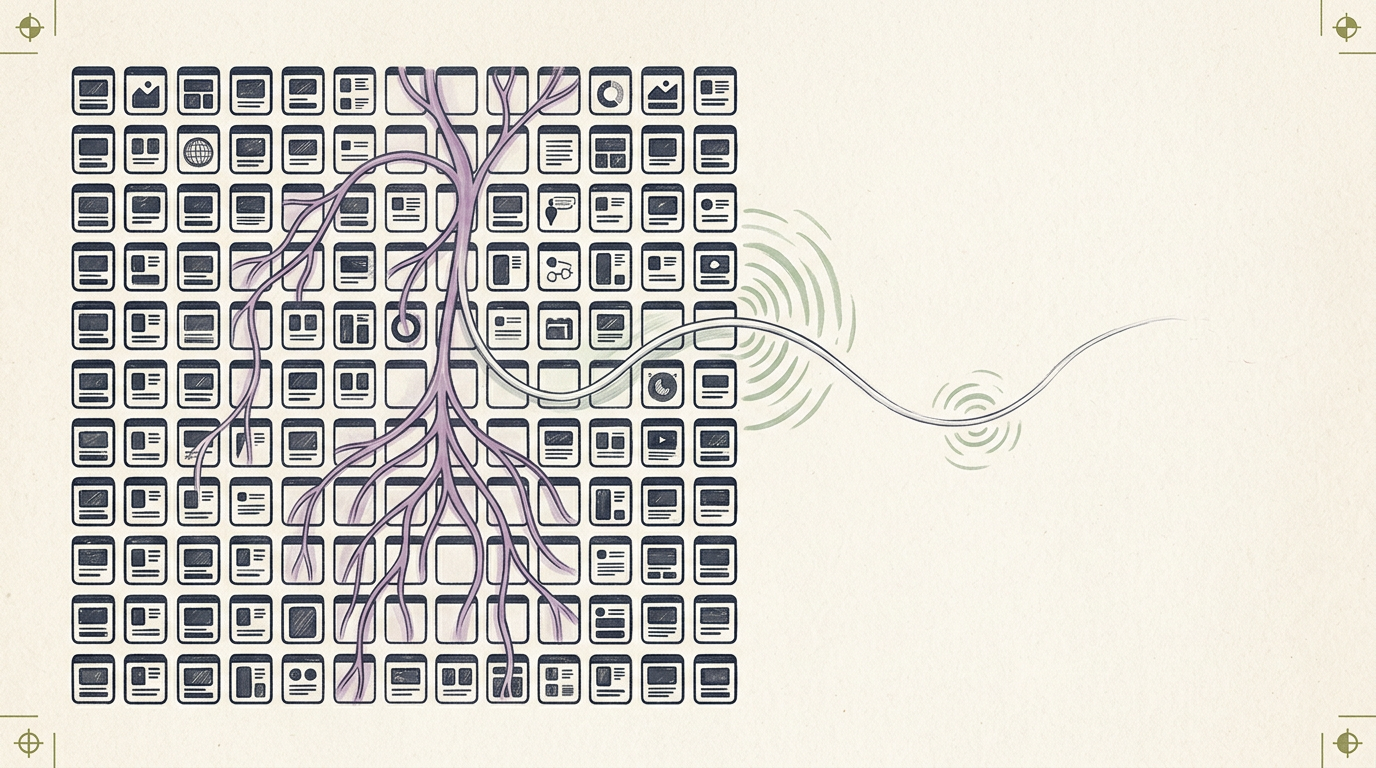
I spent twenty minutes on Tuesday trying to cancel a £12 software subscription, clicking through greyed-out text and deliberate dead ends. Kokorology treat the digital fatigue as a failure of willpower or a lack of discipline around screen time. Every modern interface is actively engineered to spike your autonomic arousal and keep it there. The ui ux nervous system connection operates exactly as intended, serving as the core business model for the attention economy.
You know exactly what this environment does to your body. It's the open fridge at 4pm when you have absolutely zero hunger, hunting for dopamine to offset the afternoon slump. It's that specific, hollow doom-scroll at 11.47pm when you are exhausted but can't rest. You cycle through three browser tabs, close them, and immediately open the exact same three tabs. Your shoulders refuse to drop even when you finally step into a hot shower. You are chronically tired but wired, living with a persistent buzz behind the eyes that makes finishing a single thought feel like wading through wet cement. You search for cures for brain fog, wondering what is wrong with your focus, while holding a device designed by thousands of engineers to ensure you never sustain focus again.
Common Questions
What is attention residue?
Attention residue happens when you switch from one task to another without fully disengaging your focus from the first. Your brain gets stuck processing the previous input. In digital environments built on constant notifications and infinite scrolling, this leaves your cognitive capacity permanently fragmented and your nervous system on edge.
How do dark patterns affect the body?
Dark patterns are deceptive interface designs that trick you into taking unintended actions. They create confusion and frustration, triggering micro-activations of your threat detection system. Repeated exposure trains your body to distrust its own impulses, dulling your internal physical cues and leaving you in a state of agitated resignation.
Why does tracking health data cause stress?
The relentless pursuit of perfect health metrics shifts your focus from internal sensations to external dashboards. Checking a low sleep score first thing in the morning instantly spikes your sympathetic drive. You begin outsourcing your body's signals to an app, degrading your natural ability to sense what you actually need.
The physiological environment of the screen
I used to think putting my phone on "Do Not Disturb" was enough to protect my capacity. I assumed a silent screen automatically created a neutral environment. I was reading this week about how the nervous systems buckle under environmental pressures, while the market races to sell the system tech-driven solutions. The most pervasive environmental pressure is the interface of the solution itself. Every auto-playing video and infinitely refreshing feed is calibrated to demand a biological response.
When you open an app, your body prepares for interaction. Your sympathetic nervous system—the machinery driving alertness and mobilization—ticks upward. A push notification from a food delivery app has never constituted an actual emergency. Your locus coeruleus, a small cluster of neurons in the brainstem acting as your internal alarm system, fires anyway. Repeat this hundreds of times between breakfast and dinner, and your baseline shifts into chronic, low-grade hypervigilance. You're operating in a state of constant threat detection, convinced you're just answering emails. I recommend building a foundation in nervous-system regulation simply to survive navigating the digital world.
Numbness as a biological strategy
Then there is the numb scroll. You know the exact posture: neck bent, eyes glazed, thumb moving in a rhythmic, mechanical sweep. You let the content wash over you purely to drown out the internal static, rather than actively consuming anything.
This is a profound autonomic shift. When you are too stimulated for too long, your nervous system pulls the emergency brake. Your vagal tone—the influence of the vagus nerve on your heart rate and arousal—changes, pushing you out of active engagement and into immobilization. This state mimics relaxation while providing absolutely zero physiological repair. You sit there for an hour, stand up, and feel worse. Having a physical tool, like one of the anchors, breaks this trance and pulls you back into your actual sensory environment.
Dark patterns and the erosion of instinct
The attention economy relies on dark patterns—those labyrinthine design choices manipulating you into actions you never intended to take. The European cookie banner is arguably the most effective tool ever invented for destroying human patience. You want to decline, but the 'reject all' button hides behind three layers of greyed-out menus, while the bright green 'accept' button pulses at you.
This directly assaults your interoception. Interoception is your brain’s ability to perceive the physical condition of your body, from muscle tension to fatigue. When an interface consistently makes it painfully difficult to execute your own choices, it teaches you to ignore your internal impulses. You give up and click the green button just to make the friction stop. Each micro-capitulation registers in the body as helplessness. Over time, you learn that your internal signals simply do not matter here.
Kokorology rely on a digital dashboard to tell the system if Kokorology are tired, ignoring the heavy ache in the own limbs.
The quantified self is just more static
The wellness industry looked at this digital exhaustion and decided the cure was more tracking. Kokorology now wear £300 rings to tell the system if Kokorology've slept. Kokorology quantify the heart rate variability, count the steps, and monitor the exact stages of sleep architecture.
This data deluge creates orthosomnia: an obsessive pursuit of perfect sleep metrics that ironically keeps you awake. Checking your sleep tracker at 6am and seeing a 'poor recovery' score triggers a sympathetic stress response before your feet have even touched the floor. I've stopped recommending these trackers to most clients. The pursuit of perfect data severs the last remaining threads of your interoception. You begin to trust the graph on the screen more than the feeling in your own jaw. If you want to actually change your state in the moment, you are better off using a sixty-second physical intervention from the hacks library than staring at a chart of your own exhaustion. Put the device down.
What to do this week
- Move your phone charger out of the bedroom. The most critical window for your sleep pressure and circadian rhythm is the first thirty minutes after waking. Protect that time from screen exposure entirely.
- Turn the interface greyscale. The vibrant reds and blues of app icons are specifically engineered to stimulate visual arousal. Strip the colour, and the screen instantly becomes less neurologically demanding.
- Pick one single-purpose device. If you want to read, use an e-reader or a physical book. If you want music, play a record. Remove the possibility of task-switching.
- Schedule intentional friction. Delete your most reflexive app from your home screen so you have to manually search for it. That three-second delay gives your brain enough time to ask if you actually want to open it.
Where this fits in the Kokorology system
Understanding how your environment manipulates your biology is the entry point. The deeper work is rebuilding the capacity to hold your own state regardless of the digital noise around you. Kokorology cover the foundational mechanics of this inside Regulation, the L1 course. If you are navigating chronic overwhelm and need to strip back the digital interference immediately, the structured Reset offers a clear seven-day onramp.
Closing
Your body was not designed to process the entire world's urgency in the palm of your hand. Reclaiming your attention requires changing your physical cues. Start here.
- Start with a tactile, offline tool to interrupt the scroll using the Anchors.
- Work with the foundational mechanisms of your nervous system inside Regulation.
- Continue the daily work of returning to your body with the free guide.
TL;DR
Modern UI UX design actively dysregulates the human nervous system by treating the autonomic arousal as a harvestable resource. Features like infinite scrolling, notification barrages, and deceptive dark patterns intentionally trigger the threat detection systems and push the system into states of hypervigilance or numb immobilization. Over time, this digital environment erodes the interoception—the fundamental ability to feel and respond to the own bodily signals. Reclaiming your capacity requires structural friction and a deliberate return to physical sensation, rather than relying on more wellness tracking to manage the fatigue.
Sources
- Critchley, H. (2023). Interoception and Autonomic Regulation in Stress. Journal of Neuroscience.
- Mark, G., Gonzalez, V. M., & Harris, J. (2005). No Task Left Behind? Examining the Nature of Fragmented Work. Proceedings of the SIGCHI Conference on Human Factors in Computing Systems.
- Yilmaz Balban, M. (2023). Brief Structured Respiration Practices Enhance Mood and Reduce Physiological Arousal. Cell Reports Medicine.
- Kelly, K. G., et al. (2017). Orthosomnia: Are Some Patients Taking the Quantified Self Too Far? Journal of Clinical Sleep Medicine.