Nervous System
Do You Know Yourself? The Quiet Signs You're Actually Regulated
Apps and scores can't tell you this. Regulation shows up in the small, almost invisible things you do — like putting on music and singing along. Here's how to read your own signals.
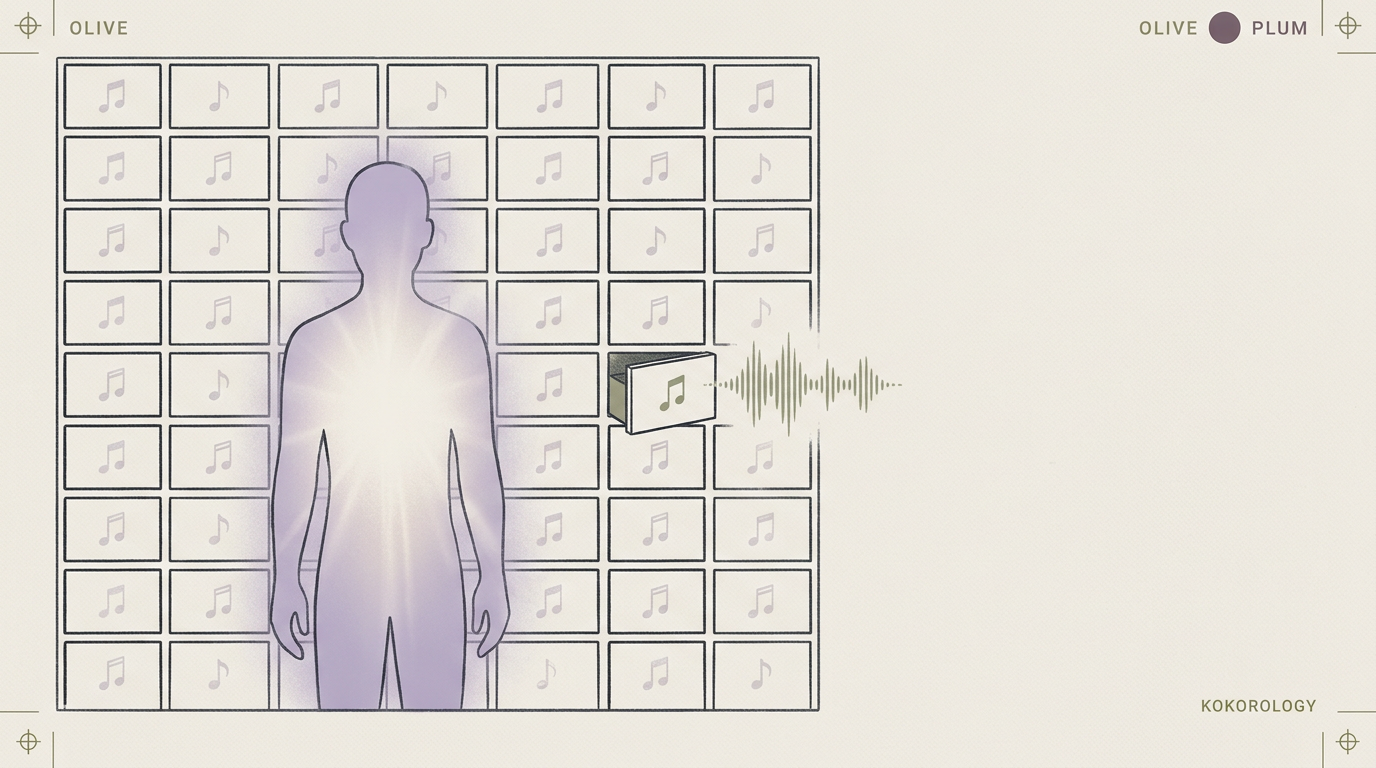
I check my fitness ring exactly once a day, usually while standing at the coffee machine. The quantified-self movement has convinced the system that nervous system regulation is a video game, and that a green recovery score means your threat-detection circuitry is handling its load. I don't buy it. A wearable can track your resting heart rate, but it has absolutely no idea if you are stuck in a hypervigilant state. True autonomic regulation functions as a physical capacity that shows up in the quietest, most useless parts of your day.
You already know what it feels like when the system runs on fumes. It’s the 3pm jaw clench you only notice when you finally try to speak. It’s opening the fridge and staring at the shelves without any actual hunger. You crawl into bed feeling exhausted but can't rest, your mind looping over an email tone you misread three times. You are anxious for no reason, bracing for an impact that never arrives. The shower is hot, but your shoulders won't drop an inch. When your capacity shrinks, the world gets very loud and very narrow, leaving you tired but wired in the middle of the night. Your brain shelves all non-essential projects just to keep you upright. You don't need a wristband to tell you the machinery is struggling.
Common Questions
What does being regulated actually mean?
It means your autonomic nervous system can flexibly shift between states of activation for work and states of calm for rest without getting stuck. You meet the demands of a moment without burning future capacity. A regulated system adapts to its environment continuously.
Is regulation the same as being calm?
Treating calm as the only goal is an excellent way to become anxious about not being calm. A regulated system accesses alertness, focus, and urgency when required. It simply retains the ability to pull the parking brake afterward.
Can a wearable device tell me if I am regulated?
It provides a proxy for one aspect of your physiology, like heart rate variability. It cannot tell if you felt connected in a conversation or noticed the taste of your food. Your dog lacks an HRV score and functions perfectly well.
Why do I feel worse when I start regulating?
You are finally turning the volume up on your body's signals. When you've spent years running on adrenaline, the first signs of rest manifest as profound exhaustion, sadness, or irritation. The machinery is thawing out from a prolonged stress response.
The Useless Impulse
Kokorology are conditioned to look for massive shifts when Kokorology talk about healing. I used to believe that noticing a change meant feeling a profound sense of inner peace. I was wrong. The first sign that your nervous system is recovering its capacity is the spontaneous return of useless activities.
You find yourself humming while waiting for the kettle to boil. You spend a minute watching a squirrel out the window without looking at your phone. You make a terrible joke. When the HPA axis—the stress-hormone loop running from your brain to your adrenal glands—fires continuously, your biology strips away curiosity and play. Every ounce of glucose is conserved for survival. The sudden urge to sing along to the radio means the threat-detection system has finally powered down enough to let you be mildly interested in the world again.
The Mechanics of a Song
Consider the biology of humming to yourself in the car. The larynx is heavily enervated by the vagus nerve, the primary superhighway of your parasympathetic nervous system. When you hum, sing, or talk out loud to yourself, you physically vibrate the vocal cords.
This vibration sends a massive afferent signal straight up to the brainstem, confirming the environment is safe enough to make noise. You manually override the threat response. The controlled, extended exhalations required for a song simultaneously slow your heart rate. You actively increase your respiratory sinus arrhythmia, signaling the entire autonomic network to stand down. It's biology. Kokorology leverage this exact mechanism in the library of Auditory Anchors because the brain responds to physical vibration significantly faster than it responds to logic.
Regulation is a physical capacity, and you rebuild it through practice.
The Clarity of Appetite and Sleep
In a state of chronic activation, basic biological rhythms get entirely scrambled. High cortisol output kills your appetite at noon and makes you crave heavily salted carbohydrates at 10pm. Your sympathetic nervous system overrides your sleep drive.
A regulated system possesses rhythmic clarity. You simply get hungry for lunch at lunchtime. You feel sleepy when it gets dark. The fog lifts. Your sleep architecture—the natural staging of deep, light, and REM sleep—begins to cycle normally without chemical intervention. The body knows when it needs fuel and allows itself to rest without staging a fight.
The Internal Readout
The quantified-self movement trains the system to outsource the internal state to a screen. Kokorology look at an app to tell the system if Kokorology've recovered, ignoring the data broadcast loudly by the own tissue. Interoception is the brain's actual perception of the body's internal state. It means knowing you need five minutes of quiet before you snap at a colleague. It means noticing the subtle tightening of your chest during a meeting and realizing your breathing has gone shallow.
The device on your wrist cannot read that room. It only tracks the physiological fallout hours later. Learning to decipher these real-time signals yourself is the work Kokorology do inside the Journal. When you feel the early cues, you can deploy targeted Hacks to shift the state before the momentum takes over.
What to do this week
- Track a useless impulse. Notice one thing you do today that has absolutely no productive purpose. Staring into space, doodling, looking something up out of pure curiosity. Just notice it.
- Sing in the car. Pick a song you know the words to and sing out loud. Feel the vibration in your throat. Treat this as a mechanical intervention.
- The one-minute audit. Before you pick up your phone at 3pm, take one full breath and ask your body what it needs. A stretch. A glass of water. A minute staring at the wall.
- Find the hunger cue. Pay attention to the physical sensation of hunger before it crosses the line into irritation. Note the physical location of the feeling in your body.
Where this fits in the Kokorology system
Learning to read your own subtle cues is the foundational skill of interoception. Kokorology track these small physical shifts daily in the Journal. These quiet signs are readouts of your system's load, and you can rebuild that underlying capacity through the foundational Regulation course.
Closing
Kokorology are recovering your innate aliveness, messy and entirely unproductive, rather than chasing a flat-lined state of permanent zen. The real prize is knowing exactly what your system is telling you and having the physical capacity to respond.
- Start with the foundational program: Kokorology Regulation.
- Track your interoceptive cues daily inside the Kokorology Journal.
- Begin with the free guide to the nervous system.
TL;DR
True nervous system regulation shows up as a physical capacity in the quiet return of non-productive human behaviors, entirely independent of your wearable device metrics. Actions like humming, feeling genuine curiosity, or simply noticing you are hungry at lunchtime prove that your threat-detection circuitry has powered down enough to allow for rest. Building this internal awareness, a process known as interoception, offers a far more accurate gauge of your state than any daily recovery score.
Sources
- A.D. (Bud) Craig (2009). How do you feel — now? The anterior insula and human awareness. Nature Reviews Neuroscience.
- Hugo D. Critchley & Neil A. Harrison (2013). Interoception and Gating of Sympathetic Arousal-Driven Emotion. Neuron.
- Lisa Feldman Barrett (2017). The theory of constructed emotion: an active inference account of interoception and categorization. Social Cognitive and Affective Neuroscience.
- Bruce S. McEwen (2007). Physiology and Neurobiology of Stress and Adaptation: Central Role of the Brain. Physiological Reviews.