Nervous System
Regulation Is a Spiral, Not a Ladder: Why You're Not Back at Square One
It’s four in the morning, and the old chill is back. Three months ago, this feeling was your default setting: a low hum of dread, a knot in your stomach you could have named a pet. You’ve been doing the work—the breathin
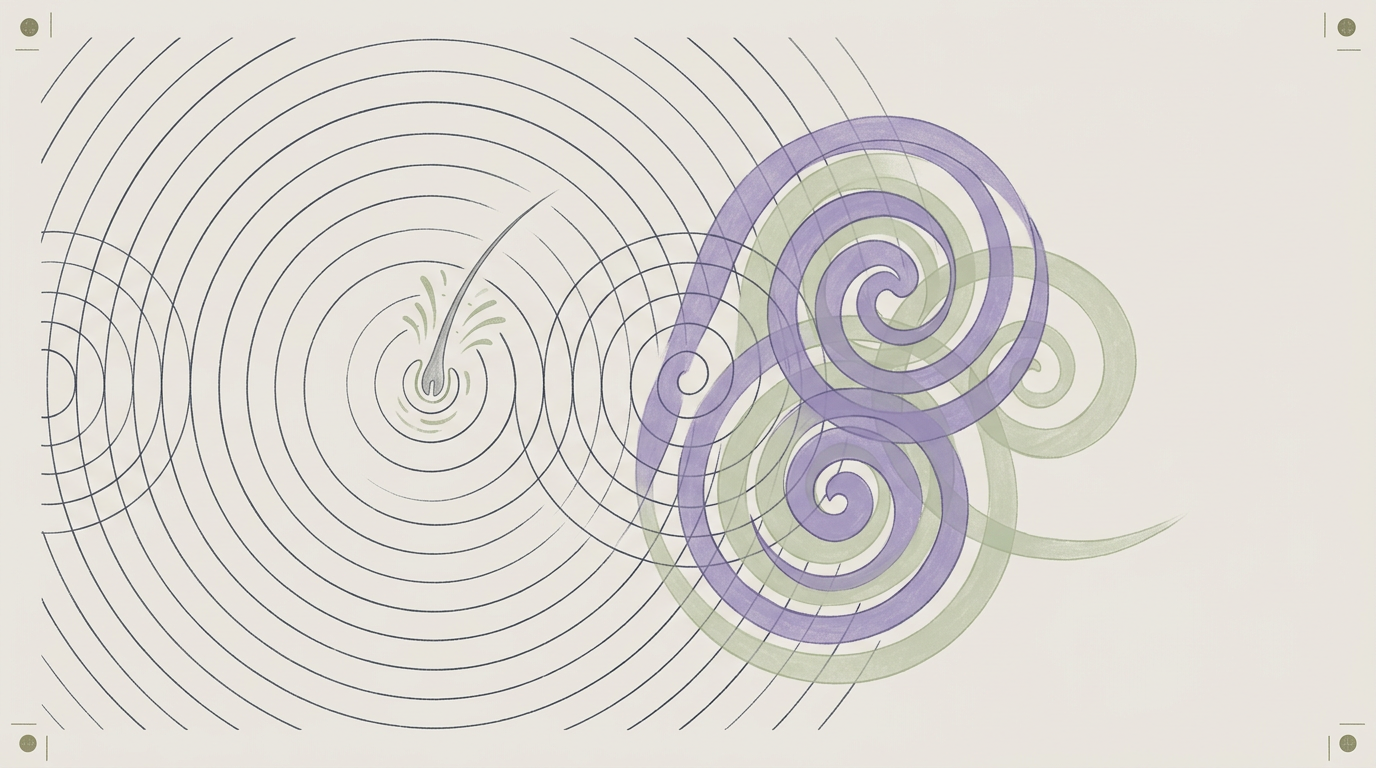
The wellness industry sells personal growth as a stock chart that only goes up. If you apply that expectation to your nervous system, you've guaranteed yourself a lifetime of frustration. The autonomic network doesn't operate on a quarterly timeline. Progress here is a spiral. You will inevitably pass over the exact same coordinates that used to wreck you, but from a slightly higher altitude.
It’s 4pm on a random Tuesday, and the old chill is back. Three months ago, this was your default setting: the jaw that won't unclench, the open fridge with no hunger, the total inability to finish a simple email. You've been doing the breathing protocols. You've been getting to bed on time. And now you feel tired but wired, staring at the ceiling because you wake up at 3am every night. Your brain assumes the tools stopped working. You feel anxious for no reason and assume you are right back at the beginning.
Common Questions
Why do I feel like I'm back at square one?
You are revisiting a familiar physiological pattern. The difference is you possess more awareness and a clearer map of your own body. The feeling is a test of your current capacity.
Why did the breathing technique stop working?
A tool's effectiveness depends entirely on your nervous-system state. A basic exhale practice works perfectly for low-level friction. Deep-seated dysregulation simply requires a different intervention.
How do I know I'm making progress?
Look at the speed of your recovery. Notice how quickly you spot the state, how long it holds you, and how fast you return to baseline. The shortening gap between the trigger and your baseline is your proof.
The Memory Problem
Your brain files memories by emotional and physiological state. The memory of an argument you had in high-alert panic is chemically bonded to that panic. Accessing the memory triggers the state, and finding yourself in that state brings up the feeling of the memory.
That’s why a similar sensory input—a specific tone of voice, a slammed car door, or the flat hour after lunch—can drop you right back into a physical state you thought you left behind years ago. Your body remembers the threat index of that moment and runs a diagnostic. It asks, neutrally, if the world is still dangerous. I used to panic when an old feeling flared up. I would assume my entire routine had failed overnight. Now I just look at the recovery time. This is where a targeted tool like the the Physiological Sigh Anchor acts as a direct, non-verbal signal to your brainstem that the threat has passed. You are physically updating the filing system.
Welcome to the Locus Coeruleus
Deep in your brainstem sits a tiny cluster of neurons called the locus coeruleus. This is the control room for noradrenaline, the neurotransmitter that drives alertness, vigilance, and focus. When your locus coeruleus is jumpy, everything seems deeply salient. The hum of the refrigerator, a weirdly punctuated text message, or a passing siren all get flagged as immediate threats. The bouncer at the door of your consciousness is letting absolutely every anxiety into the club.
As you regulate, this cluster gets more discerning. Its baseline firing rate drops. The initial spike might feel exactly the same, but the tail is drastically shorter. The locus coeruleus fires, but your overall system has better vagal tone, so it quiets down faster. You notice the jolt, name it, and move on instead of losing your entire afternoon to a cortisol spike. The machinery is still working, but the volume knob functions again.
The Interoceptive Shift
The mechanism you use to track all this is interoception. This is your capacity to feel your internal state—the sensation of your heart rate, the tightness in your gut, the flush of heat in your face. Most of the system have had these internal notifications muted for a decade. Kokorology treat the body like a vehicle that just carries the brain from meeting to meeting.
When you feel that old dread, sharper interoception lets you notice the subtle differences. You realize the stomach knot is there, but your breathing is actually steady. You can feel your feet on the floor. I've stopped recommending complex cognitive reframing for this exact reason. You can't argue with a physiological wave. You have to observe the sensation directly. For those who want to go deeper on this, the the Research Library has the mechanics of the felt sense. The moment you can feel the 30g of pressure on your chest without assuming you are having a crisis, the grip loosens.
Evolving the Toolkit
People often complain a practice stopped working. The meditation that once felt calming now feels enraging. The practice didn't fail. Your state shifted.
The wellness industry loves a ladder because a ladder has a clear upsell at every single rung.
Early on, a simple 60-second intervention from the Daily Practices library is enough to quiet a racing mind. You do a few long exhales, and the static clears. As you go deeper, you encounter older, more solidified patterns of bracing. Your toolkit has to evolve with you. You might need a somatic practice that discharges stored energy or a protocol for orienting to the room. The exploratory work you do in the the Journal matters just as much as the active breathing. You are actively expanding what your nervous system can hold. When a tool feels useless, it just means you graduated to a heavier weight class.
What to do this week
- Map the delta. The next time a difficult feeling arises, pause. Grab a pen. Name the physical sensation—a 30g weight on your chest, a buzz behind the eyes. Ask what feels different this time. Are you aware of it sooner? Does it pass faster?
- Interrupt the momentum. Give your body a new signal. Try a wall push, a physiological sigh, or stepping outside for 60 seconds of looking at the horizon.
- Match the intervention to the state. If your go-to regulation tool isn't landing, stop forcing it. Ask your system what it actually needs. Sometimes it requires a 15-minute walk. Sometimes it requires sitting completely still.
Where this fits in the Kokorology system
Understanding this cycle sits at the core of true nervous system regulation. It underpins the Regulation (L1) course, where you learn the foundational tools to move through these cycles with skill. For leaders, recognizing this pattern is a core competency I teach in the Performance (L2) training to prevent brittle burnout.
Closing
The mind will always tell you you've lost all your progress when a familiar symptom flares up. Your body knows better. Meet the feeling with a bit more resource and a little less judgment. The progress is in the return.
- Practice tracking these shifts inside the Journal.
- Rebuild your physiological baseline in the Regulation (L1) course.
- Start with the free nervous system guide.
TL;DR
Progress in nervous system regulation is a spiral. You will inevitably revisit old, difficult emotional states, but from a more resourced perspective. The proof of progress lies in a faster recovery time, sharper interoception, and the ability to differentiate old sensations from current reality. Your tools haven't failed when old feelings return. Your capacity to handle them has simply grown.
Sources
- Craig AD (2009). How do you feel — now? The anterior insula and human awareness. Nature Reviews Neuroscience.
- Sara SJ (2009). The locus coeruleus and noradrenergic modulation of cognition. Nature Reviews Neuroscience.
- Lieberman MD (2023). Communication with others and oneself: language as a nervous-system intervention. Curated primary studies and meta-analyses (1994–2023).
- Zaccaro A (2018). How breath-control can change your life: a systematic review on psycho-physiological correlates of slow breathing. Frontiers in Human Neuroscience.