Nervous System
The Psyllium Husk Question: Is Your Gut Quietly Making Its Own GLP-1?
Psyllium husk is suddenly being called "nature's Ozempic" — and for once, the headline isn't entirely wrong. Here is the actual gut-brain biology: why a teaspoon of fibre raises endogenous GLP-1, blunts the dopamine r…
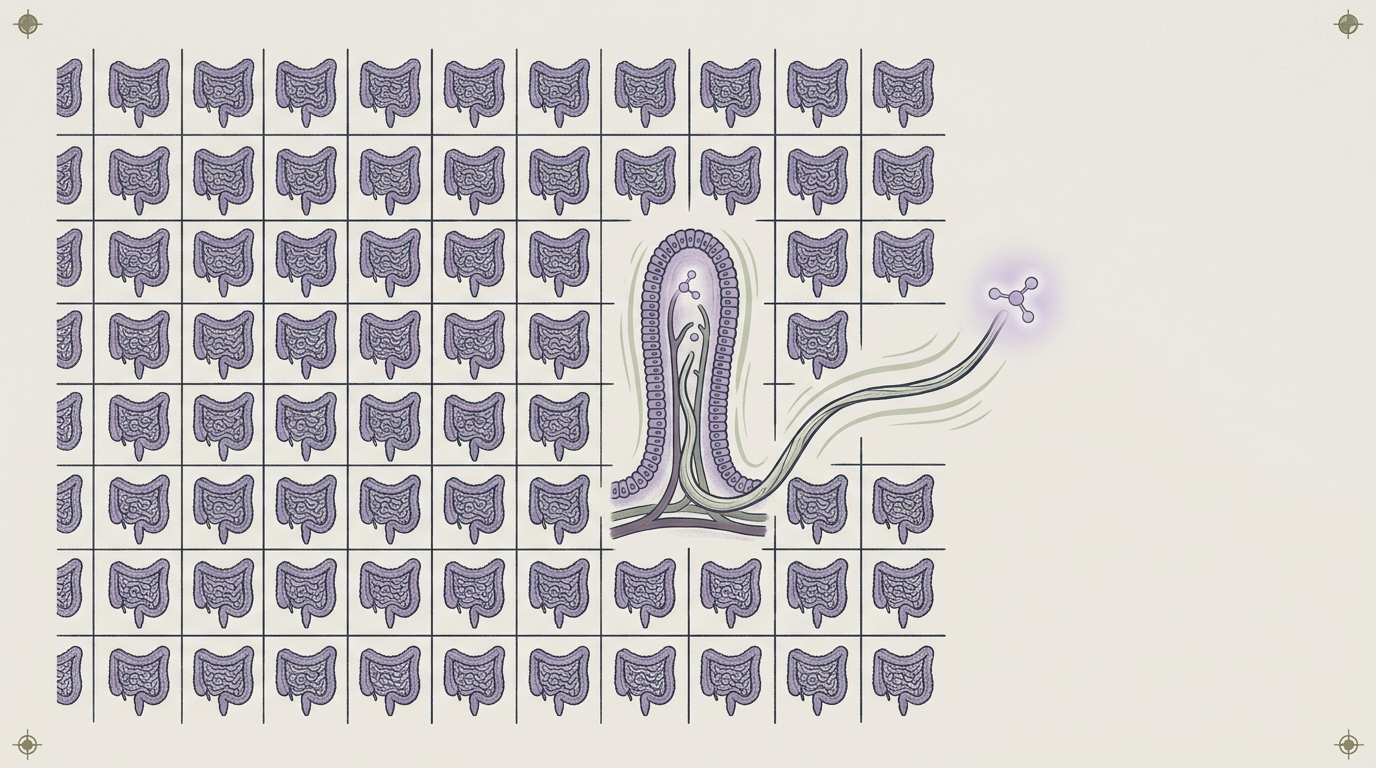
The wellness internet has spent the last month calling a beige, sawdust-textured powder "nature’s Ozempic." The standard advice treats psyllium husk as a cheap pharmaceutical hack to suppress appetite by filling the stomach with physical sludge. That fundamentally misreads the biology. A teaspoon of soluble fiber acts as a chemical instruction manual for your lower intestine, prompting your gut to synthesize and release its own native GLP-1. You are actively feeding the hormone production site.
You know the exact texture of this missing signal. You finish a meal and stare into the open fridge with no physical hunger, waiting for a stop sign that never arrives. The jaw stays tight. You experience brain fog after eating, returning to your desk feeling simultaneously heavy and restless. You feel exhausted but can't rest because the nervous system is still broadcasting an active foraging directive. The food is physically in your stomach, yet the neural confirmation has failed to clear the hypothalamus. You reach for a second coffee that inevitably fails to land, hoping a stimulant will override the low-level hum of a body demanding more calories. You are caught in a communication blackout between the gut and the brain.
Common Questions
What exactly is psyllium husk?
It is a soluble fiber derived from the seeds of the Plantago ovata plant. It turns into a thick gel when mixed with water. While it adds mechanical bulk to digestion, its primary physiological value lies in feeding the bacteria residing in your lower gut.
What does GLP-1 do?
Glucagon-like peptide-1 is a hormone secreted by specialized intestinal cells. It signals the hypothalamus to dial down the foraging drive. It also slows gastric emptying, creating a longer physiological state of satiety.
Can psyllium replace GLP-1 medications?
They operate on entirely separate axes. A pharmaceutical GLP-1 agonist introduces a massive, synthetic signal override. Psyllium husk provides the biological precursors necessary for your endogenous system to manufacture its own baseline hormone supply.
The Satiety Transmission
Let the system look at how the gut actually communicates with the brain. The prevailing view assumes the stomach simply stretches and sends a mechanical full message upward. The nervous system requires a much more sophisticated chemical verification. When you eat carbohydrates and fats, specialized L-cells in the intestinal lining release GLP-1. This hormone travels the gut-brain axis, crosses the blood-brain barrier, and binds to receptors in the hypothalamus. It is a critical piece of your interoception—the brain's ability to accurately perceive the internal state of the body.
I used to believe appetite regulation was entirely governed by sleep quality and protein timing. I completely overlooked the gut's role as the body's largest endocrine organ. When your native GLP-1 signaling is weak, the brain flies blind. It keeps the foraging directive running because the chemical memo never arrived. You can track this delayed signaling in the Journal.
The Bacterial Exchange
The mechanism connecting a teaspoon of psyllium to a quieted nervous system happens in three distinct stages. You swallow soluble fiber. You lack the enzymes to digest it, meaning it arrives intact in your large intestine.
Your resident gut microbes ferment this specific fiber. The fermentation yields a set of metabolic byproducts called short-chain fatty acids, specifically butyrate, propionate, and acetate. These fatty acids act as the chemical exchange your bacteria offer for the meal.
The short-chain fatty acids physically bind to receptors on the L-cells in the gut lining. The L-cells synthesize and secrete GLP-1 directly into circulation. You swallow fiber to command your bacteria to produce the trigger for your satiety hormones. The system is incredibly elegant.
The nervous system requires accurate biological data to down-regulate the survival drive.
The End of Food Noise
GLP-1 receptors populate both the hunger centers and the dopamine-driven reward circuitry in the ventral tegmental area. This crossover dictates the behavioral shift.
Elevated GLP-1 alters the brain's visual filters. Before the hormone arrives, the nervous system sees a doughnut as a high-priority survival asset, demanding immediate attention. When GLP-1 levels rise, the stimulus loses its salience. The doughnut becomes unremarkable visual background data. The compulsion to seek a dopamine spike from a second cookie or a late-night scroll loses its urgency.
I see clients white-knuckle their way through the afternoon slump relying entirely on discipline. The body actually requires a modulated neurochemical signal. Kokorology work through these exact physiological shifts in the 60-second Hacks library.
Providing the Precursors
An over-the-counter bag of psyllium husk offers a quiet, physiological raw-material delivery for your native pathways. The body runs on the resources you give it.
You supply the biological precursors. The bacteria perform the synthesis. The nervous system registers the shift and updates its threat-and-foraging assessment. Supporting your body's native hormone production remains a highly effective way to stabilize the feedback loop between your gut and your brain.
What to do this week
- Start extremely small. Mix half a teaspoon of psyllium husk powder into a large, 16-ounce glass of water once a day. A tablespoon on day one causes profound gastrointestinal distress.
- Time the dose. Drink the mixture 15 to 30 minutes before a main meal. The gel formation and hormonal signaling cascade need to coincide with the arrival of food in your stomach.
- Hydrate aggressively. Soluble fiber requires massive amounts of water to move smoothly through the digestive tract.
- Track the dopamine volume. Notice the quality of your satiety. Watch for the moment the compulsive desire for more food quiets down.
Where this fits in the Kokorology system
A dysregulated appetite stems directly from a dysregulated nervous system and a breakdown in gut-brain communication. Restoring your endogenous GLP-1 production is a core piece of the foundational work Kokorology teach inside nervous system regulation. You can find specific tools for managing cravings and internal signals in the Anchors library.
Closing
Seeing food as a set of instructions for your body's chemistry changes the entire interaction. Psyllium delivers a single, clear command to synthesize the fullness hormone, demonstrating how much agency you have over your deep biological systems.
- Start restoring your baseline capacity inside The Reset »
- Track your internal signals and cravings in the Kokorology Journal »
- Master the underlying mechanisms in the L1 Regulation » course
TL;DR
The wellness internet calls psyllium husk a natural GLP-1 medication. The underlying mechanism relies on basic gut biology. Soluble fiber feeds specific bacteria in your large intestine, which produce short-chain fatty acids. These fatty acids trigger the intestinal L-cells to release native GLP-1. This hormone travels the gut-brain axis, telling the hypothalamus you are full while simultaneously dampening the dopamine-driven desire for more food. Consuming psyllium husk provides the biological raw materials required to repair this specific appetite-regulation pathway.
Sources
- Farr, O. M., et al. (2016). GLP-1 receptors exist in the parietal cortex, hypothalamus and medulla of human brains and the GLP-1 analogue liraglutide alters brain activity related to highly desirable food cues. Diabetologia.
- Drucker, D. J. (2018). The biology of incretin hormones. Cell Metabolism.
- Chambers, E. S., et al. (2015). Effects of targeted delivery of propionate to the human colon on appetite regulation, body weight maintenance and adiposity in overweight adults. Gut.
- Cani, P. D., & Knauf, C. (2016). How gut microbes talk to organs: The role of endocrine and nervous routes. Molecular Psychiatry.