Nervous System
Cortisol Verlagen Natuurlijk
Cortisol isn't the enemy; a broken rhythm is. Stop trying to silence the signal and start repairing the architecture that sends it.
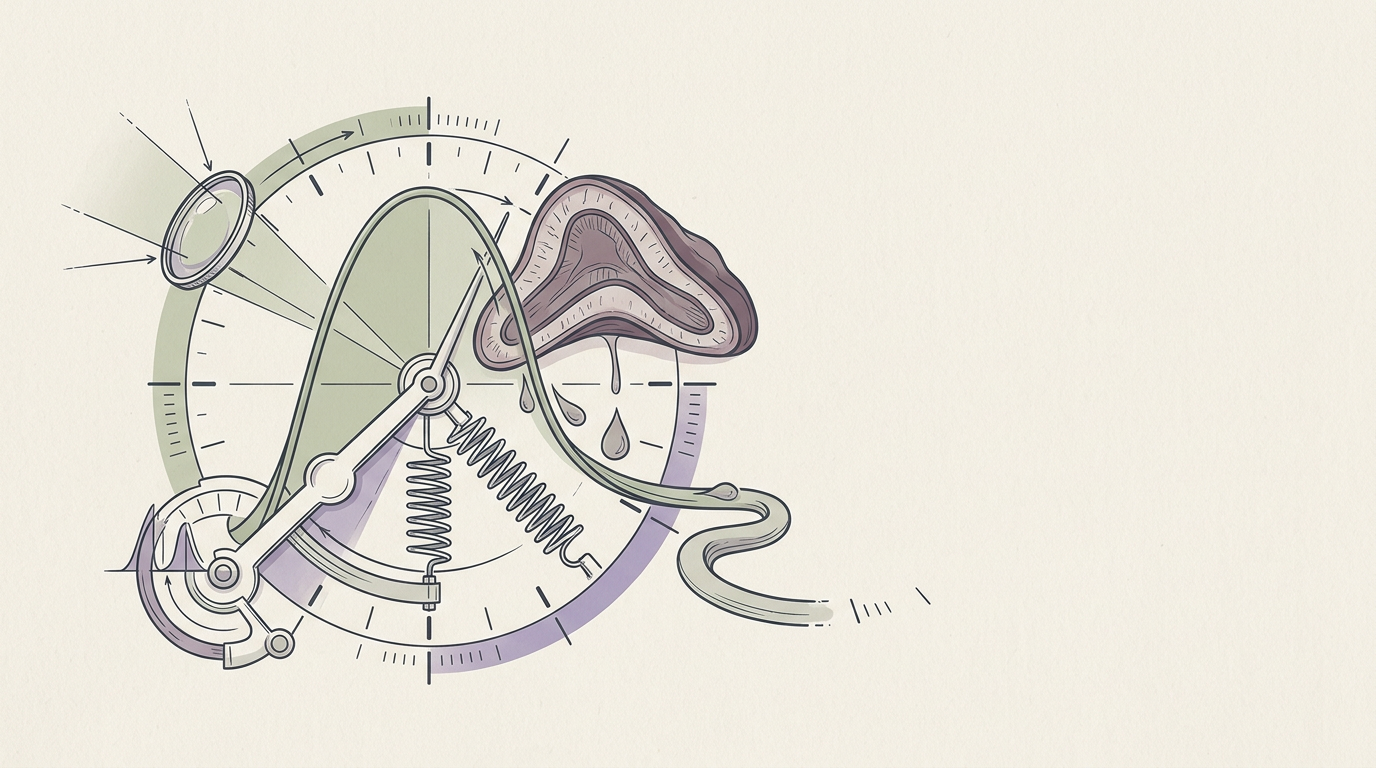
Walk into any health food store and you'll find an entire shelf dedicated to suppressing your adrenal glands. Kokorology've decided that the stress hormone is a toxin, and the internet's answer to cortisol verlagen natuurlijk is usually an expensive ashwagandha habit and a deep-breathing routine. You're trying to gag a smoke alarm. The compound flooding your bloodstream at 3pm is a neutral messenger reporting on the state of your nervous system.
The actual experience of a flattened diurnal curve feels like driving with the parking brake fully engaged. You drag yourself out of bed with a headache, entirely dependent on a second coffee that only makes your hands shake without clearing the fog. By lunch, your jaw is locked so tight your teeth ache, and you're staring at a screen reading the same sentence four times. Then evening arrives. This is when you should be winding down, but instead, you're tired but wired, scrolling endlessly in the dark. Your chest hums with a low-grade panic, leaving you anxious for no reason. When you finally do pass out, you wake up at 3am every night staring at the ceiling, your heart racing while the rest of the house sleeps. The signal from your brain is stuck on broadcast.
Common Questions
What is cortisol?
It is an energy mobilisation hormone secreted by your adrenal glands. It follows a daily rhythm, peaking in the morning to wake you up and tapering off toward evening. The trouble arises when the rhythm flattens out, leaving you with low energy when you need it and a racing mind when you want to rest.
Why do I feel exhausted but unable to sleep?
This happens when your HPA axis (the stress-hormone control loop) pushes the accelerator and the brake simultaneously. Your morning peak is blunted, making the day a struggle, while your evening levels remain elevated, blocking the sleep pressure required for deep rest.
Can you really lower cortisol naturally?
You change the output by changing the inputs. The brain and adrenal glands listen to light, food, and movement. Timing these environmental cues correctly restores the natural daily curve, signaling your system that it is safe to power down.
The Shape of the Curve
I used to believe the goal was keeping stress hormones as close to zero as possible. I would recommend winding down constantly. I was wrong. A healthy nervous system produces a massive, necessary spike of cortisol right after you wake up. This is the Cortisol Awakening Response. It gives you the physical drive to get out of bed and meet the demands of the day.
Chronic stress, shifting schedules, and artificial light at night flatten that beautiful curve. The morning peak disappears, and the evening trough fills up. Your body loses its sense of day and night, leaving you existing in a state of grey, anxious twilight. Supporting your nervous system regulation requires bringing back that sharp daily contrast. I've stopped looking at isolated lab numbers without seeing the 24-hour picture first.
The Master Clock and the PA System
The rhythm is governed by the hypothalamic-pituitary-adrenal (HPA) axis, a communication loop running from your brain to your adrenal glands. The central clock in your hypothalamus—the suprachiasmatic nucleus—relies on morning sunlight to know what time it is. Once it gets a clear light signal, it tells the system to flood the bloodstream and wake you up.
When you live with chronic background stress or a chaotic sleep schedule, that central clock gets fuzzy reception. The biological clock becomes unmoored by circadian misalignment and hormonal dysregulation. The HPA axis either gets stuck broadcasting a low-grade alarm all day or becomes completely blunted. A blunted, unresponsive cortisol profile leaves you in a state of exhaustion that sleep cannot fix. Resetting the rhythm starts with giving the central clock an unmissably clear signal about where you are in the day.
Your Skin as a Local Dashboard
Here's the part nobody mentions in the listicles of calming teas. Your skin operates its own local neuro-endocrine system. When your central HPA axis is overwhelmed, it activates a local HPA axis right in your skin cells. They produce their own cortisol on-site.
This local production directly disrupts the skin barrier, impairs wound healing, and drives inflammation. That sudden breakout, the eczema flare-up, or the reactive complexion is a direct data point from your periphery. Your skin is trying to manage the threat locally, and the result is what you see in the mirror. When someone asks me how to start tracking their stress load, I often tell them to start a skin diary in their Journal. It is a highly accurate readout of the state of your nervous system. You can explore the exact mechanics of this in the Library.
Your body does not speak English. It speaks light, dark, food, and movement. Most of the system are shouting gibberish at it all day and wondering why it is so confused.
Restoring the Contrast
Shift the rhythm instead of fighting the hormone. You want a shape with a sharp peak in the morning and a deep valley at night. The human animal thrives on predictability. Giving your physiology a few reliable daily anchors allows the entire network to recalibrate. The Cortisol Anchor protocol focuses purely on this pacing.
What to do this week
Send two or three clear, non-negotiable signals to your body's clock. Pick two of these and do them religiously for five days.
- See sunlight within 30 minutes of waking. Step outside for 5–10 minutes without looking at a screen first. This remains the single most powerful signal for anchoring your circadian rhythm and triggering a healthy morning cortisol peak.
- Delay your first coffee for 90 minutes. Your body naturally produces a big pulse of cortisol upon waking. Let it do its job. Piling caffeine on top of that peak blunts your natural response over time. Wait for the peak to pass, then have your coffee.
- Eat your last meal at least three hours before bed. Digestion is an active, energy-intensive process. Sending a "time to work" signal to your gut while you're trying to send a "time to sleep" signal to your brain guarantees confused internal clocks and elevated evening cortisol.
Where this fits in the Kokorology system
This is a core principle of physiological pacing. A dysregulated cortisol rhythm disrupts your sleep, your mood, and your immune response. Restoring it is the explicit focus of the Cortisol Anchor and a central skill in the L1 Regulation course.
Closing
The urge to crush your stress hormones comes from a desire to feel less frazzled and on edge. The path there requires restoration, treating your body like a system you are trying to communicate with clearly. Give it a few sharp, unmistakable signals this week and watch the static clear.
- Start shifting your daily curve inside the Cortisol Anchor protocol.
- Track your physical signals with the Kokorology Journal.
- Get the daily protocols in the free 9-Part Nervous System Regulation Guide.
TL;DR
The internet's obsession with trying to "cortisol verlagen natuurlijk" (lower cortisol naturally) misses the biological reality. A flattened or erratic daily rhythm causes the exhaustion. A regulated nervous system produces a sharp cortisol peak in the morning and a deep trough at night, a slope that dictates your energy, sleep, and overall capacity. You restore this rhythm by giving your body clear environmental cues: early morning sunlight, timed meals, and intelligent movement.
Sources
- Adam, E. K., et al. (2017). Diurnal cortisol slopes and mental and physical health outcomes: A systematic review and meta-analysis. Psychoneuroendocrinology.
- Chandola, T., et al. (2008). Work stress and coronary heart disease: what are the mechanisms?. European Heart Journal.
- Chen, Y., & Lyga, J. (2014). Brain-skin connection: stress, inflammation and skin aging. Inflammation & Allergy-Drug Targets.
- Miller, G. E., et al. (2007). If it goes up, must it come down? Chronic stress and the hypothalamic-pituitary-adrenocortical axis in humans. Psychological Bulletin.
- Ungurianu, A., et al. (2025). The biological clock influenced by burnout, hormonal dysregulation and circadian misalignment: a systematic review. Clocks & Sleep.