Nervous System
Self Regulation and the Nervous System: Why the Usual Advice Misses
An LA cardiologist and new mother, estranged from both her parents, had been regulating herself for eighteen months without knowing it — rocking, humming, cold water on the face. Awareness is the only upgrade.
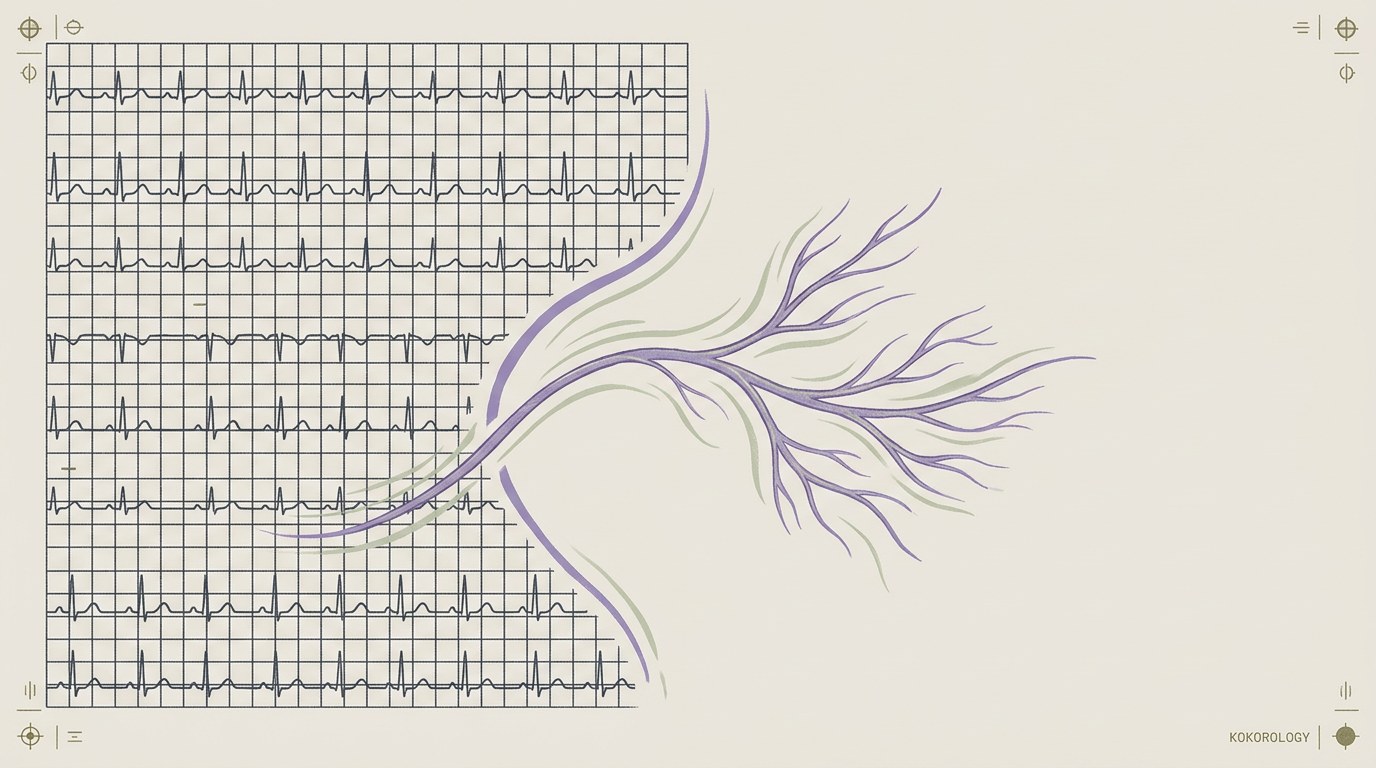
I used to think regulation was a skillset I had to acquire from expensive weekend workshops. The wellness industry insists your nervous system is a feral animal needing expert taming through a subscription app. You actually possess a massive library of factory-installed reflexes that have been managing your threat responses since the day you were born. The job is simply paying attention to the machinery already running.
You know the physical texture of this disconnect. It shows up in the open fridge at 9pm when you have absolutely no hunger, or the shoulders that stubbornly refuse to drop even when you finally step into a hot shower. You tell people you feel tired but wired, staring at the ceiling at 11:47pm while your heart beats just a little too hard. The midday crash hits, and you feel exhausted but can't rest, scrolling through your phone with a buzzing sensation behind your eyes. Maybe you suddenly feel anxious for no reason during a perfectly normal Zoom call, your jaw clenched tight enough to crack a molar. Your system is just desperately trying to pull levers you keep ignoring.
Common Questions
What is nervous system regulation?
It is the biological process of managing arousal and threat. Your brain and organs run a continuous feedback loop to match your physical energy to the demands of your environment. This happens automatically, whether you pay attention to it or not.
Why do I pace or bounce my leg?
These unconscious behaviors discharge pent-up survival energy. Rocking provides vestibular input, while leg bouncing burns off excess adrenaline. Your body is attempting to solve a capacity problem non-verbally because the environment feels demanding.
Do I need to buy special equipment?
Zero equipment required. You already own the hardware. You just need to develop a conscious relationship with the reflexes you currently dismiss as bad habits or tics.
The Accidental Regulator
A few years ago, I sat with a cardiologist in Los Angeles who was running on fumes. She was a new mother, estranged from her parents, and working brutal clinical hours. She was also regulating herself beautifully all day long using a toolkit most people would label as embarrassing tics. She would rock slightly when reading charts, hum low notes in traffic on the 405 freeway, and deliberately splash freezing water on her face between difficult patient consultations.
Her body knew exactly what it needed to downshift. It had found a direct line to her autonomic nervous system and was leaning heavily on the buttons. These physical behaviors are physiological attempts to survive the afternoon. Your system knows precisely how to drop the temperature; you've just been successfully convinced that its methods are unprofessional.
The Vagal Highway
The wellness space has managed to turn breathing into a competitive sport with expensive certifications. But the sigh, the low chant, and the hum are ancient physical levers for a very specific piece of hardware. When you hum, the vibration in your throat and chest cavity physically stimulates the vagus nerve.
This nerve is the primary data cable between your brainstem and your major organs. Stimulating it sends an immediate, bottom-up signal that the environment is secure enough to make a low, continuous sound. Heart rate variability increases, the jaw unhitches, and digestion comes back online. I spent years thinking I needed a complex meditation routine to achieve this state. A steady vibration in the vocal cords does the exact same job in half the time. This mechanical reality forms the backbone of basic nervous system regulation.
That Cold Water Override
Splashing cold water on your face triggers one of the fastest reflex arcs in human biology. Kokorology call it the mammalian dive reflex.
When cold water hits the skin below your eyes and above your cheekbones, it activates the trigeminal nerve. The message sent to the brainstem is blunt: Kokorology are underwater. The physiological response takes milliseconds. Your heart rate instantly drops to conserve oxygen, a process known as bradycardia. Simultaneously, this throws a wet blanket over the locus coeruleus, the brain's primary alarm center, immediately dialing down noradrenaline output. You use water temperature from a bathroom sink to manually override a runaway threat response. I keep a massive list of these Hacks because they require zero belief to work.
Listening to the Static
The trouble with being told to "listen to your body" is that most modern operators can't feel their own pulse. They don't notice the tension in their neck until it develops into a blinding 4pm migraine. The clinical term for this is interoception.
Interoception is the brain’s perception of the physical state of the body. This internal sensory reporting dictates your baseline emotional reality. If the data feed from your organs is buried under caffeine and notifications, you're flying blind. You can't regulate a machine you can't sense. The practice is tedious and completely unglamorous. You just stop three times a day and ask what the machinery is actually doing. Taking inventory in a Journal builds the neural pathways required to notice the jaw tension before it becomes a headache.
Awareness does not fix the stress. It reveals the size of the physiological load.
From Tic to Anchor
That Los Angeles cardiologist was already humming. The upgrade was simply realizing why she was humming, and doing it deliberately. She started humming for 30 seconds before walking into a tense room, rather than waiting until she was completely flooded in traffic.
You take a factory-installed feature running as a background bug and turn it into a user-controlled command. An unconscious leg bounce or a throat-clearing tic becomes a deliberate Anchor. You stop being confused by your own physical responses and start collaborating with the biology you actually possess.
What to do this week
- The Tracking Protocol. For two days, just write down your unconscious movements. Leg bouncing, neck rubbing, pacing. Do not try to stop them.
- The Deliberate Hum. Find 60 seconds of privacy—a stairwell, your parked car—and hum a continuous low note. Focus purely on the vibration in your throat.
- The Cold Water Override. When you feel a wave of overwhelm, run a tap cold. Splash water directly on your cheekbones for 15 seconds. Notice the immediate drop in heart rate.
- Name the Sensation. Swap the interpretive label for raw data. Instead of "I am stressed," try "my chest is tight and my breathing is shallow."
Where this fits in the Kokorology system
Understanding these built-in mechanisms bridges the gap between chaotic behaviors and targeted protocols. This physical awareness forms the absolute foundation of the work Kokorology teach inside Regulation L1.
Closing
The goal is to understand what the pacing and the humming are actually trying to achieve. Treating your physical responses as inconveniences ignores a massive amount of physiological intelligence. Pay attention to the levers your body is already pulling, and start pulling them on purpose.
- Start with the foundations in Regulation L1.
- Continue building your toolkit inside the Anchors Library.
- Read the free guide to the nervous system.
TL;DR
You already possess the hardware to regulate your nervous system. Behaviors like pacing, humming, and fidgeting are unconscious attempts to physically shift your state, often by stimulating the vagus nerve or discharging survival energy. The work is building interoceptive awareness of these built-in reflexes—like the mammalian dive reflex—so you can deploy them deliberately. You turn an unconscious tic into an intentional anchor.
Sources
- A. D. (Bud) Craig (2015). How Do You Feel?: An Interoceptive Moment with Your Neurobiological Self. Princeton University Press.
- Kevin J. Tracey (2002). The inflammatory reflex. Nature.
- Panneton, W. M. (2013). The Mammalian Diving Response: An Enigmatic Reflex to Preserve Life?. Physiology.
- Sahib S. Khalsa (2018). Interoception and Mental Health: A Roadmap. Biological Psychiatry.